
















India’s Forex Reserves Touch Record $729.33 Billion; West Bengal Enters New Era of Commercial Oil Production
By Anil P. Kastuar | Editor | IBG NEWS
India’s Foreign Exchange Reserves Reach Historic High
India’s foreign exchange reserves have climbed to a fresh record, strengthening the country’s external financial buffer and adding to its economic resilience.
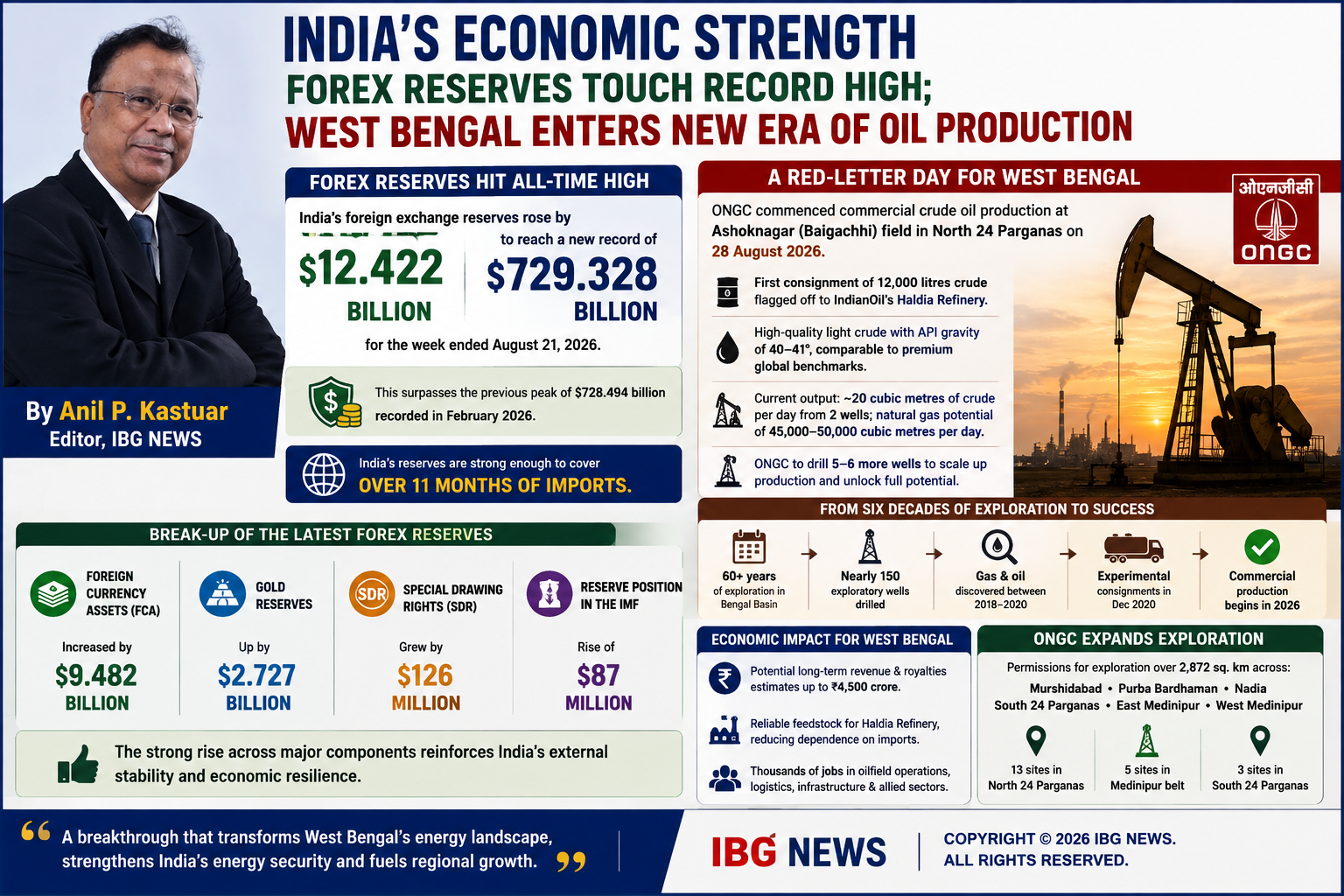
For the week ended August 21, 2026, India’s forex reserves increased by $12.422 billion, reaching an all-time high of $729.328 billion, according to the figures cited from the Reserve Bank of India.
The latest level is higher than the previous record of $728.494 billion, recorded in February 2026.
The substantial reserve accumulation provides India with a stronger cushion against external economic pressures and is estimated in the supplied information to be sufficient to cover more than 11 months of imports.
Foreign Exchange Reserve Components
The weekly rise was supported by gains across several major components of India’s foreign exchange reserves. The largest component, Foreign Currency Assets (FCA), registered a significant increase of $9.482 billion during the week.
The improvement in the overall reserve position further strengthens India’s capacity to manage external-sector risks and maintain stability amid fluctuations in global financial and currency markets.
Note: The supplied source text ends midway through the detailed component-wise breakdown of the reserves.
A Red-Letter Day for West Bengal: ONGC Begins Commercial Oil Production at Ashoknagar
West Bengal has reached a significant milestone in its energy journey with the commencement of commercial crude oil production at the Ashoknagar (Baigachhi) field in North 24 Parganas.
On August 28, 2026, ONGC began commercial production from the field, with the first consignment comprising a 12,000-litre tanker dispatched to IndianOil’s Haldia Refinery.
The development marks a major transition for the Bengal Basin—from decades of exploration and geological assessment to actual commercial hydrocarbon production.
High-Quality Light Crude
The Ashoknagar field is producing crude oil described in the supplied information as a particularly high-quality light crude, with an API gravity of approximately 40–41 degrees.
Its characteristics place it in a category comparable with premium light crude benchmarks. Such crude generally requires less complex refining processes and can be efficiently converted into products such as petrol and diesel.
At present, the field is producing approximately 20 cubic metres of crude oil per day from two operational wells.
The field also has natural-gas potential, with eventual production estimated at approximately 45,000–50,000 cubic metres per day.
ONGC is planning additional development activity, including the drilling of five to six more wells, to expand production and assess the wider potential of the field.
Six Decades of Exploration Finally Yield Results
The Ashoknagar development represents the outcome of a prolonged exploration effort in West Bengal.
According to the supplied information, ONGC spent more than 60 years searching for commercially viable hydrocarbon resources in the Bengal Basin and drilled nearly 150 exploratory wells before achieving a major breakthrough.
The discovery phase accelerated between 2018 and 2020, when gas and subsequently oil resources were identified at Ashoknagar.
Although initial experimental consignments were dispatched in December 2020, commercialisation was delayed by several challenges, including structural issues, land acquisition and the impact of the COVID-19 pandemic.
With commercial production now underway, the Bengal Basin is being positioned as India’s eighth producing hydrocarbon basin.
Potential Economic Gains for West Bengal
The commercialisation of Ashoknagar could have wider economic implications for West Bengal.
Preliminary projections cited in the supplied information indicate that the state could potentially receive up to ₹4,500 crore in long-term revenue and royalties as the field reaches its broader commercial potential.
The project could also strengthen the supply chain for IndianOil’s Haldia Refinery by providing a domestic source of crude, potentially reducing dependence on supplies transported from outside the region or imported from overseas.
Employment and Infrastructure
The development of the oilfield is expected to generate economic activity beyond direct petroleum operations.
Expansion of roads, pipelines, storage facilities, transportation networks and supporting services could create opportunities across logistics, engineering, equipment supply, manufacturing and other allied sectors.
The emerging energy ecosystem could therefore provide both direct and indirect employment opportunities in the region.
ONGC Expands Exploration Across West Bengal
Following the Ashoknagar development, exploration activity is also expanding to other parts of the state.
The supplied information states that the West Bengal Government has granted ONGC permissions for hydrocarbon exploration covering approximately 2,872 square kilometres.
The exploration programme includes areas in:
- Murshidabad
- Purba Bardhaman
- Nadia
- South 24 Parganas
- East Medinipur
- West Medinipur
Deep seismic surveys and exploratory drilling are being planned across these areas. Earlier natural-gas discoveries around Ranaghat in Nadia have added to expectations regarding the region’s hydrocarbon potential.
ONGC has also mapped potential drilling locations, including 13 sites in North 24 Parganas, five in the Medinipur region and three in South 24 Parganas, according to the information provided.
Drilling Deep Into the Bengal Basin
The exploration programme involves establishing deep-well drilling facilities capable of reaching depths of approximately 2,500 to 6,000 metres below the surface.
Individual project clusters are expected to require around five acres of land for drilling and associated infrastructure.
The scale of the exploration indicates that Ashoknagar could represent more than an isolated success. If further commercially viable discoveries are made, West Bengal could emerge as an increasingly important contributor to India’s domestic hydrocarbon production.
A New Chapter for Bengal’s Energy Economy
The beginning of commercial oil production at Ashoknagar is therefore significant not merely because crude oil is being extracted in West Bengal, but because it demonstrates the possibility of converting a long-running exploration programme into a productive energy asset.
For the state, the development could bring revenue, industrial activity, infrastructure expansion, employment and greater integration with India’s energy supply chain.
For India, successful development of the Bengal Basin could add another domestic source of hydrocarbons and strengthen the country’s broader energy-security efforts.
By Anil P. Kastuar
Editor | IBG NEWS