

















Andaman & Nicobar Islands: Strategic Blueprint Calls for Stronger Defence, Economic Resilience and Ecological Safeguards
By Anil P. Kastuar, Editor, IBG NEWS
The Andaman and Nicobar Islands are emerging as an increasingly important component of India’s maritime strategy in the Indo-Pacific, with their geographical position offering significant advantages for surveillance, logistics, defence and regional connectivity.
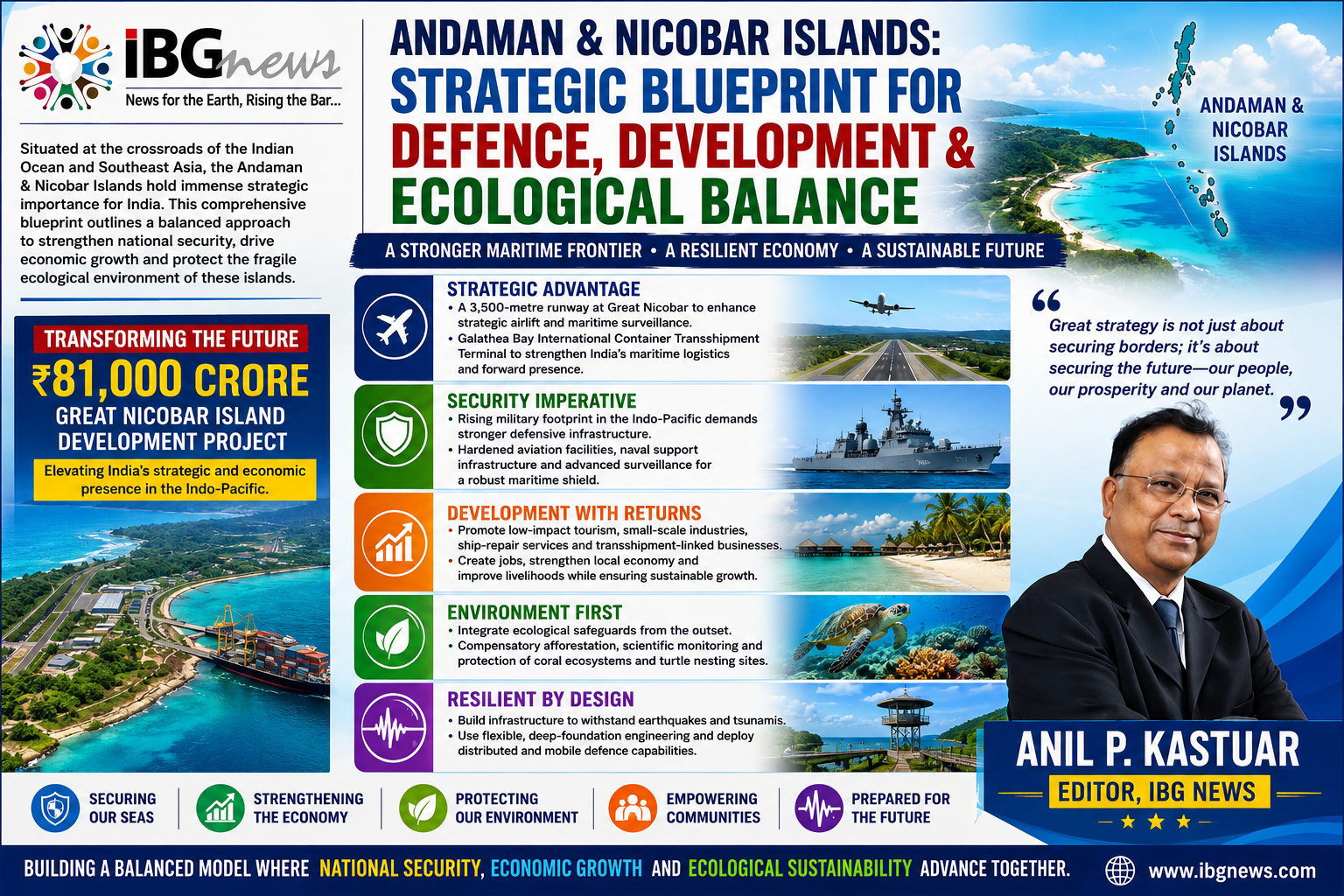
A strategic blueprint examining the future of the islands argues that India needs to pursue a carefully calibrated approach that combines national security requirements with economic development and environmental responsibility. The document places particular emphasis on the ₹81,000-crore Great Nicobar Island Development Project, describing the broader transformation of the island chain as a potential shift in India’s regional posture.
A Strategic Maritime Location
The southern Andaman and Nicobar chain occupies a strategically significant position near the major maritime routes connecting the Indian Ocean with Southeast Asia. According to the blueprint, the location of Great Nicobar near the Six-Degree Channel and the approaches to the Strait of Malacca could provide India with an important platform for maritime surveillance and defence operations.
The document also highlights the proposed 3,500-metre runway at Great Nicobar, which it envisages as supporting strategic airlift and maritime surveillance capabilities. Such infrastructure, the blueprint argues, could provide a persistent operational presence that mainland facilities cannot replicate in the same geographic position.
Another major element is the proposed International Container Transshipment Terminal at Galathea Bay. The blueprint notes the area’s deep-water characteristics and sees the facility as having the potential to strengthen India’s maritime logistics and forward-basing capabilities.
Security Concerns in the Indo-Pacific
The strategic assessment identifies the expanding military and infrastructure footprint of major regional powers as an important consideration for India’s island policy.
It argues that developments across the wider Indo-Pacific, including infrastructure activity around the Indian Ocean, make it necessary for India to ensure that its strategically located island territories remain adequately connected, defended and developed.
The blueprint therefore advocates stronger defensive infrastructure, including hardened aviation facilities, naval support infrastructure and other security installations. However, it also proposes that such development should be designed around the specific strategic and ecological characteristics of the islands rather than encouraging unrestricted industrial expansion.
Development With Economic Returns
The document argues that a purely military approach would not be sufficient to create a resilient island ecosystem.
It proposes carefully managed economic activity, particularly low-impact tourism, small-scale industries, ship-repair services and container-transshipment-related businesses. Such activities could potentially create employment opportunities and strengthen the economic foundations of communities living in the region.
The proposed tourism model favours relatively low-volume, high-value ecological tourism rather than mass tourism that could place excessive pressure on freshwater resources and waste-management systems.
Environment Cannot Be an Afterthought
One of the blueprint’s central recommendations is to integrate environmental protection into infrastructure planning from the beginning.
It calls for compensatory afforestation, scientifically monitored ecological measures and dedicated conservation initiatives for sensitive marine and terrestrial habitats. It also specifically highlights the need to protect coral ecosystems and leatherback turtle nesting areas around Galathea Bay.
This approach suggests that environmental mitigation should be treated as an integral component of strategic infrastructure planning rather than as a separate exercise undertaken after construction decisions have already been made.
Building for Seismic Resilience
The islands’ geological vulnerability is another important consideration identified by the blueprint.
Because the Andaman and Nicobar region is situated in a seismically active zone, the document recommends that major infrastructure around Galathea Bay incorporate flexible and deep-foundation engineering capable of dealing with severe seismic shocks and possible tsunami impacts.
The blueprint also proposes the use of distributed and mobile defence capabilities, arguing that a combination of surveillance systems and mobile assets could enhance the defensive envelope without immediately depending upon extensive land transformation.
A Three-Way Balance
The strategic assessment ultimately presents the development of the Andaman and Nicobar Islands as a balancing exercise involving national security, economic sustainability and ecological protection.
Its central proposition is that India’s island strategy should strengthen maritime security while simultaneously creating a viable local economy and embedding environmental safeguards into the development process.
For India, the challenge is therefore not simply whether the islands should be developed, but how that development can create long-term strategic resilience without undermining the ecological systems that make the archipelago unique.
The Andaman and Nicobar Islands could consequently become more than a forward defence position. With careful planning, they have the potential to evolve into an integrated maritime-security, logistics and economic hub—provided that infrastructure expansion, local interests, disaster resilience and environmental stewardship advance together.
— Anil P. Kastuar
Editor, IBG NEWS