

















India’s Vulture Conservation Drive Gains Momentum as Bhupender Yadav Opens National Workshop in Panchkula
Environment Minister stresses Vulture Safe Zones, scientific breeding and stronger technical capacity to support recovery in the wild
By Suman Munshi, IBG NEWS
Panchkula, Haryana | September 6, 2026
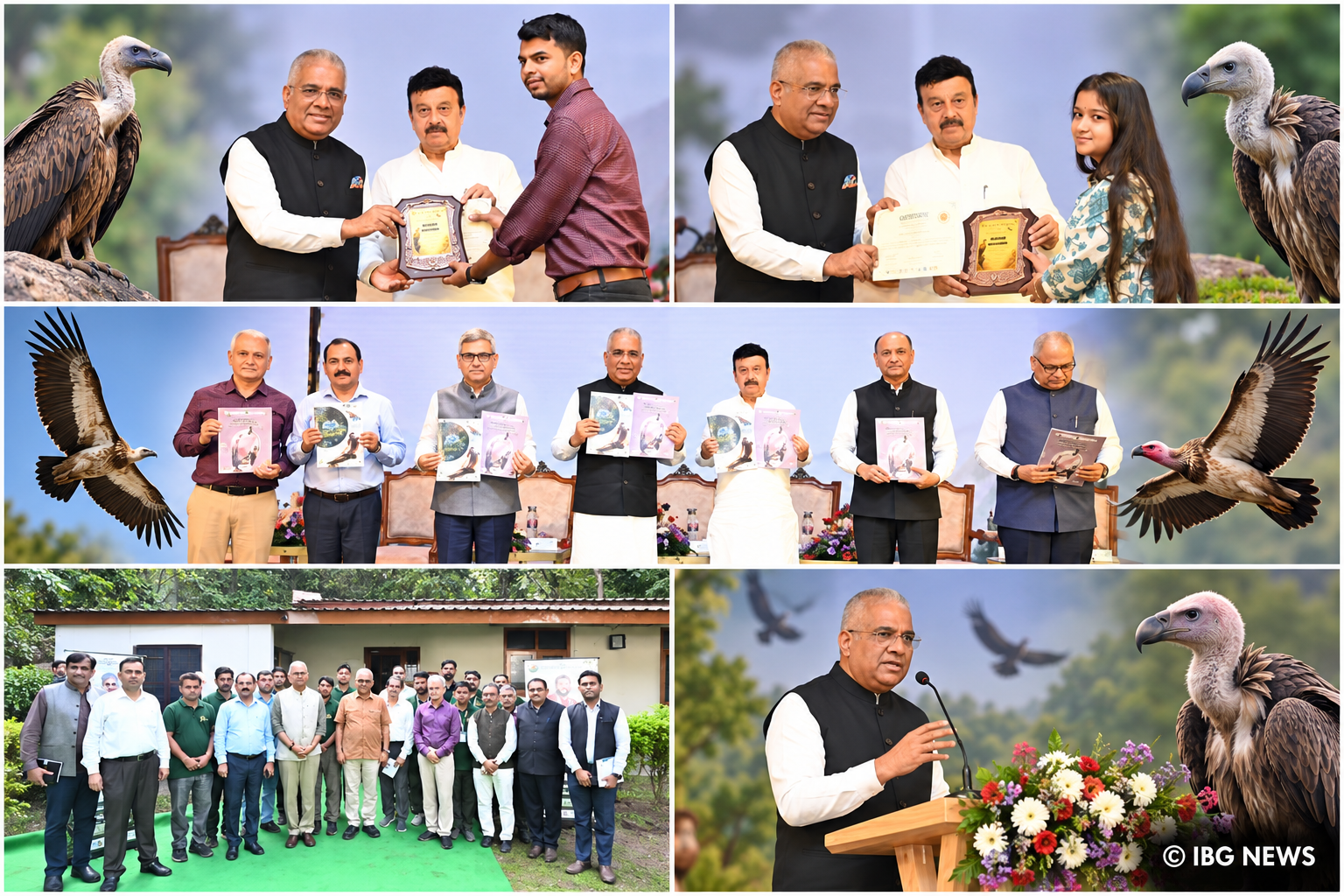
India renewed its commitment to restoring its declining vulture populations on International Vulture Awareness Day 2026, as Union Environment, Forest and Climate Change Minister Bhupender Yadav inaugurated a national workshop in Panchkula focused on strengthening the country’s long-term conservation efforts.
Held under the theme “From Crisis to Recovery – Conserving India’s Vultures,” the national workshop brought together government officials, scientists, veterinarians, zoo specialists and conservation practitioners to discuss strategies for protecting vultures and rebuilding viable populations in the wild.
The event was attended by Haryana Environment, Forest and Wildlife Minister Rao Narbir Singh, along with senior representatives of the Union Environment Ministry and the Haryana Government.
The programme was jointly organised by the Ministry of Environment, Forest and Climate Change (MoEFCC), Central Zoo Authority (CZA), Haryana Forest & Wildlife Department, Bombay Natural History Society (BNHS) and the Jatayu Conservation Breeding Centre (JCBC), Pinjore.
Vultures: Nature’s Critical Clean-Up System
Addressing the gathering, Bhupender Yadav underlined the ecological importance of vultures, describing them as highly efficient natural scavengers that help dispose of animal carcasses, recycle nutrients and contribute to maintaining ecological balance.
India supports a diverse range of resident and migratory vultures, including the White-rumped, Long-billed, Slender-billed, Red-headed, Egyptian, Himalayan Griffon, Eurasian Griffon, Cinereous and Bearded Vultures.
The Minister noted that India’s vulture populations experienced a severe decline beginning in the 1990s. Among the factors associated with the crisis was the contamination of carcasses through veterinary medicines that proved harmful to vultures feeding on them, alongside wider disruptions to their food supply.
Yadav stressed that conservation must extend beyond individual species and follow an ecosystem-based approach, linking species protection with broader environmental management.
According to the Minister, this philosophy is reflected in India’s conservation initiatives covering a range of species and ecosystems, including big cats, sloth bears, the Great Indian Bustard, dolphins, gharials, wild water buffaloes and vultures.
Call for More Vulture Safe Zones
A key message from the workshop was the need to expand and strengthen Vulture Safe Zones across the country.
Yadav called for continued work on:
- Promoting vulture-safe veterinary practices
- Ensuring safe and adequate food availability
- Improving carcass-management practices
- Building technical expertise in conservation
- Strengthening cooperation between government departments and conservation organisations
- Supporting the recovery of vulture populations in natural habitats
He advocated a “Whole of Government” and “Whole of Society” approach, urging veterinarians, livestock owners, local administrations and communities to participate actively in protecting the birds.
The approach places particular emphasis on preventing vultures from feeding on carcasses containing substances harmful to them.
Jatayu Conservation Breeding Centre Emerges as Key Conservation Hub
Before inaugurating the workshop, Yadav visited the Jatayu Conservation Breeding Centre at Pinjore, where he reviewed the centre’s activities and interacted with officials working on vulture conservation.
The facility, established through collaboration between the Haryana Forest Department and BNHS, has developed into an important conservation-breeding centre for three critically affected species — the White-rumped, Long-billed and Slender-billed Vultures.
The centre uses scientific husbandry and conservation techniques that include artificial incubation, veterinary care, breeding programmes and genetic management.
During 2025–26, the centre reportedly housed 356 vultures and successfully bred 35 chicks. It also released or contributed 87 vultures for reintroduction, while 90 birds were transferred to other conservation-breeding institutions.
The centre’s contribution extends beyond breeding. During the period, 1,222 people from 22 institutions received training, helping expand India’s technical expertise in vulture conservation.
Conservation Success Measured Beyond Numbers
Haryana Minister Rao Narbir Singh highlighted the significance of the Pinjore breeding programme and stressed that conservation success should not be judged simply by the number of animals born in captivity.
He said the larger objective is to establish healthy, genetically managed populations, generate scientific knowledge, develop technical expertise and ultimately contribute to the recovery of species in their natural habitats.
This perspective places conservation breeding as a bridge toward restoring sustainable wild populations rather than an end in itself.
‘Story of Jatayu’ Book Released
The inaugural programme also saw the release of the coffee-table book “Story of Jatayu: Saving India’s Vulture.”
The publication traces India’s vulture-conservation journey, documenting the dramatic population decline and the subsequent development of organised conservation-breeding efforts at JCBC Pinjore.
The programme also included the distribution of prizes to winners of online drawing and digital photography competitions organised around the theme of vulture conservation.
From Crisis to Recovery
The Panchkula workshop reflects a broader shift in India’s vulture-conservation strategy—from responding to a dramatic population crisis to building the scientific, institutional and community infrastructure required for long-term recovery.
With conservation breeding, safer veterinary practices, protected feeding landscapes, technical training and community participation being pursued together, authorities are seeking to ensure that vultures regain a sustainable presence across India’s ecosystems.
For a species whose ecological service is often overlooked, protecting vultures is also about protecting the health and balance of the landscapes in which people and wildlife coexist.
The message from Panchkula was clear: the road from “crisis to recovery” will depend not on one institution or one intervention, but on sustained scientific action and cooperation across government, conservation organisations, veterinary professionals and local communities.
By Suman Munshi | IBG NEWS

