
















New CAFE Norms Aim for 16.7% Improvement in Passenger Vehicle Fuel Efficiency by 2032
By Suman Munshi
Chief Editor, IBG NEWS
New Delhi, September 30, 2026: The Government of India has notified a new set of Corporate Average Fuel Economy (CAFE) norms for passenger vehicles, introducing a progressively stricter framework aimed at improving fuel efficiency, encouraging cleaner mobility technologies and reducing the sector’s dependence on fossil fuels.
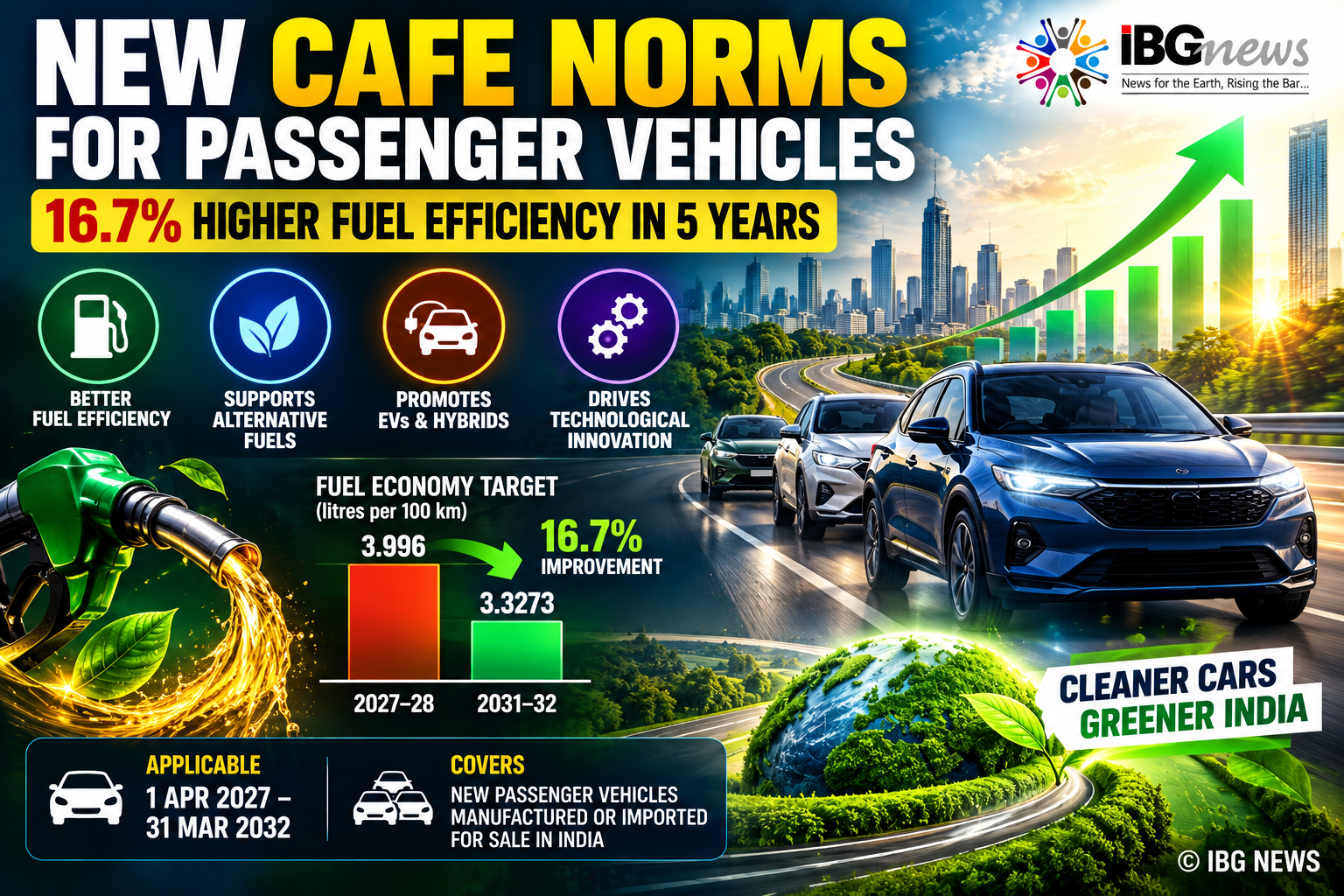
The new regulations will come into force on April 1, 2027, and remain applicable until March 31, 2032. They will cover new passenger vehicles manufactured in India or imported for sale in the domestic market.
Under the revised framework, manufacturers will face progressively tighter fleet-average fuel consumption targets over the five-year period. The benchmark is set to decline from 3.996 litres per 100 km in 2027–28 to 3.3273 litres per 100 km in 2031–32, representing an improvement of approximately 16.7%.
Greater focus on heavier vehicles
The new CAFE framework introduces a revised and comparatively flatter target curve based on vehicle weight. While lighter vehicles will face relatively softer requirements, heavier vehicles will be subject to stronger fuel-efficiency expectations.
The reference vehicle weight has been increased from 1,082 kg under the existing framework to 1,229 kg under the new norms, reflecting changes in the composition and characteristics of India’s passenger vehicle market.
Technology-neutral approach
Rather than prescribing a single technology pathway, the new framework provides manufacturers with multiple options to improve their fleet-level efficiency.
The regulations recognise the potential contribution of electric vehicles, hybrid technology, alternative fuels and other energy-saving technologies. They also encourage innovations such as solar-reflective paints, advanced glazing and more efficient air-conditioning systems that can contribute to lower energy consumption.
The approach is designed to provide the automobile industry with greater flexibility while encouraging continued investment in fuel-saving and low-carbon technologies.
Key Features of the New CAFE Framework
1. Stronger fleet-average efficiency targets
The overall fleet-average targets have been strengthened compared with the existing regime. At the same time, manufacturers will have multiple compliance pathways, allowing them to determine the technology mix most suitable for their vehicle portfolios.
2. Recognition for cleaner and renewable fuels
The framework introduces a Carbon Neutrality Factor (CNF) to recognise the contribution of renewable and lower-carbon fuels, including ethanol-blended petrol, biofuels and compressed biogas (CBG).
This gives manufacturers an additional route to improve fleet-level CAFE performance alongside conventional efficiency improvements and vehicle electrification.
3. More fuel-conservation technologies recognised
The number of recognised fuel-conservation technologies has been expanded from four to 12.
Eligible technologies can receive a concession of 1 g CO₂/km per technology, subject to an overall maximum concession of 9.0 g CO₂/km under the framework.
4. Incentives for advanced vehicle technologies
Several cleaner and advanced vehicle technologies will receive volume derogation factors, or “super credits,” when fleet-average performance is calculated.
These include:
- Battery Electric Vehicles (BEVs)
- Range-Extended Electric Vehicles (REEVs)
- Plug-in Hybrid Electric Vehicles (PHEVs)
- Strong Hybrid Electric Vehicles (SHEVs)
- Flex-Fuel Vehicles
The mechanism is intended to encourage manufacturers to expand the availability and adoption of these technologies.
5. Greater flexibility through compliance blocks
Manufacturers will be able to manage their obligations through specified two-year and three-year compliance blocks.
This provision is intended to give companies additional flexibility while transitioning their product portfolios and investing in new technologies.
6. Credit generation, carry-forward and trading
Manufacturers that perform better than their prescribed targets can generate CAFE credits, which may be carried forward within the permitted compliance blocks.
Companies facing a compliance shortfall may use eligible carry-forward provisions, participate in credit exchanges or trades with other manufacturers, or purchase credits through the buyout mechanism administered by the Bureau of Energy Efficiency (BEE).
This system is designed to provide manufacturers with flexibility in managing differences in their product mix and pace of technology adoption.
7. Dual testing framework
The new regime will use both the Modified Indian Driving Cycle (MIDC) and the Worldwide Harmonized Light Vehicles Test Procedure (WLTP) for reporting.
The dual-testing approach is expected to support India’s gradual movement toward internationally harmonised vehicle testing practices.
8. Exemption for very low-volume manufacturers
Manufacturers selling fewer than 1,000 passenger vehicles annually will remain exempt from fleet-average CAFE obligations. The provision is intended to avoid imposing disproportionate compliance requirements on very small-volume manufacturers.
What the New CAFE Rules Mean for India’s Auto Industry
The revised CAFE framework represents a shift from simply prescribing tighter fuel-consumption limits toward creating a broader technology-neutral compliance ecosystem.
For automobile manufacturers, the new rules create incentives to combine improvements in conventional internal-combustion engines with hybridisation, electrification, alternative fuels and other energy-efficiency technologies.
For consumers, the longer-term objective is improved vehicle energy efficiency and reduced fuel consumption, although the eventual impact on vehicle prices, technology choices and model availability will depend on how individual manufacturers respond to the regulations.
The framework also reflects the changing structure of India’s automobile market, where electric vehicles, hybrids, flex-fuel vehicles and vehicles capable of using alternative fuels are becoming increasingly relevant to the industry’s technology strategy.
A five-year transition toward greater efficiency
With implementation beginning in April 2027, manufacturers will have a five-year regulatory period through March 2032 to progressively improve fleet-level performance.
The government expects the framework to support energy efficiency, technological innovation, alternative fuels and electrification, while giving automobile companies flexibility in selecting the technologies and compliance strategies best suited to their product portfolios.
By Suman Munshi
Chief Editor, IBG NEWS

