















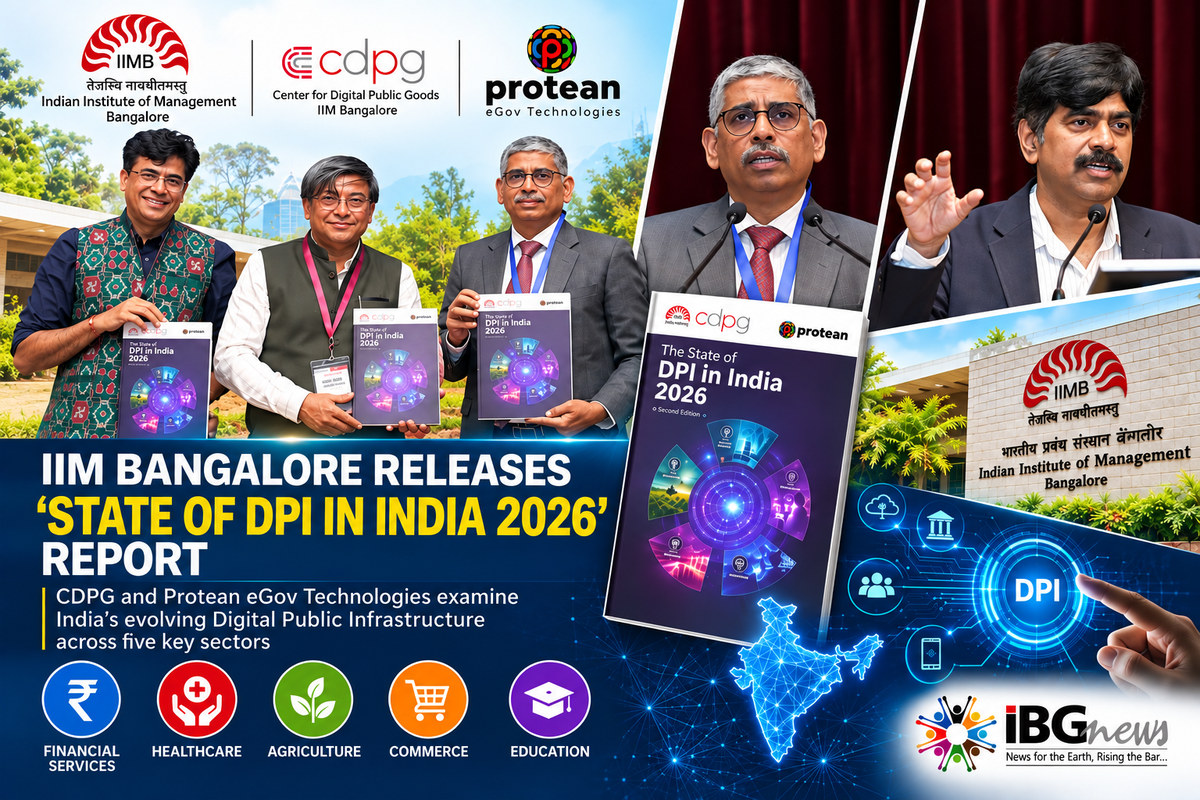
IIM Bangalore Releases ‘State of DPI in India 2026’ Report, Maps India’s Next Digital Infrastructure Phase
By Suman Munshi | IBG NEWS
Bengaluru, September 30, 2026: The Center for Digital Public Goods (CDPG) at IIM Bangalore has released the second edition of its State of DPI in India 2026 report, examining how India’s Digital Public Infrastructure (DPI) is developing across key sectors and moving towards more interconnected digital ecosystems.
The report was unveiled during the Annual Policy Conclave organized by CDPG in collaboration with the eGov Foundation at IIM Bangalore. V. Easwaran, Executive Director and Chief Operating Officer of Protean eGov Technologies Ltd.; Viraj Tyagi, CEO of eGov Foundation; and Prof. R. Srinivasan, Chairperson of CDPG and faculty member in the Strategy area at IIM Bangalore, participated in the release.
Commissioned by Protean eGov Technologies and prepared by CDPG, the report studies DPI implementation across five sectors—financial services, healthcare, agriculture, commerce and education.
From Digital Foundations to Connected Ecosystems
The latest edition builds upon the DPI maturity framework introduced in the report’s first edition. It broadens the analysis to additional sectors and focuses on how shared digital infrastructure can connect different participants within increasingly complex ecosystems.
According to the report, India has demonstrated the ability to develop and scale digital infrastructure for use at population level. The next challenge is no longer limited to establishing individual digital systems or foundational digital “rails”.
The report identifies a shift towards linking existing infrastructure, creating digital institutions around these systems and enabling trusted interactions between different participants.
Prof. R. Srinivasan said the 2026 edition aims to strengthen the evidence base surrounding India’s changing DPI landscape. He noted that comparative analysis and interactive visualizations can help understand how open, reusable and interoperable digital infrastructure may contribute to inclusive growth, institutional coordination and resilient public-service systems.
DPI 1.0 Moves Towards DPI 2.0
One of the report’s central observations is India’s transition from DPI 1.0 to DPI 2.0.
The first phase largely concentrated on establishing foundational infrastructure for areas such as digital identity, payments and public-service delivery. The emerging phase involves greater interoperability between multiple digital systems, including identity platforms, payments, credentials, registries, consent mechanisms and data-sharing frameworks.
The five sectors covered in the report demonstrate different aspects of this transition.
- Financial services: Interoperable digital transactions have demonstrated the potential for large-scale adoption and integration.
- Healthcare: Shared registries and consent-based systems are supporting the development of connected health information infrastructure.
- Agriculture: Interoperable systems are being explored to connect farmers with markets, advisory services and government programmes.
- Commerce: Digital marketplaces, logistics networks and procurement systems are increasingly moving towards interoperability.
- Education: Digital infrastructure is supporting learner identities, portable credentials, digital learning and continuity across different stages of education.
DPI Maturity Is More Than Technology
The report argues that DPI maturity should not be viewed simply as a system being either “implemented” or “not implemented”. Instead, it is an evolutionary process involving technology, institutions, participation and trust.
The assessment therefore considers factors beyond technological deployment, including institutional adoption, ecosystem participation, user confidence and innovation emerging around shared digital infrastructure.
Financial services, according to the report’s assessment, have reached a relatively advanced stage of leveraging interoperable digital infrastructure, while other sectors remain at different stages of development and adoption.
A major factor determining the value of DPI, the report suggests, is coordination across ecosystems.
As digital infrastructure expands, governments, businesses and citizens increasingly need to interact across organizational boundaries. Common standards, trusted data exchanges, shared registries and appropriate governance arrangements therefore become increasingly important.
DPI as an Institutional Transformation
The report also presents DPI as more than a technological undertaking. Digital infrastructure provides the technical foundation, but its effectiveness depends on institutions, standards, incentives and governance frameworks that allow different participants to work together.
This issue becomes particularly important when digital systems span multiple ministries, government departments and administrative levels.
The report points towards a stronger whole-of-government approach, where interoperable systems and coordinated governance can help reduce fragmentation and create more seamless citizen interactions with public services.
Looking Towards DPI 3.0 and Artificial Intelligence
The report also looks beyond the current DPI 2.0 phase and discusses the possible emergence of DPI 3.0, where artificial intelligence could introduce an additional intelligence layer to interconnected digital infrastructure.
As multiple trusted digital systems become connected, AI could potentially use information from these infrastructures to support decision-making, identify emerging needs and enable more coordinated or personalized services.
However, the report emphasizes that greater integration of AI must be accompanied by appropriate safeguards.
Privacy, accountability, transparency and interoperability will remain important foundations of trusted digital ecosystems. The report also highlights the importance of techno-legal frameworks to support these principles as AI becomes more deeply integrated into digital infrastructure.
Under the DPI 3.0 concept outlined in the report, digital institutions could eventually play a larger role in coordinating interactions between government, markets and society.
Why the Report Matters
India’s DPI journey is increasingly moving from the creation of individual digital platforms towards connecting multiple systems into interoperable networks.
The State of DPI in India 2026 report provides a sector-wise perspective on this transition and highlights a central question for the next phase of India’s digital transformation: how effectively can existing digital infrastructure be connected, governed and trusted across institutional boundaries?
The report’s findings indicate that future progress will depend not only on building new technology but also on strengthening governance, interoperability, participation and public trust.
About CDPG
The Center for Digital Public Goods (CDPG) at IIM Bangalore was established as a centre focused on advancing research and practice related to Digital Public Goods and Digital Public Infrastructure. Developed in collaboration with iSPIRT, the Centre brings together knowledge and experience emerging from India’s DPI initiatives and works across areas including research, policy, ecosystem development and capacity building.
About Protean eGov Technologies
Protean eGov Technologies Ltd., incorporated in 1995, develops technology-enabled and citizen-centric e-governance solutions. The company has worked on population-scale digital systems and collaborates with the Indian government on various digital infrastructure and e-governance initiatives.
Report: State of DPI in India 2026
Released by: Center for Digital Public Goods, IIM Bangalore
Commissioned by: Protean eGov Technologies Ltd.
Sectors covered: Financial Services, Healthcare, Agriculture, Commerce and Education
By Suman Munshi | IBG NEWS

