














Karnataka Government Honours MIRM Bengaluru Researcher Dr Sangeeta Nath for Work on Alzheimer’s and Parkinson’s Diseases
Karnataka Government Honours MIRM Bengaluru Researcher Dr Sangeeta Nath for Work on Alzheimer’s and Parkinson’s Diseases
Award-winning MAHE research explores how astrocytes protect themselves from toxic proteins linked to neurodegenerative disorders
By Antara Tripathy | IBG NEWS
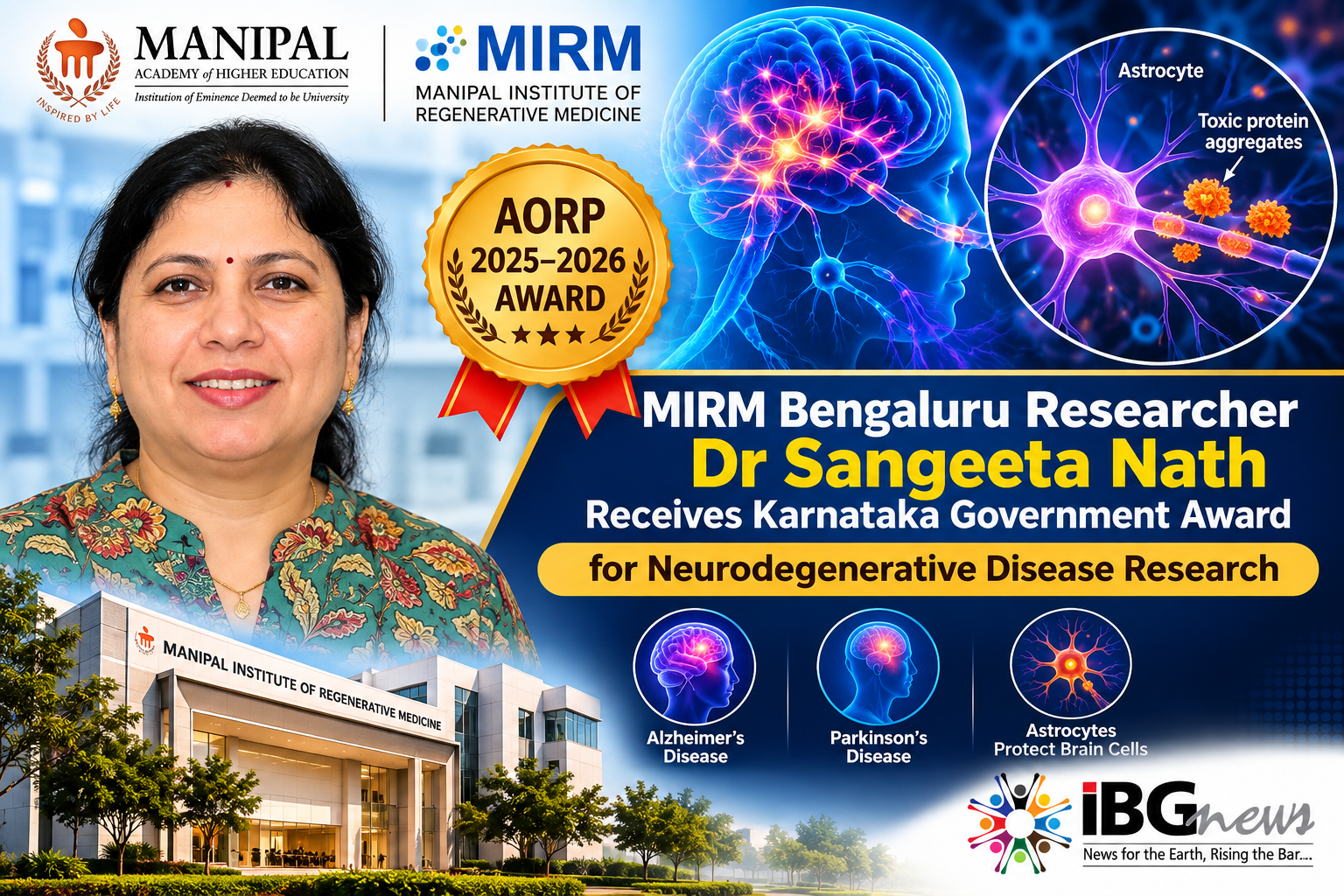
Bengaluru, October 2026: Research into the cellular mechanisms behind Alzheimer’s and Parkinson’s diseases has earned recognition for Dr Sangeeta Nath, Associate Professor at the Manipal Institute of Regenerative Medicine (MIRM), MAHE Bengaluru.
Dr Nath has received the AORP 2025–2026 Award for Outstanding Research Publication in Medical & Life Sciences, presented by the Vision Group on Science and Technology (VGST), Government of Karnataka. The honour recognises significant contributions to scientific research and high-quality academic publication.
The recognition comes for research from Dr Nath’s laboratory investigating a fundamental question in neuroscience: why can certain brain-supporting cells survive exposure to toxic protein accumulations that can severely damage neurons?
Understanding the Brain’s Supporting Cells
Dr Nath’s research focuses on astrocytes, a type of glial cell that performs essential supporting functions for neurons and contributes to maintaining a healthy environment within the brain.
Her laboratory studies how astrocytes respond to toxic protein aggregates, particularly amyloid-beta and alpha-synuclein. Abnormal accumulation of these proteins is closely associated with Alzheimer’s and Parkinson’s diseases, respectively.
According to the research, toxic protein aggregates can move directly from one cell to another through extremely thin cellular connections known as tunnelling nanotubes.
These microscopic connections are not restricted to transporting protein aggregates. They can also facilitate the movement of important cellular components, including mitochondria and lysosomes, between cells.
Could Tunnelling Nanotubes Help Cells Cope With Stress?
An important aspect of the research concerns what happens to a cell while these nanotubes are being formed.
The studies indicate that cells reorganise their actin cytoskeleton—part of the internal structural framework responsible for maintaining cellular shape and supporting movement.
The findings suggest that tunnelling nanotubes could play a protective role by helping reduce some of the mechanical and chemical stress generated by toxic protein aggregates. In this way, the structures may help explain why astrocytes can withstand conditions that are damaging to neurons.
Dr Nath said that since establishing her independent laboratory in May 2019, her research has concentrated on understanding why astrocytes are comparatively capable of surviving toxic protein aggregates.
She explained that the laboratory’s findings indicate tunnelling nanotubes may help relieve aggregate-induced cellular stress. A deeper understanding of this mechanism, she said, could eventually help researchers identify potential therapeutic targets for Alzheimer’s and Parkinson’s diseases.
Importantly, the findings represent fundamental cellular research rather than an established treatment for either disease. Further research would be required to determine whether these biological mechanisms can eventually be translated into therapeutic approaches.
Recognition for Fundamental Neuroscience Research
Commenting on the award, Prof. Madhu Veeraraghavan, Pro Vice Chancellor, MAHE Bengaluru, highlighted the importance of sustained fundamental research in tackling complicated neurological disorders.
He said Dr Nath’s work demonstrates the scientific relevance of research being undertaken at MIRM and contributes to a better understanding of cellular responses associated with Alzheimer’s and Parkinson’s diseases.
The research has broader significance because healthy neurons depend heavily on surrounding glial cells, including astrocytes. Understanding how these cells protect themselves under stressful conditions could therefore offer researchers additional clues about the biological processes involved in neurodegeneration.
Findings Published in International Scientific Journals
Research from Dr Nath’s laboratory has appeared in scientific journals including BBA Molecular Basis of Disease, Cellular and Molecular Life Sciences, iScience, and Cell & Bioscience.
The work has investigated several interconnected processes, including the cell-to-cell movement of toxic protein aggregates, changes in the cytoskeleton and the possible protective functions of tunnelling nanotubes.
The AORP 2025–2026 Award acknowledges Dr Nath’s contribution to medical and life-sciences research while drawing attention to the continuing importance of fundamental cellular biology in understanding neurodegenerative diseases.
For conditions as complex as Alzheimer’s and Parkinson’s, such investigations into how individual cells respond, communicate and protect themselves may help establish the scientific foundations for future therapeutic research.
About MAHE
Manipal Academy of Higher Education (MAHE) is an Institution of Eminence Deemed-to-be University offering programmes across health sciences, management, law, humanities and social sciences, technology and science. Its constituent institutions operate across campuses including Manipal, Mangalore, Bengaluru, Jamshedpur and Dubai.
MAHE received Institution of Eminence status from the Government of India’s Ministry of Education in 2020. According to the information provided for this report, the university was ranked third in the NIRF 2025 university rankings.
By Antara Tripathy
IBG NEWS

