














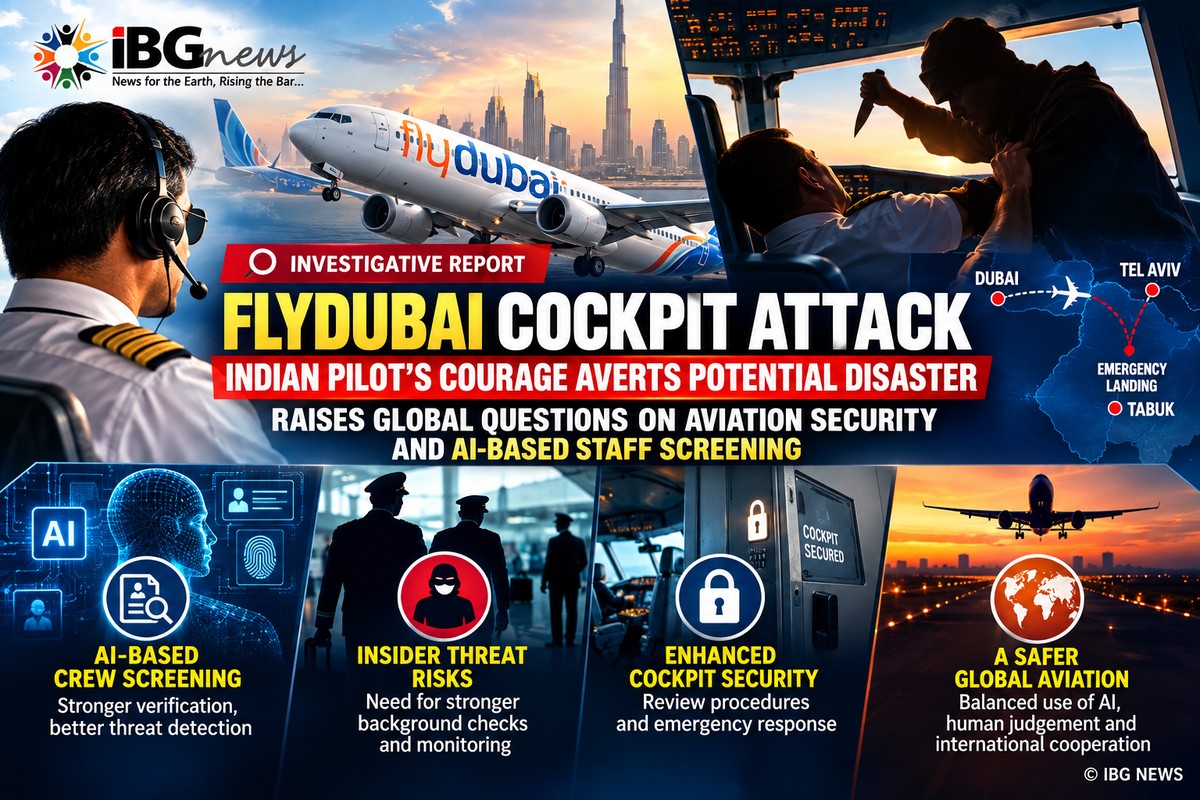

Flydubai Cockpit Attack Raises Aviation Security Concerns: Indian Pilot’s Response Highlights Need for Stronger Safety Measures and AI-Based Monitoring
By Suman Munshi | IBG NEWS
Kolkata, 2 October 2026
An alleged attack involving a co-pilot aboard a Flydubai aircraft has brought renewed attention to aviation security, cockpit safety and the potential risks posed by threats originating within an airline’s own workforce. The incident, in which Indian pilot Captain Smit Machchhar reportedly played a key role in responding to the emergency, has also prompted questions about crew recruitment, personnel screening and the use of Artificial Intelligence (AI) to strengthen aviation security.
The incident has attracted international attention following statements by Indian Prime Minister Narendra Modi and Israeli Prime Minister Benjamin Netanyahu praising the Indian pilot’s reported actions. Allegations of ideological radicalisation and a possible extremist motive have also emerged. However, the precise circumstances, motive and sequence of events require confirmation through the relevant authorities’ investigation.
The episode has highlighted a critical issue for the global aviation industry: how can airlines protect passengers and crew members against potential insider threats while maintaining fair recruitment practices, professional confidentiality and the fundamental rights of employees?
Indian Pilot’s Response Draws International Attention
Captain Smit Machchhar’s reported response during the emergency has brought attention to the importance of professional training, quick decision-making and coordination among flight crew members.
According to media reports, the Indian pilot took action during the alleged assault and helped facilitate a response that enabled the aircraft to land safely. The involvement of other crew members and individuals on board was also reportedly important in managing the situation.
The incident illustrates the importance of emergency preparedness in commercial aviation, where flight crews must be equipped to manage unexpected situations while maintaining operational safety.
Although the pilot’s actions have received public recognition, the complete sequence of events and the respective roles of those involved remain matters for the formal investigation.
Allegations of Extremism Require Independent Verification
The incident has also generated discussion about the possibility of an ideologically motivated attack. Israeli officials have reportedly raised concerns about alleged radicalisation and the possibility that the incident involved extremist beliefs.
These allegations have not, however, established the motive or demonstrated that the incident was part of a wider terrorist operation. Such conclusions require credible evidence, a transparent investigation and an assessment of the circumstances surrounding the alleged attack.
Investigators will need to examine relevant communications, employment and training records, witness accounts and other admissible evidence before establishing whether the incident was premeditated or ideologically motivated.
It is equally important to distinguish between an individual’s verified conduct and assumptions based on nationality, religion or personal beliefs. Effective aviation security must be guided by credible evidence rather than prejudice or speculation.
Insider Threats: An Emerging Challenge for Aviation Security
Airlines around the world have developed extensive security arrangements to protect aircraft, passengers, airports and sensitive operational systems. These measures traditionally focus on external threats, including unauthorised access, prohibited items and unlawful interference.
However, an incident involving an authorised flight crew member raises a different set of security questions.
Pilots and other aviation professionals undergo extensive training and receive access to highly sensitive operational environments. Their responsibilities require airlines to maintain rigorous systems for verifying professional qualifications, monitoring compliance and addressing legitimate safety concerns.
The Flydubai incident raises several areas that the aviation industry may need to examine:
- Recruitment verification: Whether identity, employment history, professional qualifications and relevant security checks are consistently validated.
- Fitness for duty: Whether established occupational health and professional assessment procedures are being followed appropriately.
- Workplace reporting: Whether colleagues have accessible and confidential channels to report credible safety concerns.
- Cockpit emergency preparedness: Whether procedures adequately address emergencies involving an authorised member of the flight crew.
- Regulatory cooperation: Whether relevant aviation authorities have effective mechanisms for exchanging verified safety information across international borders.
These are areas for further examination and should not be interpreted as evidence of any particular failure by Flydubai or the authorities involved.
Artificial Intelligence Could Support More Effective Personnel Screening
The growing availability of AI-powered technologies presents opportunities for airlines to improve administrative verification, operational oversight and the identification of potential safety issues.
AI can process large volumes of authorised information, identify inconsistencies and help human professionals prioritise matters requiring further review. When properly implemented, such systems may support existing security procedures without replacing the judgement of qualified personnel.
1. Intelligent recruitment and credential verification
AI-supported document verification can assist airlines in examining pilot licences, training certificates, identity documents and employment records. Automated systems may identify missing information, inconsistencies or potentially altered documents for further examination.
Final verification should remain with authorised licensing bodies and appropriately trained airline personnel.
2. Professional and occupational assessments
Airlines can strengthen existing occupational health and fitness-for-duty programmes by ensuring that pilots receive appropriate professional assessments and access to confidential support.
AI may help manage assessment records and administrative workflows, but it should not independently diagnose mental health conditions, predict violent behaviour or determine an employee’s fitness to fly.
3. Continuous compliance monitoring
AI-based systems can assist in tracking licence renewals, mandatory training, duty-hour limits, safety procedures and operational compliance.
Alerts arising from these systems should be reviewed by qualified human professionals to determine whether they reflect genuine safety concerns or simply administrative errors.
4. Confidential reporting and early intervention
A well-established reporting culture is essential for maintaining aviation safety. Airlines should provide accessible and confidential mechanisms through which pilots, cabin crew and other employees can raise legitimate concerns.
AI-assisted analysis of safety reports may help identify recurring procedural problems or emerging organisational risks. However, individual cases must be assessed fairly, confidentially and with appropriate safeguards against retaliation.
5. Evidence-based risk assessment
Machine learning can help analyse verified safety records, training gaps and operational incidents to identify patterns that may otherwise be difficult to detect.
Such systems require regular accuracy testing, bias assessments and independent oversight. Religion, ethnicity, nationality, lawful political opinions and other protected personal characteristics must not be used as indicators of dangerousness.
6. Human oversight and accountability
No AI-generated alert should automatically result in dismissal, suspension, loss of flight privileges or other serious employment consequences.
Any consequential decision should involve qualified human reviewers, documented evidence, transparent procedures and a meaningful opportunity for affected employees to challenge inaccurate information.
Why AI Cannot Replace Human Judgement
Despite its potential, AI has important limitations when applied to aviation security.
An employee with an excellent professional record may unexpectedly engage in misconduct, while another employee experiencing personal difficulties or displaying unusual behaviour may pose no security threat whatsoever.
Poorly designed predictive systems may generate false alerts, reinforce existing biases or encourage excessive surveillance. They may also create an atmosphere of mistrust among aviation professionals, potentially discouraging employees from reporting safety concerns.
Airlines must therefore adopt a balanced approach that combines technology with professional assessments, effective supervision, employee support, confidential reporting and evidence-based investigations.
The purpose of AI should be to strengthen established safety systems, not to label employees as potential criminals based on unverified behavioural patterns.
Reassessing Cockpit Security and Emergency Response
The alleged incident also highlights the importance of reviewing existing cockpit emergency procedures.
Cockpit security measures are primarily intended to prevent unauthorised individuals from entering the flight deck. An emergency involving someone who already has authorised access presents a different operational challenge.
Airlines and aviation regulators may consider reviewing emergency communication procedures between the cockpit and cabin crew, the handling of violence or incapacitation involving flight crew, and the effectiveness of crisis-management training.
Regular simulation exercises can help pilots and cabin crew prepare for unexpected situations, including emergencies that require rapid coordination without compromising aircraft control.
Any proposed changes to cockpit procedures must undergo rigorous safety assessments to ensure that measures designed to address one threat do not inadvertently create another.
International Cooperation Is Essential
Commercial aviation operates across national boundaries, making cooperation between airlines, regulators and law-enforcement agencies an important component of security.
The incident provides an opportunity to review international procedures for credential verification, reporting credible security concerns, sharing relevant information lawfully and coordinating investigations.
Aviation regulators and industry organisations can also examine whether existing standards provide sufficient guidance on insider-threat prevention, personnel vetting, emergency preparedness and responsible technology adoption.
Any reforms should be proportionate, evidence-based and consistent with applicable privacy, employment and human-rights protections.
Protecting Passengers Without Compromising Employee Rights
Aviation security depends on the trust placed in highly trained professionals. At the same time, that trust must be supported by robust accountability systems and clear procedures for addressing credible safety concerns.
The response to an alleged insider attack should not lead to indiscriminate surveillance, discrimination or unsupported accusations against employees.
Airlines need to establish a workplace environment in which professional integrity, psychological support, transparent reporting and effective safety oversight operate together.
AI may contribute to this process by improving record verification, identifying administrative inconsistencies and helping safety teams analyse verified information. Its deployment, however, must remain subject to appropriate governance, independent evaluation and human responsibility.
Conclusion: Building a More Resilient Aviation Safety System
The alleged Flydubai cockpit attack has brought an important aviation security challenge into public discussion: protecting passengers and crew members from risks that may originate within an organisation itself.
Captain Smit Machchhar’s reported response highlights the significance of preparedness, professional training and coordinated action during emergencies. At the same time, the incident underlines the need for a thorough investigation into the circumstances, the alleged attacker’s motive and the effectiveness of existing safeguards.
For the global aviation industry, the way forward involves strengthening recruitment verification, improving emergency response, supporting aviation professionals and responsibly integrating AI into existing security frameworks.
Technology can help airlines identify inconsistencies and manage complex safety information, but it cannot guarantee that an individual will never engage in harmful conduct. Effective prevention requires reliable evidence, professional judgement, fair procedures and continuous improvement.
Ultimately, aviation security must protect every passenger and employee while preserving the integrity, privacy and dignity of the people responsible for keeping aircraft safe.
IBG NEWS Editorial Note: This article discusses reported allegations and potential aviation-security improvements. The precise circumstances and motive associated with the incident, as well as any possible institutional shortcomings, require independent verification through the relevant authorities. Allegations should not be treated as established facts before the conclusion of the investigation, and all individuals retain the right to due process.
Tighten the article for online readersClarify the opening with an uncertainty label

