












India’s Manufacturing Sector Rebounds in September 2026 as Domestic Demand and Export Orders Surge
By Anil P. Kastuar | IBG NEWS
Kolkata | 2 October 2026
India’s manufacturing sector recorded a strong recovery in September 2026, supported by rising domestic consumption, expanding export orders and increased factory employment. The latest business activity indicators point to renewed momentum in industrial production, with several key sectors witnessing improved demand.
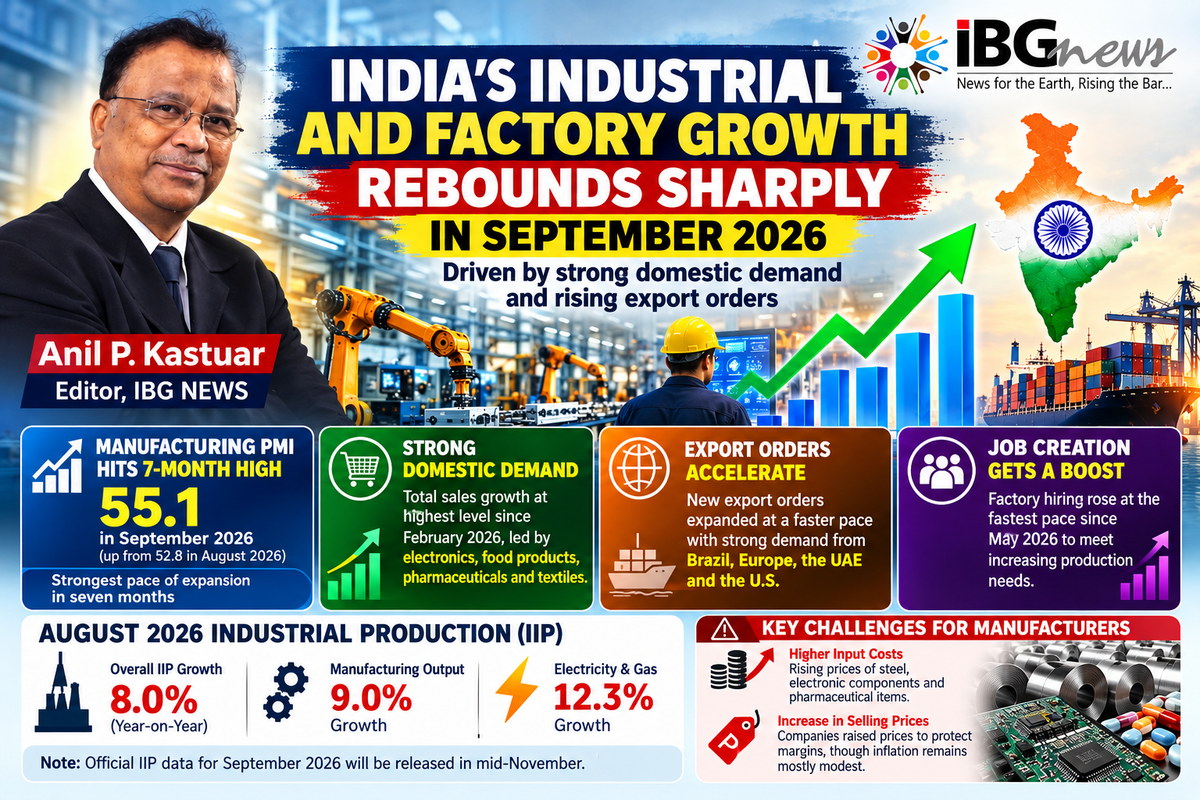
According to the HSBC India Manufacturing Purchasing Managers’ Index (PMI), manufacturing activity climbed to 55.1 in September, compared with 52.8 in August 2026. The latest reading represents the fastest rate of expansion in seven months, remaining comfortably above the 50-point mark that separates growth from contraction.
Domestic Demand Drives Manufacturing Growth
The improvement in manufacturing activity was largely supported by stronger domestic demand. Total sales recorded their highest growth since February 2026, reflecting increased orders across several major industries.
Electronics, food processing, pharmaceuticals and textiles emerged as important contributors to the expansion. The rise in demand encouraged manufacturers to increase production and strengthen their operational activities to meet growing market requirements.
The improvement in sales also indicates a broader recovery in business activity, with manufacturers experiencing stronger order inflows towards the end of the third quarter.
Export Orders Gain Momentum
India’s manufacturing sector also benefited from a significant acceleration in international demand. New export orders expanded at a faster pace in September, with manufacturers reporting increased business enquiries and orders from overseas markets.
Brazil, Europe, the United Arab Emirates and the United States were among the regions contributing to the improvement in export demand. The stronger international order pipeline provided additional support to Indian factories, complementing the recovery in domestic consumption.
The expansion in export orders reflects the growing importance of international markets in sustaining manufacturing activity and supporting industrial growth.
Rising Production Supports Job Creation
The improvement in factory activity also translated into increased employment opportunities. Manufacturers stepped up recruitment to address rising production requirements and manage the growing volume of new orders.
September witnessed the fastest pace of job creation in the manufacturing sector since May 2026, indicating that businesses were responding to stronger demand by expanding their workforce.
The increase in hiring could also provide additional support to household incomes and consumption, although the longer-term impact will depend on whether the current expansion in industrial activity is sustained.
August Industrial Production Provides a Strong Foundation
The September manufacturing expansion follows encouraging official industrial production figures for August 2026.
The Index of Industrial Production (IIP) recorded 8.0% year-on-year growth in August, supported by improved performance in key industrial segments.
Manufacturing output increased by 9.0%, while electricity and gas production registered growth of 12.3%. These figures highlighted the strength of industrial activity before the latest improvement in manufacturing sentiment and new orders.
However, the official IIP figures for September 2026 are not yet available. The September data are expected to be released in mid-November, in line with the usual reporting schedule. Consequently, the latest PMI reading should be viewed as an indicator of business activity rather than a substitute for the official industrial production figures.
Rising Input Costs Remain a Challenge
Despite the encouraging expansion in manufacturing activity, businesses continue to face cost-related pressures.
Manufacturers reported higher prices for steel, electronic components and pharmaceutical inputs, increasing overall production expenses. These rising costs have placed additional pressure on operating margins, particularly for companies that are unable to pass on the full increase to customers.
In response, several manufacturers raised their selling prices at a faster pace to protect profitability. Nevertheless, the reported increase in selling prices remained relatively modest, suggesting that companies were balancing cost recovery with the need to remain competitive.
Managing input cost inflation while maintaining production efficiency is likely to remain a significant concern for manufacturers in the coming months.
Outlook: Sustaining Industrial Momentum
The September 2026 PMI reading indicates a broad improvement in India’s manufacturing environment, supported by stronger domestic orders, expanding exports and increased employment.
The performance of electronics, pharmaceuticals, food products and textiles has contributed to the sector’s recovery, while rising international demand has created additional opportunities for Indian manufacturers.
However, sustaining this momentum will depend on how businesses manage higher input costs, maintain competitive pricing and convert new orders into consistent production growth.
The forthcoming September IIP figures will provide a more comprehensive assessment of industrial performance. Until then, the latest PMI data offer an encouraging indication of manufacturing activity, while cost pressures remain an important challenge for businesses.
IBG NEWS | Business & Economy

