














Mumbai Airport to Redevelop Terminal 1B from January 2027; 91% of Passenger Traffic to Remain Unaffected
Mumbai, October 4, 2026: Mumbai International Airport Limited (MIAL), operated by Adani Airport Holdings Limited (AAHL), is set to begin the phased redevelopment of the northern section of Terminal 1B in January 2027, citing safety concerns associated with the ageing infrastructure. The redevelopment is expected to modernise the terminal while ensuring that the majority of airport operations continue without disruption.
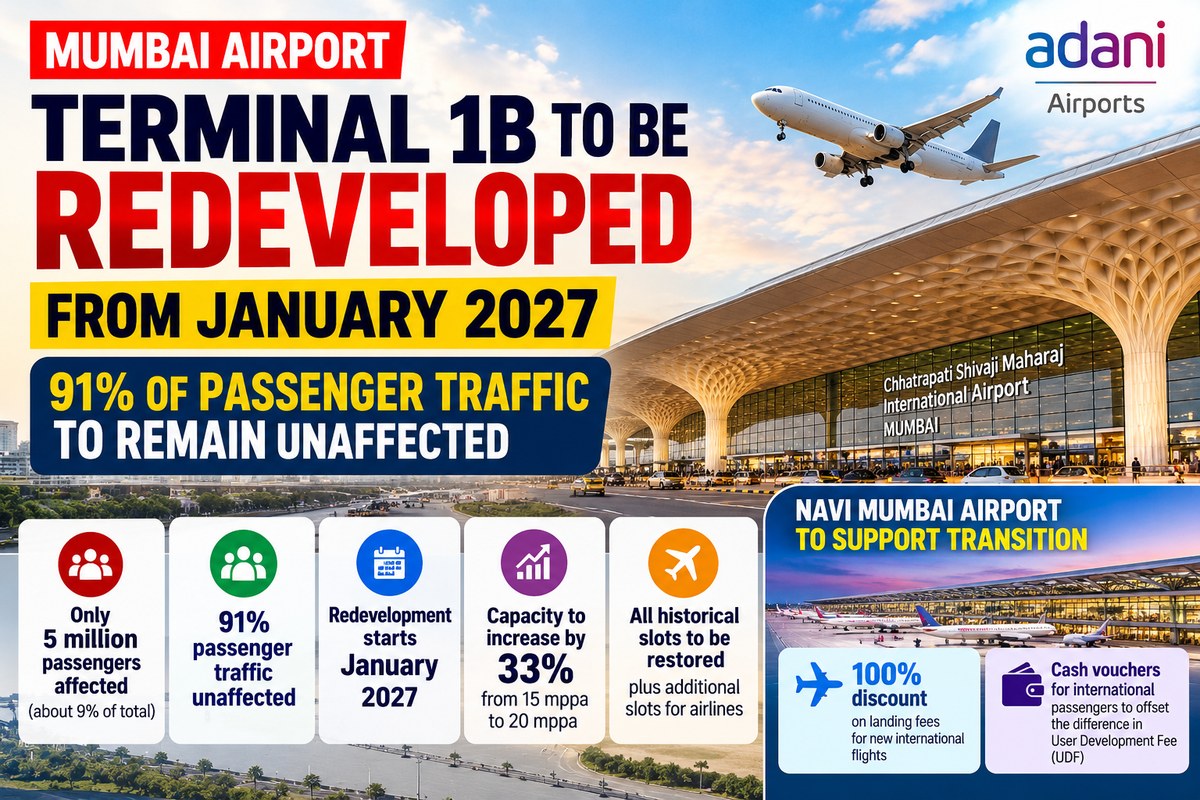
According to the media release issued by Adani Airports on October 3, approximately 91% of Mumbai Airport’s passenger traffic will remain unaffected during the initial phase of the project. Of the airport’s annual passenger volume of around 55 million, approximately 5 million passengers, representing about 9% of the total, will be temporarily affected by the planned redevelopment.
Safety Concerns Prompt Terminal Redevelopment
The 60-year-old Terminal 1 infrastructure has been a longstanding safety concern, with only temporary measures undertaken over the years. The risks associated with continued operations became more pronounced following a fire incident at Terminal 1 in April 2026, according to the airport operator.
The redevelopment will initially focus on the northern section of Terminal 1B, which accounts for approximately one-third of Terminal 1’s capacity. The phased approach is intended to minimise inconvenience to passengers and reduce operational disruptions rather than shutting down the entire terminal.
Arun Bansal, CEO of Adani Airport Holdings Limited, stated that passenger safety remains the top priority and that the redevelopment is essential to address the risks associated with ageing airport infrastructure. He also clarified that the temporary relocation of certain airline operations to Navi Mumbai does not indicate a permanent transfer of traffic from Mumbai Airport.
Terminal Capacity to Increase by 33%
The redevelopment is expected to significantly enhance the capacity of Terminal 1. Following completion, its annual passenger-handling capacity is projected to increase from the existing 15 million to approximately 20 million, representing a 33% rise.
The upgraded terminal is also expected to restore all historical airline slots, along with additional slots, creating greater operational opportunities for airlines and supporting future passenger growth.
The airport operator stated that consultations with airlines regarding the future of Terminal 1 have been ongoing since 2020. The proposed redevelopment was also presented to the Airports Economic Regulatory Authority (AERA) and incorporated into the approved tariff framework.
Navi Mumbai Airport to Support the Transition
To facilitate the redevelopment and maintain connectivity, Adani Airports has offered airlines the option to temporarily relocate their operations to Navi Mumbai International Airport, depending on their operational requirements.
Navi Mumbai International Airport is positioned as an alternative facility capable of accommodating the additional passenger traffic during the redevelopment period. The airport operator has committed to supporting airlines through the transition to ensure continuity of services.
As an incentive to attract new international services, Navi Mumbai International Airport is offering a 100% discount on landing fees for new international flights. The airport also plans to provide cash vouchers to international passengers to offset the difference in User Development Fees (UDF) between Navi Mumbai and Mumbai airports.
Two Airports to Strengthen Mumbai’s Aviation Network
Mumbai Airport and Navi Mumbai International Airport are expected to function as complementary aviation hubs, addressing the growing demand for air travel in India’s commercial capital region.
The availability of Navi Mumbai International Airport provides an alternative for airlines and passengers, enabling Mumbai Airport to undertake the redevelopment in phases while maintaining the continuity of essential services.
The project represents a significant step towards improving passenger safety, expanding terminal capacity and strengthening the aviation infrastructure of the Mumbai metropolitan region.
By Suman Munshi
Chief Editor, IBG NEWS
www.ibgnews.com

