















How to Build a Skill Set for Becoming a Great Architect in the Modern Design Era
By Suman Munshi | IBG NEWS
Architecture is changing faster than at almost any point in its history. The profession is no longer limited to drawing plans, preparing elevations and supervising construction. Today’s architect is expected to understand design, technology, sustainability, construction, data, artificial intelligence, economics, human behaviour and communication.
The most successful architects of the coming decade will not simply be those who can produce attractive buildings. They will be professionals who can understand complex problems, develop intelligent design responses, test those ideas digitally, communicate them convincingly and turn them into buildings that perform in the real world.
Becoming such an architect requires a deliberate skill-building strategy rather than learning software randomly or collecting certificates.
1. Design Thinking: Learn to Think Before You Draw
The foundation of great architecture is not software. It is observation and reasoning.
A strong architect begins by asking:
- Who will use this building?
- What does the site demand?
- How does climate influence the design?
- What are the cultural and social conditions?
- What are the client’s actual objectives?
- What constraints exist?
- What opportunities are hidden within those constraints?
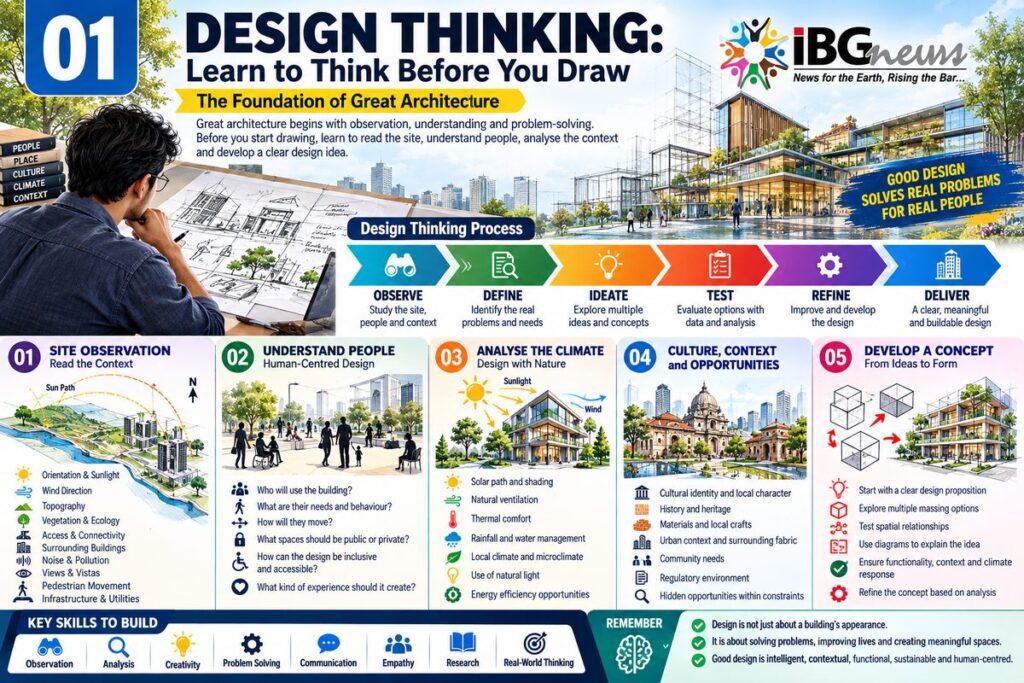
A modern design process
A useful framework is:
Observe → Define → Ideate → Test → Refine → Deliver
Develop these abilities
Site observation
Learn to analyse:
- orientation
- sunlight
- wind
- topography
- vegetation
- access
- surrounding buildings
- noise
- views
- pedestrian movement
- infrastructure
Spatial thinking
Understand how people experience:
- entry
- transition
- circulation
- public and private zones
- vertical movement
- light
- scale
- proportion
- enclosure
Concept development
Don’t begin every project with a building shape. Begin with a problem and a proposition.
The best concepts should explain why the building looks, works and feels the way it does.
Great design is not decoration added to a building. It is intelligent problem-solving expressed through space.
2. Architectural Communication: Make Your Ideas Understandable
A brilliant idea that cannot be communicated effectively is unlikely to survive a real project.
Architects communicate with clients, engineers, contractors, authorities, consultants, developers and users. Each audience understands information differently.
Therefore, communication should become a core professional skill.
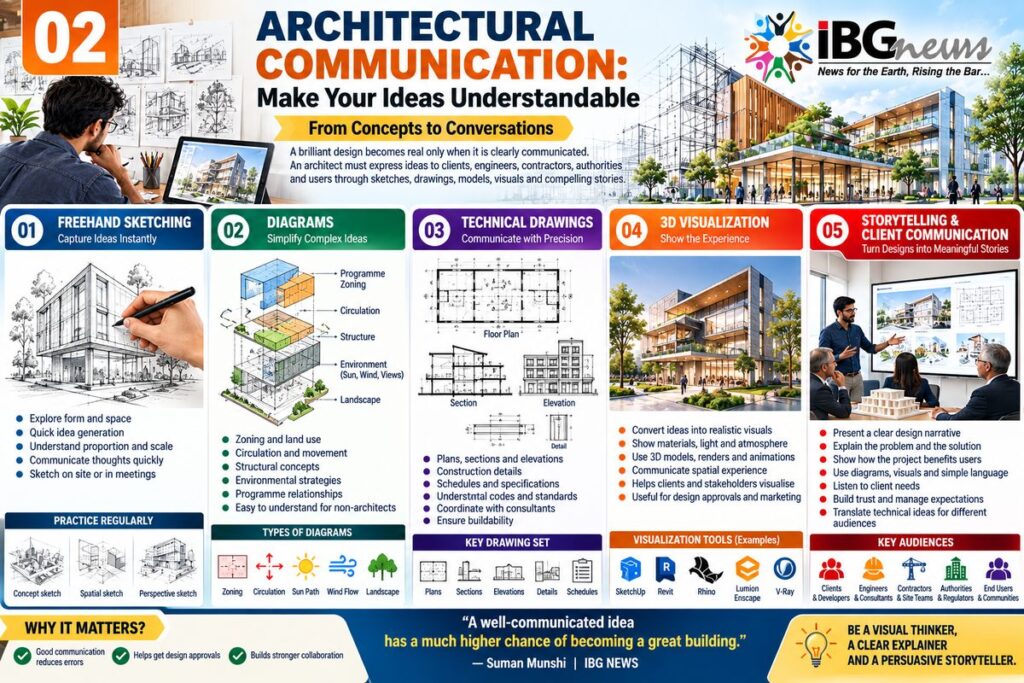
Build competence in:
Freehand sketching
Sketch rapidly to explore:
- form
- proportion
- circulation
- massing
- façade ideas
- spatial relationships
Diagrams
Learn to convert complex information into simple graphics:
- zoning diagrams
- circulation diagrams
- environmental diagrams
- structural concepts
- programme relationships
Technical drawings
Become comfortable with:
- plans
- sections
- elevations
- details
- schedules
- specifications
3D visualization
Use models and renders to explain spatial experience rather than simply creating attractive images.
Storytelling
A strong presentation should answer:
- What is the problem?
- What is the design response?
- Why was this approach selected?
- How does it benefit users?
- How does it respond to its environment?
- Why is it practical to construct?
3. Technical & Construction Mastery: Design What Can Actually Be Built
One of the biggest differences between an inexperienced designer and a mature architect is the understanding of constructability.
A building is not merely a composition of forms. It is a coordinated system.
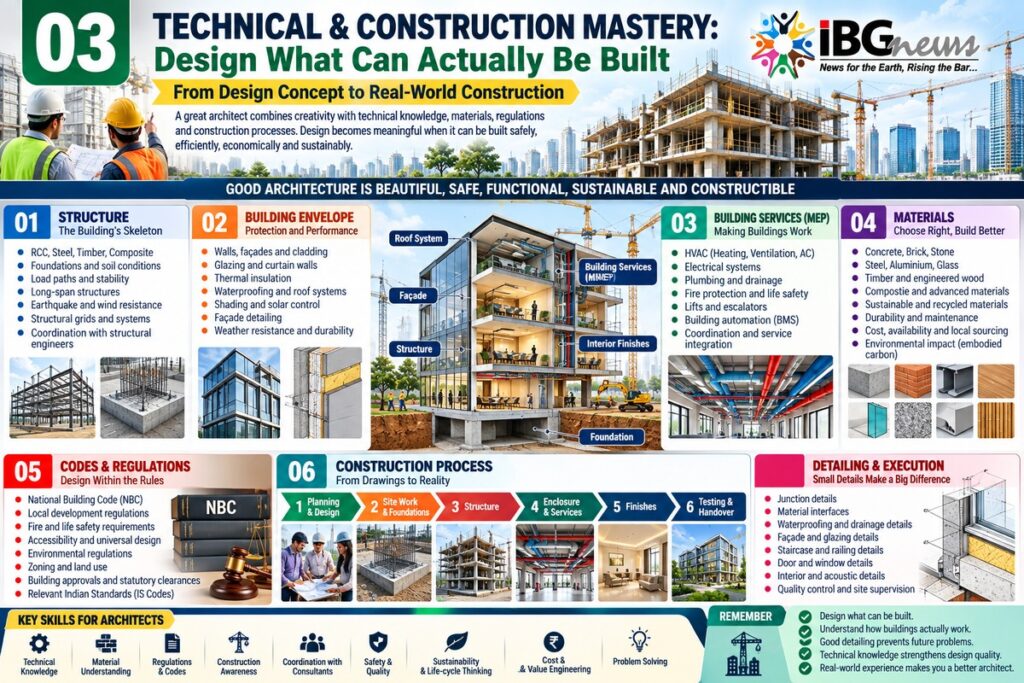
Study the major building systems
Structure
Understand the principles behind:
- RCC
- steel
- timber
- foundations
- long-span structures
- load paths
- structural grids
Building envelope
Learn about:
- walls
- façades
- glazing
- insulation
- waterproofing
- shading
- thermal bridges
- roofs
Building services
Gain working knowledge of:
- HVAC
- electrical systems
- plumbing
- fire protection
- vertical transportation
- building automation
Materials
Study how materials behave, not merely how they look.
Understand:
- strength
- durability
- weathering
- maintenance
- thermal properties
- acoustic performance
- environmental impact
- installation
Codes and regulations
A professional architect must understand the regulatory environment applicable to each project.
In India, this includes relevant provisions of the National Building Code, local development regulations, fire requirements, accessibility provisions and environmental regulations, together with applicable standards and authority requirements.
The goal is not to memorise every regulation.
The goal is to know where requirements influence design decisions.
4. BIM & Digital Delivery: Move From Drawings to Information
Building Information Modelling has fundamentally changed how architecture can be delivered.
A BIM model can become a coordinated information environment connecting architecture with structure, MEP, quantities, documentation and eventually building operations.
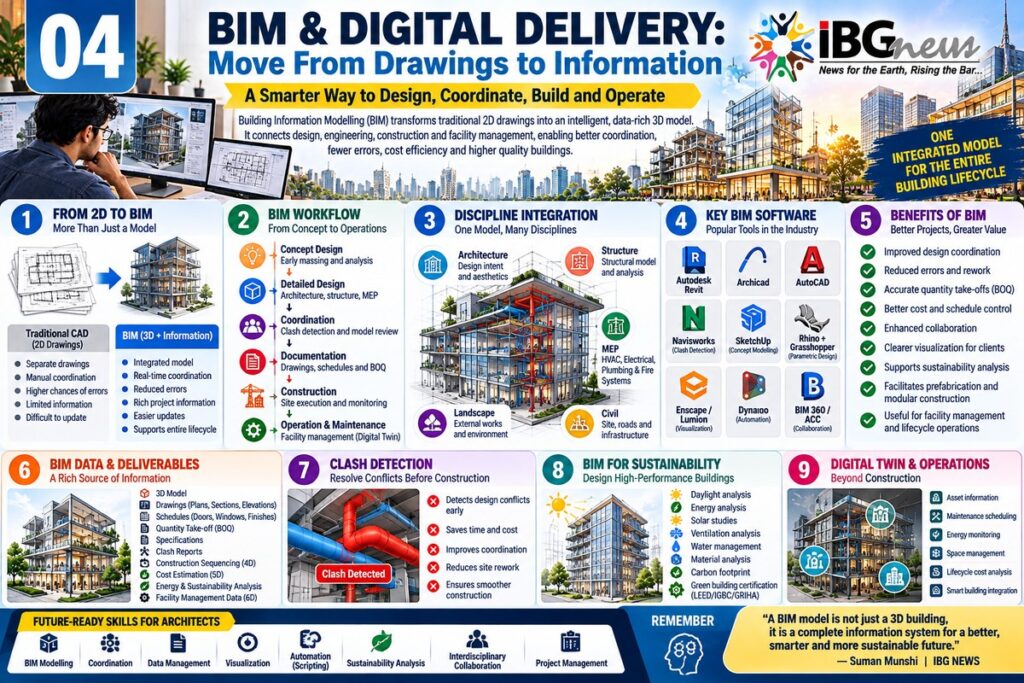
Develop a BIM skill ladder
Level 1 — Modelling
Learn:
- Revit or Archicad
- families/components
- levels
- grids
- views
- sheets
Level 2 — Documentation
Develop competence in:
- working drawings
- schedules
- details
- annotations
- model-based documentation
Level 3 — Coordination
Understand:
- architectural/structural coordination
- MEP coordination
- clash detection
- model federation
- interdisciplinary workflows
Level 4 — Data
Learn to use models for:
- quantity extraction
- material schedules
- cost information
- project data
- performance analysis
Level 5 — Digital twins
Understand how digital information can eventually support:
- facility management
- operations
- maintenance
- energy monitoring
- lifecycle management
The objective is to move from “I can model a building” to “I can manage building information.”
5. Computational Design + AI: Become More Capable, Not Less Creative
Artificial intelligence will change architectural workflows, but it does not eliminate the need for architects.
The important distinction is between using AI to generate images and using computation to improve design decisions.
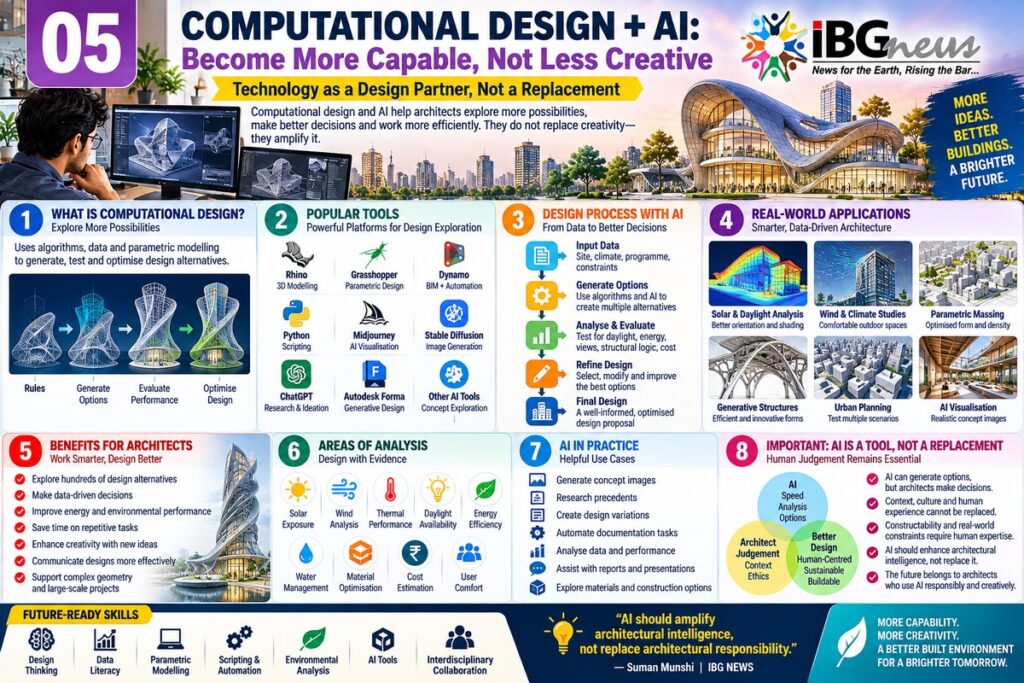
Learn computational thinking
Useful tools include:
- Rhino
- Grasshopper
- Dynamo
- Python
- parametric modelling
- generative design platforms
- AI visualization systems
What computational design can help with
A parametric workflow can explore alternatives based on:
- site constraints
- daylight
- solar exposure
- density
- circulation
- structural logic
- energy performance
- views
- programme
Instead of producing one solution, the architect can investigate hundreds of possibilities and compare them.
Where AI becomes valuable
AI can assist with:
- early-stage ideation
- visual exploration
- image generation
- precedent research
- design alternatives
- documentation assistance
- data analysis
- scripting
- workflow automation
- visualization
But the architect remains responsible for:
judgement + context + ethics + constructability + human experience.
AI should amplify architectural intelligence, not replace architectural responsibility.
6. Sustainability & Building Performance
Sustainability should not be treated as a decorative feature added near the end of a project.
It should influence the design from the beginning.
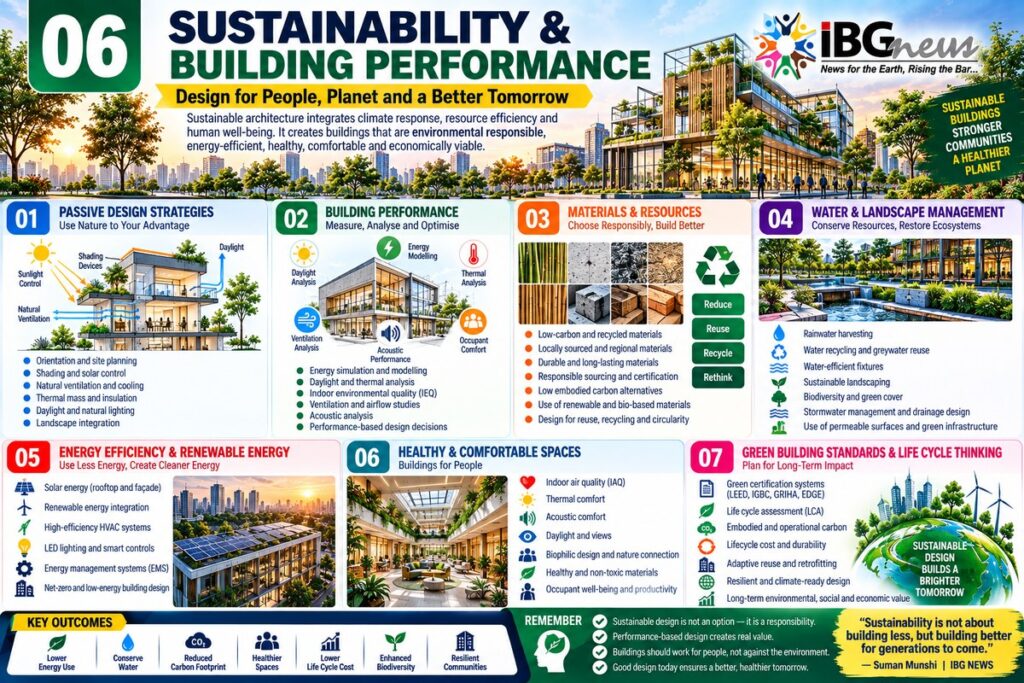
Learn passive design
Understand:
- orientation
- shading
- daylight
- natural ventilation
- thermal mass
- building envelope
- solar control
- landscape integration
Study building performance
Develop familiarity with:
- energy modelling
- daylight analysis
- thermal analysis
- solar studies
- computational environmental analysis
- water management
- embodied carbon
Materials matter
The modern architect should increasingly understand:
- low-carbon materials
- recycled materials
- local materials
- responsible sourcing
- material lifecycle
- durability
- adaptive reuse
Think beyond energy
A truly sustainable building also considers:
- water
- biodiversity
- indoor air quality
- thermal comfort
- acoustics
- occupant wellbeing
- maintenance
- lifecycle carbon
The future of architecture is moving from simply “green buildings” toward high-performance buildings designed around measurable outcomes.
7. Site & Real-World Delivery: Go Beyond the Studio
An architect who only understands drawings has an incomplete understanding of architecture.
Construction sites teach lessons that no software can fully reproduce.
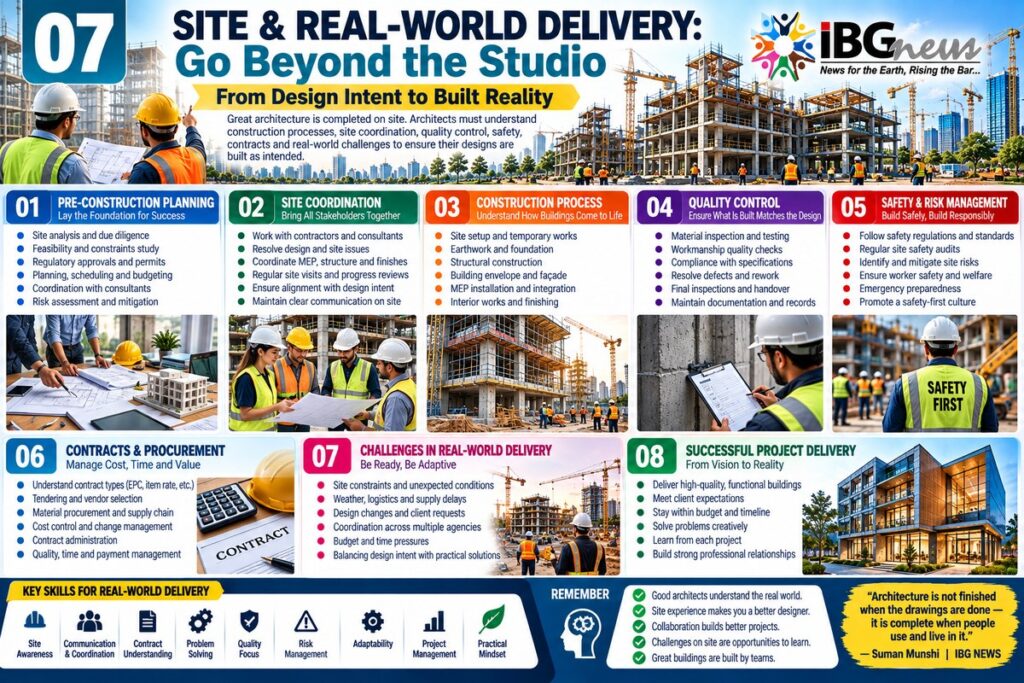
Spend time observing:
- excavation
- foundations
- reinforcement
- formwork
- waterproofing
- masonry
- façade installation
- services
- finishing
- testing and commissioning
Learn from mistakes
On-site experience reveals why:
- a beautiful detail may be impossible to construct
- a material may fail under local conditions
- a drawing may be technically correct but difficult to execute
- coordination errors become expensive
- sequencing affects cost and quality
A strong architect therefore develops a continuous feedback loop:
Design → Construction → Observation → Learning → Better Design
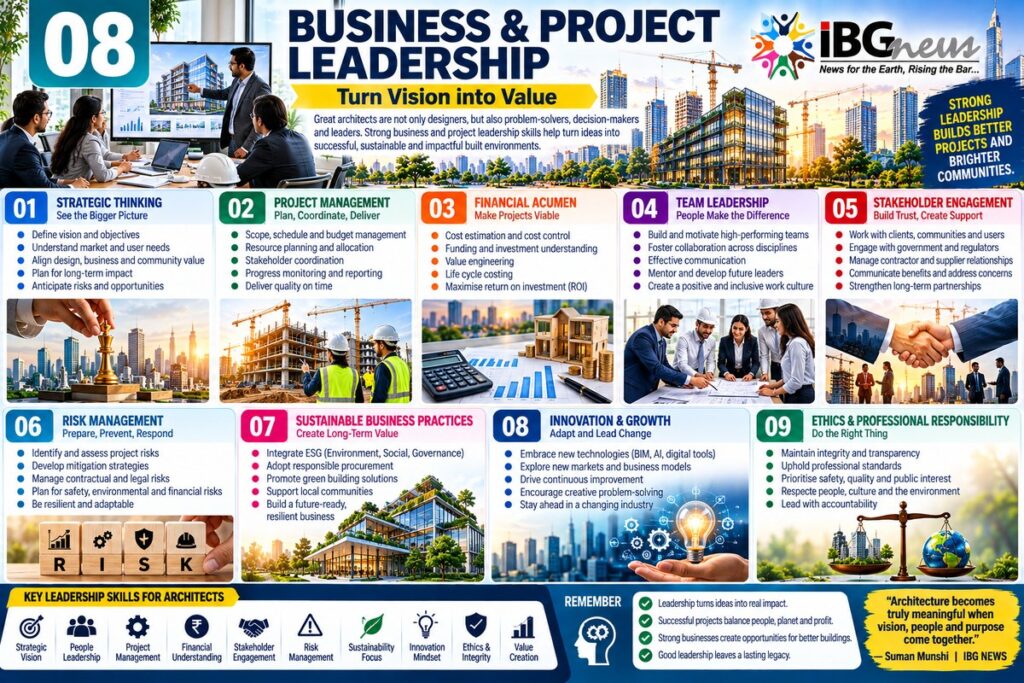
8. Business & Project Leadership
Architecture is also a professional service and a business.
An architect who understands design but cannot manage clients, budgets, contracts or teams will struggle to lead major projects.
Develop business knowledge
Learn the basics of:
- professional fees
- project costing
- budgeting
- procurement
- contracts
- risk
- variations
- scheduling
- quality control
- project documentation
Learn client management
A good architect should be able to identify:
What the client says → What the client needs → What the project actually requires
These three things are not always identical.
Develop leadership
Major projects involve:
- architects
- structural engineers
- MEP consultants
- landscape designers
- specialist consultants
- contractors
- vendors
- authorities
- project managers
The architect increasingly acts as a coordinator and leader of a multidisciplinary system.
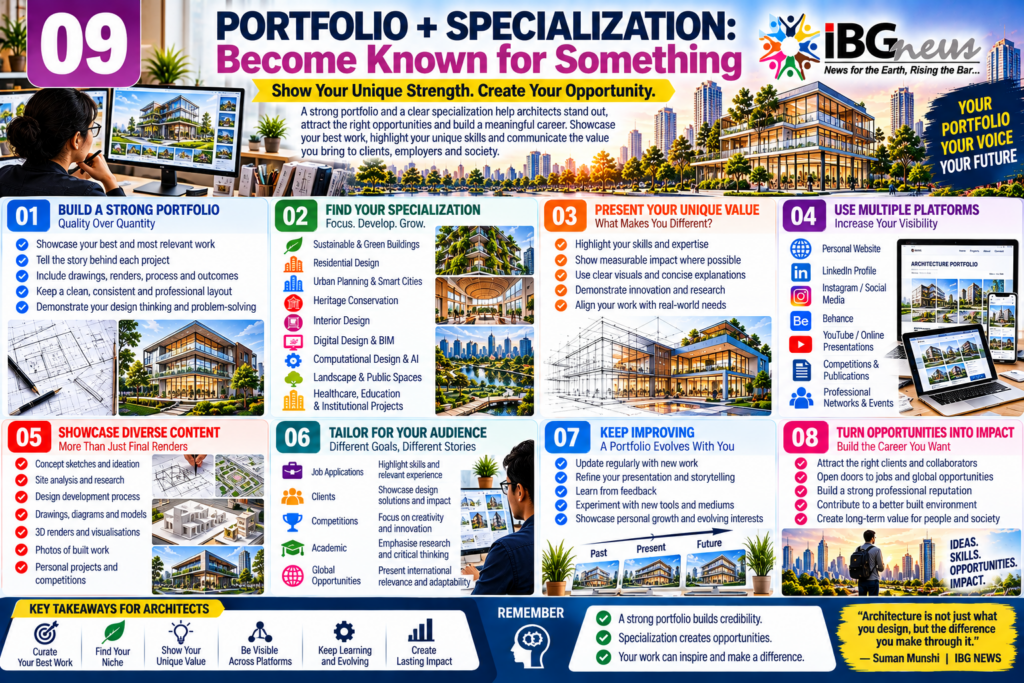
9. Portfolio + Specialization: Become Known for Something
A portfolio should not simply demonstrate that you can make attractive drawings.
It should reveal how you think.
A strong portfolio should show
- design problem
- site analysis
- research
- concept development
- alternatives considered
- drawings
- diagrams
- technical development
- material thinking
- environmental analysis
- final design
- lessons learned
Show the journey, not just the final render.
Consider specialization
The modern architectural profession offers numerous directions:
- sustainable architecture
- computational design
- healthcare architecture
- hospitality
- high-rise design
- residential architecture
- urban design
- infrastructure
- data centres
- conservation
- interior architecture
- BIM management
- façade design
- building performance
- architectural visualization
- digital fabrication
You do not have to specialize immediately.
But after gaining broad experience, developing one area of exceptional depth can dramatically increase professional value.
10. Career Roadmap: From Graduate to Global Architect
A realistic career strategy is more valuable than simply applying everywhere.
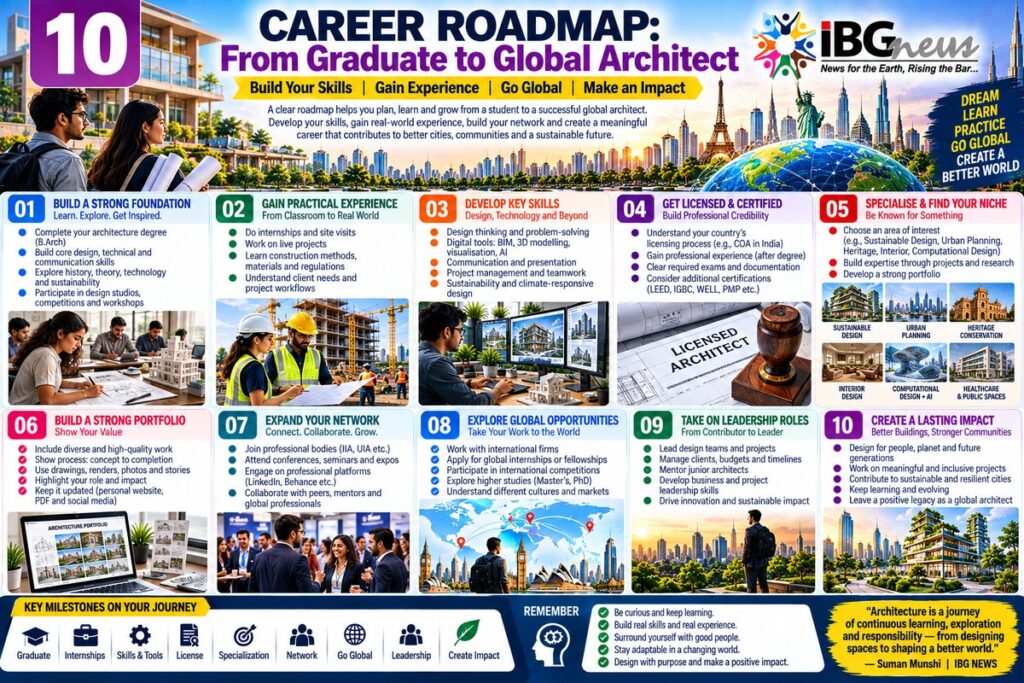
Stage 1 — Foundation
0–2 years
Concentrate on:
- drawing
- modelling
- construction
- documentation
- site experience
- architectural fundamentals
Your objective should be learning how real projects work.
Stage 2 — Professional Development
2–5 years
Add:
- BIM
- advanced visualization
- computational design
- sustainability
- coordination
- client presentations
- project responsibility
At this stage, begin identifying your strongest professional direction.
Stage 3 — Specialization
5–8 years
Become highly competent in a selected area.
For example:
Architecture + BIM
or
Architecture + Computational Design
or
Architecture + Sustainability
or
Architecture + Healthcare
or
Architecture + Urban Design
Stage 4 — Leadership
8+ years
Move toward:
- project architect
- design lead
- BIM lead
- specialist consultant
- associate
- project director
- studio leader
- independent practice
The objective becomes creating and leading systems rather than simply completing tasks.
Where Should a Young Architect Work?
The best first employer is not necessarily the company with the most famous name.
Look for a practice where you can experience:
Design + Documentation + BIM + Consultants + Construction + Client Interaction
Global practices worth researching
Some internationally prominent practices that can provide exposure to advanced design, technology, multidisciplinary collaboration or complex projects include:
- Gensler
- Foster + Partners
- Skidmore, Owings & Merrill (SOM)
- BIG
- Zaha Hadid Architects
- OMA
- Heatherwick Studio
- HDR
- Perkins&Will
- HKS
- AECOM
- Arcadis
- Nikken Sekkei
These organizations differ considerably in culture and specialization, so candidates should research the individual studio, project type, role and learning opportunities rather than applying solely because of brand recognition.
Strong Indian Practices to Explore
India also has an increasingly sophisticated architectural ecosystem.
Young professionals can research practices such as:
- Morphogenesis
- CP Kukreja Architects
- Serie Architects
- Sameep Padora & Associates
- Studio Lotus
- Architecture BRIO
- Anagram Architects
- SpaceMatters
- RSP India
- HBA
The right choice depends on the kind of architect you want to become.
For example:
Want sustainability?
Look for practices where environmental performance is integrated into design.
Want large-scale projects?
Look for multidisciplinary firms working on airports, campuses, infrastructure, commercial developments and master plans.
Want computational design?
Prioritize studios using parametric modelling, scripting and advanced digital workflows.
Want construction knowledge?
Choose a practice where architects remain closely connected with documentation and site execution.
The Modern Architect’s Ideal Skill Stack
A highly competitive architect should aim for a combination such as:
Design
Architectural thinking + spatial intelligence + conceptual design
Technical
Construction + structure + materials + detailing + codes
Digital
Revit/BIM + Rhino + Grasshopper/Dynamo + visualization
AI
Generative AI + image workflows + automation + research assistance
Performance
Energy + daylight + thermal comfort + acoustics + sustainability
Professional
Cost + contracts + project management + client communication
Human
Listening + empathy + leadership + collaboration
This combination is much more powerful than becoming an expert in one software package.
A Practical 3-Year Skill-Building Plan
| Period | Primary Objective | Skills to Build |
|---|---|---|
| Year 1 | Architectural Foundation | Design, sketching, CAD, Revit, construction basics |
| Year 2 | Digital + Technical Growth | BIM, Rhino, visualization, detailing, site experience |
| Year 3 | Advanced Professional Capability | Grasshopper, AI, sustainability, performance analysis, project leadership |
Alongside these technical skills, maintain a continuous architecture portfolio.
Every significant project should become a case study.
The 80/20 Rule for Architectural Growth
Do not try to master 30 software applications.
Focus on a high-value core.
Essential
Revit/BIM
For professional documentation and coordination.
Rhino
For advanced 3D modelling and complex geometry.
Grasshopper or Dynamo
For computational and parametric workflows.
One high-quality visualization platform
For design communication.
AI tools
For ideation, research and workflow acceleration.
Excel/data skills
For project, quantity and analytical work.
Then deepen your understanding of architecture itself.
Software changes.
Architectural thinking remains.
What Will Separate Great Architects From Average Architects?
The next generation of architects will not be divided simply into people who use AI and people who do not.
The real distinction will be between professionals who:
generate images
and those who can:
define problems → analyse evidence → develop concepts → test alternatives → coordinate disciplines → understand construction → measure performance → communicate decisions → deliver buildings.
That is the difference between being a software operator and becoming an architect.
Final Formula
A great modern architect can be thought of as:
Design Intelligence
- Technical Mastery
- Digital & BIM Capability
- AI & Computational Thinking
- Environmental Responsibility
- Construction Experience
- Business Understanding
- Communication
- Leadership
- Continuous Learning
= A Future-Ready Architect
The ultimate objective should not be to become merely employable.
It should be to become valuable, adaptable and difficult to replace.
The architect of the future will combine the imagination of a designer, the precision of an engineer, the curiosity of a researcher, the practical knowledge of a builder and the judgement of a leader.
That is the skill set required to become not just an architect—but a great architecture professional.
— Suman Munshi | IBG NEWS

