











Timely Preservation and Digitisation of Analogue Heritage Materials Vital: Dr Sachchidanand Joshi
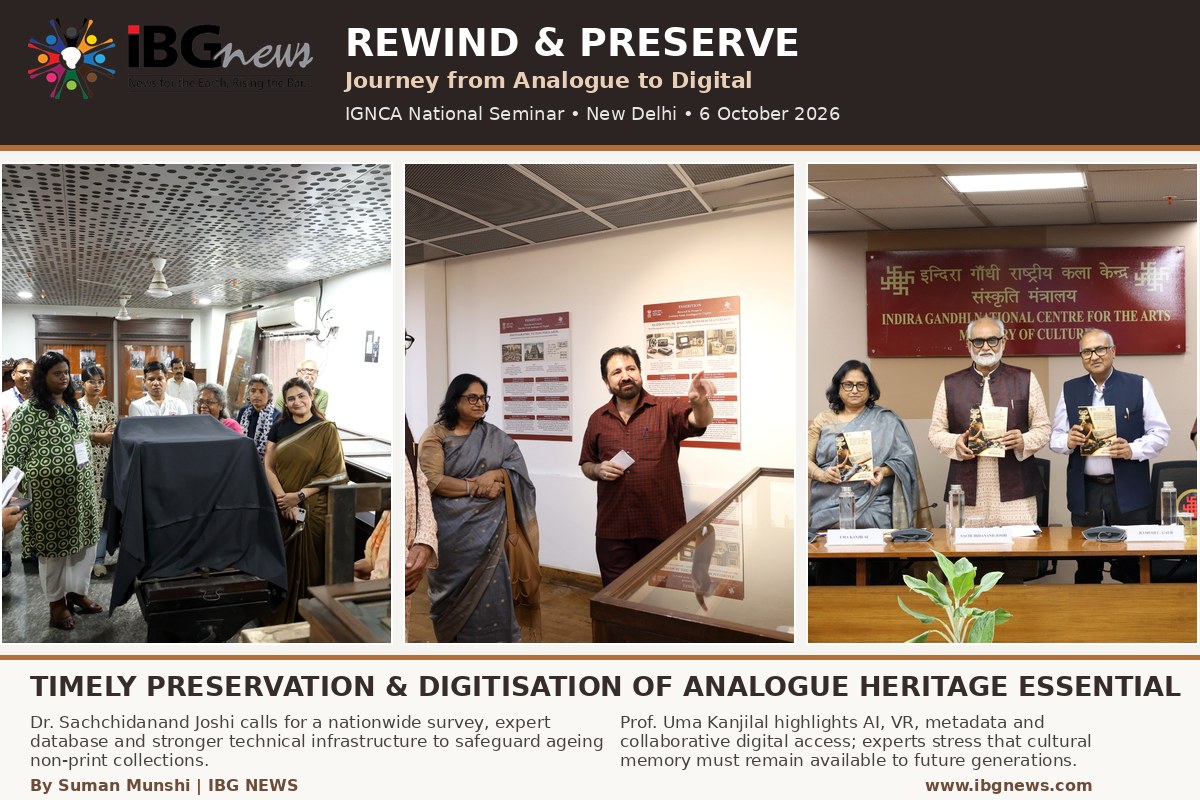
New Delhi, 6 October 2026: The urgent need to preserve, document and digitise India’s rapidly ageing analogue cultural heritage was highlighted at a national seminar organised by the Kalanidhi Division of the Indira Gandhi National Centre for the Arts (IGNCA) in New Delhi.
The two-day National Seminar, titled “The Management of Non-Print Materials in Galleries, Libraries, Archives and Museums,” has brought together scholars, researchers, archivists, museum professionals and other specialists to examine the challenges associated with the preservation, documentation, digitisation and public dissemination of non-print and audio-visual heritage collections.
The inaugural session was attended by Prof. Uma Kanjilal, Vice Chancellor, Indira Gandhi National Open University (IGNOU), as Chief Guest. Dr. Sachchidanand Joshi, Member Secretary, IGNCA, chaired the session. Prof. (Dr.) Ramesh C. Gaur, Dean, South Asian University, attended as Guest of Honour, while Prof. K. Anil Kumar, Head, Kalanidhi Division, IGNCA, delivered the welcome address. The seminar is being coordinated by Shri Verender Bangroo.
The programme began with the inauguration of an exhibition titled “Rewind & Preserve: Journey from Analogue to Digital,” highlighting the transformation of heritage materials from traditional analogue formats to digitally preserved resources.
Analogue Heritage Requires Immediate Action
In his chair’s remarks, Dr. Sachchidanand Joshi described non-print collections as an important repository of India’s cultural memory. He stressed that many analogue formats face deterioration because of their limited physical lifespan, while the technologies required to access older formats are also becoming obsolete.
Dr. Joshi called for a systematic national effort to identify and preserve such materials before they become inaccessible. He proposed a nationwide survey to determine the nature, volume and physical condition of existing non-print collections, along with the creation of a national database of experts capable of undertaking specialised preservation and digitisation work.
He also emphasised the importance of making appropriate technical infrastructure available and suggested that IGNCA could play a leading role in developing a coordinated national framework for the preservation of obsolete and ageing media.
According to him, a central facility dedicated to the digitisation of old and obsolete formats could significantly strengthen India’s preservation capabilities. Greater cooperation between cultural institutions is also necessary so that digitised collections can ultimately be made accessible to researchers, the public and future generations.
He described the “Rewind & Preserve: Journey from Analogue to Digital” exhibition as a significant step towards increasing awareness of these preservation challenges.
Technology Can Expand Access to Cultural Knowledge
Speaking at the event, Prof. Uma Kanjilal underlined that preservation should not be restricted to protecting the physical medium. The knowledge, information and cultural narratives contained within photographs, recordings, films and other non-print materials must also remain accessible.
She called for preservation, documentation, metadata creation, digitisation and digital access to be developed as interconnected components of a comprehensive heritage-management system.
Prof. Kanjilal also pointed to the potential of Artificial Intelligence (AI), Virtual Reality (VR) and other emerging technologies to make cultural resources more accessible across languages and geographical boundaries.
She stressed the importance of connecting collections currently distributed among different institutions and developing a national cultural knowledge system that can enable wider discovery and use of India’s heritage resources.
Among the priorities she identified were a national survey and registration of non-print collections, standardised metadata practices and the development of trained professionals capable of managing these resources.
Prof. Kanjilal further suggested that IGNCA and IGNOU could collaborate on specialised training programmes and micro-credential courses in preservation, digitisation and archival management.
She emphasised that cultural heritage preservation increasingly requires collaboration, networking and shared infrastructure rather than isolated institutional efforts.
Kalanidhi Can Emerge as a National Cultural Resource Centre
Prof. Ramesh Chandra Gaur highlighted the distinctive position of the Kalanidhi Division, which brings together the domains of museums, libraries, archives and galleries within an integrated framework.
He suggested that this integrated approach could provide a foundation for developing a major national centre for cultural resources.
Prof. Gaur stressed that the cataloguing, preservation, digitisation and online accessibility of non-print collections have become immediate priorities. He pointed to several challenges confronting museums and archives, including shortages of trained specialists, inconsistent metadata practices and limited access to modern technological infrastructure.
He also called for greater attention to materials generated during earlier exhibitions, including their preservation and conversion into virtual resources. Improved access to specialists, together with stronger promotion and dissemination mechanisms, would help cultural institutions derive greater value from their collections.
He noted that cultural heritage should not be viewed solely as something belonging to the past. It is equally relevant to contemporary society and future generations, making timely digitisation and wider accessibility essential.
Focus on Sustainable Management of Non-Print Collections
In his welcome address, Prof. K. Anil Kumar welcomed the participating scholars, experts and delegates and outlined the importance of the seminar’s central theme.
He stressed that the growing volume and diversity of non-print heritage materials require systematic approaches to their preservation and management. Audio-visual recordings, photographs and other cultural documents represent an important part of India’s institutional and cultural memory and require specialised methods for conservation, documentation and dissemination.
The seminar provides a platform for examining how non-print collections are changing and how institutions can manage their transition from traditional analogue formats to sustainable digital resources.
The accompanying “Rewind & Preserve: Journey from Analogue to Digital” exhibition offers visitors a visual perspective on this technological and archival transformation.
The National Seminar will continue on 7 October 2026 from 10:00 a.m., with further discussions examining various dimensions of the preservation, management, digitisation and accessibility of non-print cultural materials.
By Suman Munshi
IBG NEWS

