















AKSI Aerospace unveils 300-km combat UAV, highlighting India’s push for indigenous drone technology
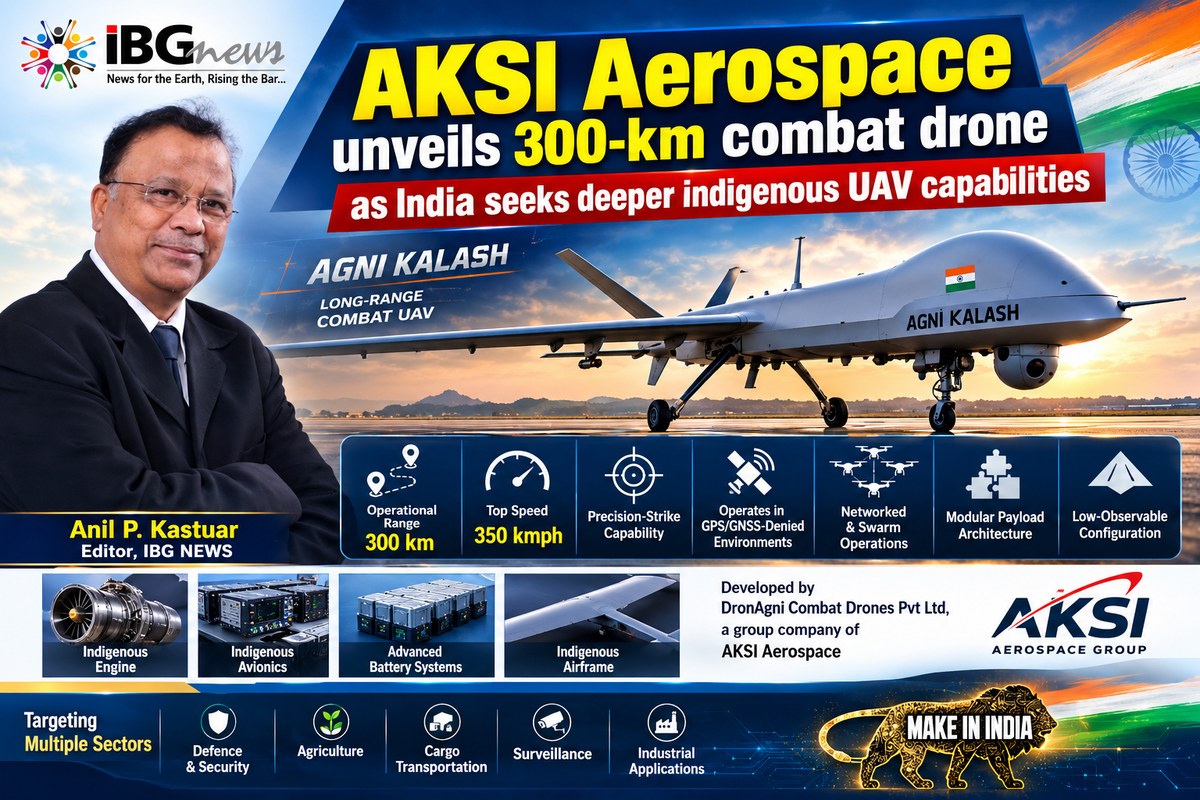
Hyderabad, October 2026: India’s growing focus on self-reliance in unmanned aerial systems has received a fresh boost with Hyderabad-based AKSI Aerospace Group unveiling Agni Kalash, a long-range combat unmanned aerial vehicle (UAV) capable of operating at distances of up to 300 km and reaching a maximum speed of around 350 kmph.
The combat UAV was formally inaugurated by Andhra Pradesh Chief Minister N. Chandrababu Naidu at the PanIIT Andhra Pradesh Summit 2026 in Vijayawada. The platform has been developed by DronAgni Combat Drones Pvt. Ltd., a group company of AKSI Aerospace.
Designed for precision missions
Agni Kalash has been developed for long-range precision-strike operations and incorporates a range of advanced capabilities aimed at enhancing its operational flexibility. According to the company, the UAV features autonomous navigation, modular payload architecture and the ability to function in environments where GPS/GNSS signals are unavailable or disrupted.
The platform is also being designed to support network-centric and swarm-based operations, while its low-observable configuration is intended to improve survivability in contested environments.
A major emphasis has been placed on indigenous technology. AKSI Aerospace said that key systems—including the engine, avionics, battery technology and airframe—incorporate domestically developed capabilities.
Its modular architecture allows the UAV to be adapted for different operational requirements by integrating mission-specific payloads and configurations.
Focus shifts from assembly to technology ownership
The unveiling comes at a time when India is seeking to strengthen domestic capabilities in drones and other unmanned systems while reducing dependence on imported technologies and components.
Industry experts believe that the next stage of growth in India’s UAV sector will depend not merely on assembling complete drones but on developing and controlling critical technologies such as propulsion, avionics, energy-storage systems and autonomous flight systems.
Pankaj Akula, Group Managing Director and Chief Technologist, AKSI Aerospace Group, said the long-term strategic strength of India’s drone industry would increasingly depend on domestic ownership of the technologies and components that power UAV platforms.
Building an indigenous UAV ecosystem
AKSI Aerospace said its nine group companies are working across several technology segments, including propulsion systems, batteries and battery-management systems, avionics, autopilots, motors and composite structures.
The group is pursuing a broader strategy to develop an integrated Indian UAV ecosystem serving multiple sectors. Besides defence and security applications, its technology portfolio is being positioned for potential use in agriculture, cargo transportation, surveillance and industrial operations.
The development of Agni Kalash therefore represents more than the introduction of another UAV platform. It reflects the wider industry effort to establish a domestic design, technology and manufacturing base for unmanned aerial systems, supporting India’s ambitions for greater technological self-reliance and resilient supply chains.
— Anil P. Kastuar
Editor, IBG NEWS

