














India Challenges OHCHR Over Alleged Double Standards in Global Human Rights Scrutiny
India Questions Selective Criticism, Western Funding Influence and Uneven International Attention to Human Rights Concerns
By Anil P. Kastuar, Editor, IBG NEWS
NEW DELHI, October 11, 2026: India’s latest diplomatic objection to comments by the United Nations human rights office over the detention of protesters in New Delhi has renewed a wider debate about impartiality, accountability and consistency in international human rights monitoring.
The central question raised by India’s position is whether the Office of the United Nations High Commissioner for Human Rights (OHCHR) applies comparable standards when examining democratic states with open media environments and countries where access to information is restricted.
The issue has gained renewed attention following the detention of demonstrators associated with the Cockroach Janta Party (CJP) movement during protests demanding the resignation of Chief Election Commissioner Gyanesh Kumar. The demonstrations were linked to allegations concerning revisions to electoral rolls. Indian authorities have cited public-order considerations, while critics have questioned the scale of the security response.
The OHCHR expressed concern over the reported detentions and called for respect for peaceful assembly. India rejected the intervention as interference in domestic affairs, arguing that the UN body had displayed selectivity in its public criticism. <Cite refs={[“turn294485news55″,”turn294485news49”]}/>
Funding and Influence: A Question of Institutional Independence
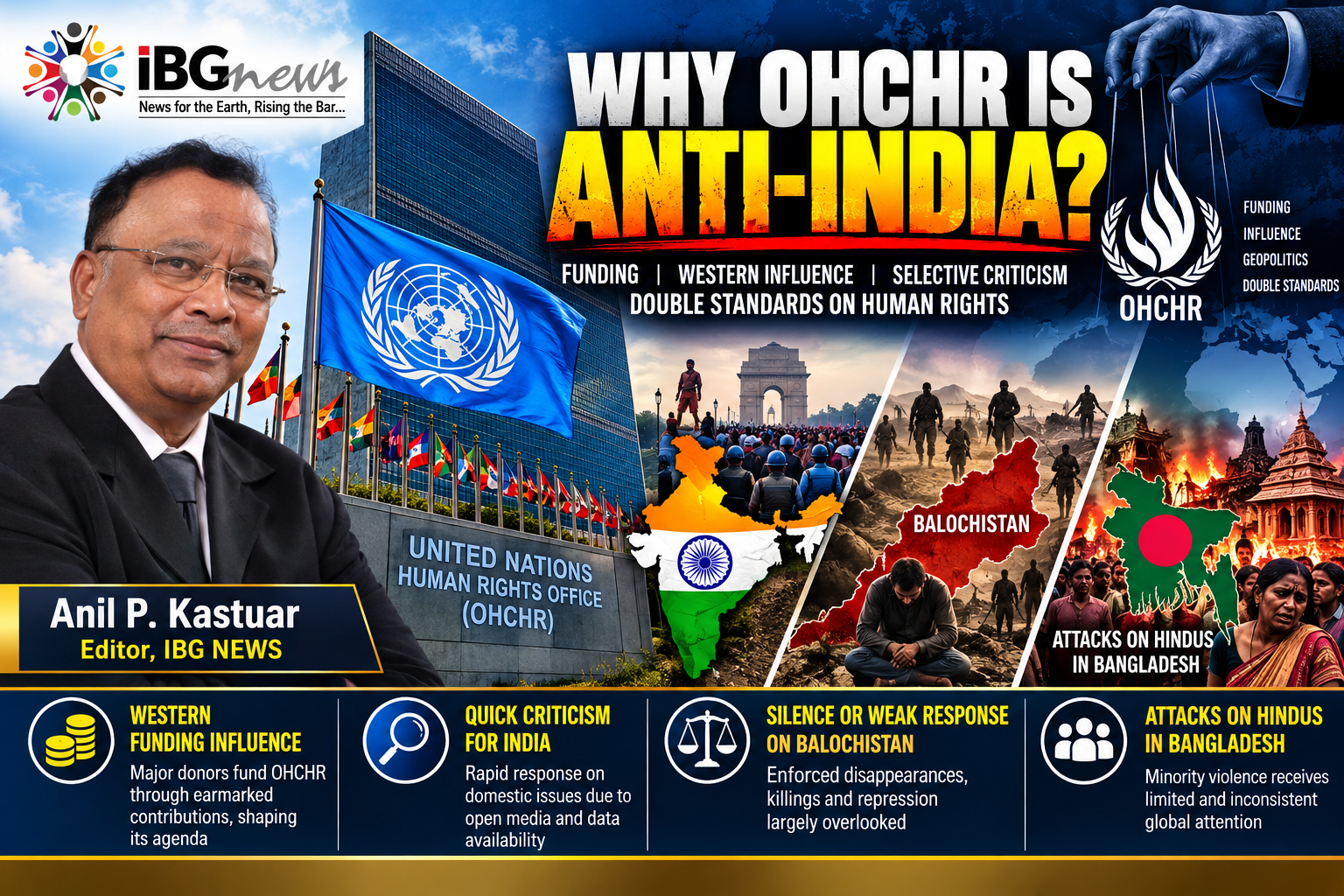
One of the principal criticisms directed at the OHCHR concerns its financial structure and the potential influence of major donors on international priorities.
The office receives funding through the UN regular budget as well as voluntary contributions from member states and other donors. Its published 2021 funding information indicated that approximately 35 per cent of its income came from the regular budget, while nearly two-thirds came from voluntary contributions. Some voluntary funding is earmarked for specific programmes or activities. <Cite refs={[“turn294485search61”]}/>
Critics argue that this funding model can create an imbalance in the allocation of resources and attention, particularly when donor governments attach conditions to their contributions. They contend that countries with greater financial influence may have greater capacity to support particular investigations, regional initiatives or thematic priorities.
However, the existence of earmarked funding does not, by itself, establish that donor governments control the OHCHR’s findings or direct its criticism of individual countries. Demonstrating such influence would require evidence connecting specific funding decisions to particular investigative or public-communications outcomes.
The broader institutional question remains whether the UN human rights system has sufficient financial independence and transparent safeguards to ensure that its priorities are determined by evidence and human rights obligations rather than geopolitical considerations.
Does India Face a Different Standard?
India’s criticism centres on what it considers an imbalance between the speed and intensity of international scrutiny directed at New Delhi and the attention given to alleged abuses elsewhere in South Asia.
The Indian argument is that an open society generates extensive public records, media reporting, court proceedings and civil-society documentation. These sources can make allegations easier for international organisations to identify and assess.
By contrast, in territories where independent reporting is restricted, access is limited or information is difficult to verify, documenting alleged abuses can be substantially more challenging.
This difference in access may affect the speed with which international bodies respond. Nevertheless, limited access does not necessarily mean that an institution is deliberately protecting a particular government. Assessing whether a double standard exists requires comparisons of the evidence available, the seriousness of the alleged violations, the responses issued and the follow-up undertaken.
For India, the relevant challenge is to ensure that international scrutiny also examines alleged abuses in Pakistan-administered areas of Jammu and Kashmir and other parts of the region, including restrictions on political expression, minority rights and freedom of association.
Jammu and Kashmir: A Longstanding Diplomatic Dispute
The disagreement between India and the OHCHR is not new.
In June 2018, the UN human rights office published its first comprehensive report on human rights conditions in Indian-administered Jammu and Kashmir and Pakistan-administered Kashmir. An updated report followed in July 2019.
The reports raised allegations concerning excessive use of force, arbitrary detention and accountability in Indian-administered Kashmir. They also documented concerns about restrictions on expression and association, discrimination against minorities and the use of anti-terror legislation in Pakistan-administered areas. The office made recommendations to both governments. <Cite refs={[“turn294485search60”]}/>
India rejected the reports, questioning their methodology, evidentiary basis and treatment of cross-border terrorism. New Delhi has consistently maintained that terrorism originating from across the border is central to understanding the security situation in Jammu and Kashmir and should not be separated from assessments of human rights.
The dispute highlights the difficulty of reconciling national security concerns with international demands for transparency, independent investigations and accountability.
A credible assessment must examine allegations against all relevant actors, including state security forces and armed groups, while distinguishing documented findings from disputed claims.
Citizenship, Foreign Funding and Domestic Legislation
India’s disagreements with international human rights institutions have also extended to domestic legislation.
During the debate surrounding amendments to the Foreign Contribution Regulation Act (FCRA) in 2020, the UN human rights leadership expressed concerns that restrictions on foreign funding could affect civil-society organisations and human rights groups.
India’s position has been that foreign financial contributions must be regulated to protect transparency, prevent misuse and safeguard national interests. Critics of the restrictions, meanwhile, have argued that overly broad regulation could constrain legitimate civil-society activity.
A similar disagreement emerged over the Citizenship Amendment Act (CAA). The OHCHR publicly raised concerns about the legislation’s discriminatory implications and sought to intervene in proceedings before India’s Supreme Court. India objected, maintaining that citizenship legislation is a sovereign matter and challenging the appropriateness of external intervention in domestic judicial proceedings.
These controversies reflect a recurring disagreement over the relationship between national sovereignty, domestic legal authority and international human rights oversight.
Kashmir and Manipur: Competing Assessments
International commentary on Jammu and Kashmir and Manipur has also drawn objections from Indian authorities, who have argued that external assessments do not adequately reflect the country’s security challenges, institutional processes or developments on the ground.
The Indian position stresses that assessments should take account of democratic institutions, judicial remedies, development programmes and security threats. Human rights advocates, however, maintain that development and security considerations do not remove the need to investigate specific allegations of abuse.
The credibility of either position depends on evidence. Government explanations require scrutiny, while international reports must demonstrate methodological transparency, reliable sourcing and consistent standards.
Balochistan: Enforced Disappearances and the Demand for International Accountability
Another critical test of the international human rights system lies in Balochistan, Pakistan, where allegations of enforced disappearances, extrajudicial killings, arbitrary detention and restrictions on peaceful political activity have repeatedly attracted concern from human rights organisations.
UN human rights experts have called on Pakistan to address alleged violations arising from counter-terrorism operations in the province. They have raised particular concern about the disappearance of activists, the treatment of peaceful demonstrators and restrictions on freedom of expression, assembly and association. The experts have also acknowledged the threat posed by armed groups and stressed that counter-terrorism operations must comply with international human rights and humanitarian law. <Cite refs={[“turn491868search0″,”turn491868search3”]}/>
These concerns raise an important question for the international community: are investigations, public statements and accountability mechanisms producing meaningful protection for affected communities?
Families searching for missing relatives require credible investigations, information about the fate and whereabouts of disappeared persons, and access to justice. Peaceful political activists and journalists must also be able to exercise their rights without fear of intimidation or unlawful detention.
The issue is not whether the United Nations has ever spoken about Balochistan—it has. The more substantive question is whether international attention, diplomatic pressure and follow-up measures have been adequate to address the scale and persistence of the allegations.
India’s argument for consistent international scrutiny would be strengthened by demanding the same evidentiary standards and accountability mechanisms for alleged violations in Balochistan as those applied to allegations involving Indian authorities. Human rights principles cannot credibly be treated as dependent on geopolitical convenience.
Bangladesh’s Hindus: Attacks on Minorities and the Question of Equal Protection
The situation of Hindu minorities in Bangladesh presents another important test of the international community’s commitment to protecting religious minorities.
Following Bangladesh’s political upheaval in August 2024, Hindu communities and other minority groups reported attacks on homes, businesses and places of worship, alongside intimidation and insecurity. The scale, circumstances and motivations of individual incidents have varied, making careful investigation essential. Nevertheless, credible reports of violence against minority communities warrant sustained attention and effective action by the authorities.
In February 2025, the UN Human Rights Office published findings on serious abuses committed during and after the 2024 protests. Its report documented human rights abuses affecting Hindus, Ahmadiyya Muslims and Indigenous people in the Chittagong Hill Tracts. It also noted that perpetrators of some attacks on minority and Indigenous communities continued to enjoy impunity. <Cite refs={[“turn491868search4″,”turn491868search5”]}/>
These findings make it inaccurate to claim that the UN has entirely ignored violence against Hindus in Bangladesh. They do, however, provide a basis for asking whether the international response has been sustained, proportionate to continuing risks and accompanied by effective monitoring of investigations and prosecutions.
The protection of religious minorities should not depend on the political orientation of a government or the strategic importance of a country. Hindu families who lose homes, businesses or access to places of worship deserve the same protection and access to justice as members of any other religious community. Allegations of targeted violence must be investigated impartially, and perpetrators should be held accountable through lawful procedures.
India and other concerned governments can legitimately press for transparent reporting on attacks, protection for vulnerable communities, independent investigations and regular updates on prosecutions. Such demands should be grounded in documented incidents and should avoid attributing collective responsibility to entire religious or national communities.
The Larger Question: Is International Scrutiny Consistent and Effective?
Taken together, the issues surrounding Balochistan, minority protection in Bangladesh and India’s disagreements with the OHCHR point to a broader challenge for the international human rights system.
The standard of scrutiny should be consistent across borders. Allegations against India must be examined on their evidence, just as allegations concerning Pakistan and Bangladesh must receive serious, sustained and impartial attention.
A credible system must go beyond issuing statements. It should explain the evidence behind its assessments, identify gaps in access to information, monitor the implementation of recommendations and report transparently on whether alleged violations are investigated and remedied.
The appropriate measure of international engagement is therefore not simply how frequently the UN criticises one country compared with another. It is whether comparable violations receive impartial investigation, meaningful public attention and effective follow-up, regardless of political alliances.
For India, the case for consistency is strongest when it demands both fair treatment in international assessments and equal protection for vulnerable communities throughout South Asia. For the United Nations, demonstrating impartiality requires a sustained commitment to those principles in practice.
Can the UN Human Rights System Improve Its Credibility?
The controversy points to several areas in which international human rights monitoring could strengthen public confidence.
First, greater funding transparency: The OHCHR could make it easier to assess how earmarked contributions influence programme priorities and how safeguards protect investigative independence.
Second, consistent regional scrutiny: Comparable allegations should receive proportionate attention regardless of the country involved, the identity of the alleged perpetrators or their strategic relationships with major powers.
Third, transparent evidentiary standards: Public statements should clearly distinguish verified information, allegations, preliminary assessments and conclusions reached after investigation.
Fourth, stronger follow-up: International institutions should explain what action they take when access is denied, evidence is incomplete or governments do not respond to requests for information.
Finally, meaningful engagement with governments: Dialogue should allow states to challenge factual errors and provide additional evidence without preventing independent scrutiny of credible allegations.
These measures would help address concerns about selectivity while protecting the independence of international human rights institutions.
Conclusion: Sovereignty and Accountability Must Coexist
India’s objections to the OHCHR raise a fundamental question about the legitimacy of international human rights monitoring: can global institutions maintain public confidence if their responses appear inconsistent across countries and regions?
Concerns about donor influence, uneven access to information and geopolitical considerations deserve examination. At the same time, claims of institutional bias must be supported by evidence rather than inferred solely from the existence of Western funding or differences in public reporting.
For India, the demand is for consistent scrutiny of alleged human rights violations across South Asia, including those attributed to state authorities and non-state armed groups. For the OHCHR, the challenge is to demonstrate that its decisions are guided by reliable evidence, transparent methods and universal standards.
Ultimately, respect for national sovereignty and accountability for human rights violations need not be opposing principles. A credible international system must recognise legitimate security concerns while applying its standards impartially, transparently and consistently.
Anil P. Kastuar
Editor, IBG NEWS
Editorial note: This article presents India’s stated objections and the arguments advanced by critics of the OHCHR. Allegations of systematic institutional bias or donor-directed investigations are not established merely by the funding structure. Readers should distinguish official positions, documented reports and analytical interpretations.

