

















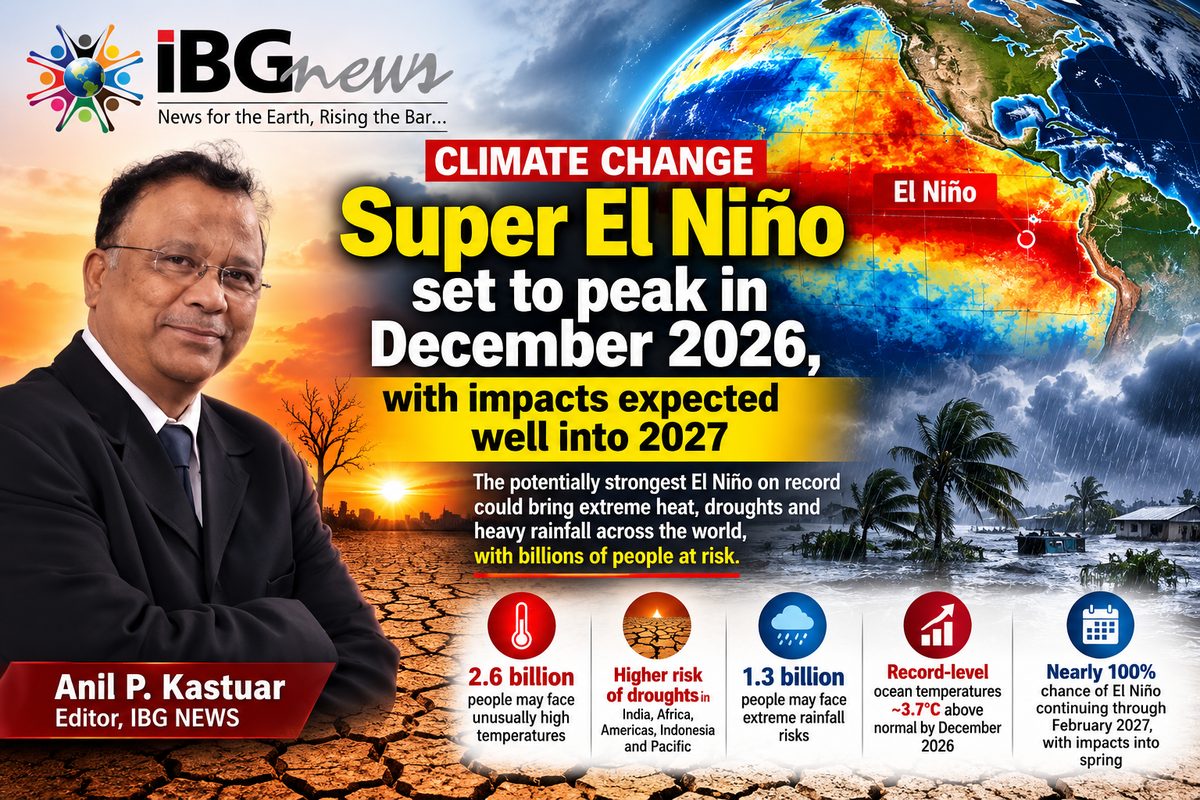
Super El Niño May Peak in December 2026, Raising Global Climate Risks Through 2027
Record Pacific Ocean temperatures could intensify extreme heat, droughts and heavy rainfall, putting billions of people at risk
By Anil P. Kastuar, Editor, IBG NEWS
A powerful El Niño event developing in the equatorial Pacific Ocean could become the strongest on record since observations began in 1950, with the World Meteorological Organization (WMO) forecasting a possible peak around December 2026. The event is expected to influence global weather patterns well into 2027, raising concerns about extreme heat, prolonged droughts and intense rainfall across several regions.
According to the WMO, sea-surface temperatures in the central and eastern tropical Pacific are continuing to rise, with the seasonal temperature anomaly in the Niño 3.4 region projected to reach approximately 3.7°C above normal during October–December 2026. If the forecast materialises, it would significantly exceed the previous record anomaly of approximately 2.6°C recorded during November 2015–January 2016.
Climate scientists have warned that the rapidly intensifying event could have far-reaching consequences for communities, ecosystems, agriculture and economies worldwide.
Pacific Ocean Temperatures Reach Unprecedented Levels
The Niño 3.4 region, a key monitoring zone in the equatorial Pacific, is widely used to assess the strength of El Niño. Recent observations indicate that ocean temperatures in this region have risen to exceptional levels.
Climate scientist Zeke Hausfather of Berkeley Earth, a lead author of the Intergovernmental Panel on Climate Change’s Seventh Assessment Report, reported that Niño 3.4 temperature anomalies had reached around 3.4°C above normal. He also noted that the September 2026 monthly anomaly reached 2.9°C, surpassing previous records cited in his assessment.
Sea-surface temperatures in the region also crossed 30°C for the first time in the observational record, reaching 30.06°C on October 5, according to the US National Oceanic and Atmospheric Administration’s Optimum Interpolation Sea Surface Temperature dataset.
The pace of intensification has been particularly striking. The WMO’s monthly Global Seasonal Climate Update reported that the Niño 3.4 temperature anomaly increased from an average of 1.6°C above normal in June 2026 to 2.5°C in August.
These developments suggest that the current event is strengthening rapidly and could establish a new benchmark for observed El Niño intensity.
December Peak Could Intensify Global Weather Extremes
The WMO expects the current El Niño to reach its strongest phase around December 2026. The anticipated peak could alter temperature and rainfall patterns across large parts of the world.
However, scientists caution that the global influence of El Niño will not be uniform. Some regions may experience unusually high temperatures, while others could face excessive rainfall, flooding or prolonged dry spells.
Meteorologist Ben Noll has estimated that approximately 2.6 billion people could experience unusually high temperatures for the time of year through December.
The projected effects are especially concerning because the event is developing against a background of exceptionally warm ocean conditions. Higher temperatures can increase heat-related health risks, place additional pressure on water supplies and worsen agricultural stress in vulnerable regions.
Drought Threats Across India and Other Regions
Several regions could face persistent or intensifying dry conditions as the El Niño event develops.
According to Noll’s assessment, drought risks include Central America, northern and southern South America, and Indonesia. Exceptionally dry conditions are also possible in parts of Africa, India, the Pacific Northwest and Canada, several South Pacific islands, and northern and eastern New Zealand.
For India, the potential consequences deserve close attention because changes in rainfall patterns can affect agriculture, reservoir levels, water availability and rural livelihoods. The actual impact will depend on regional weather conditions and the evolution of the monsoon and other seasonal systems.
El Niño is associated with shifts in atmospheric circulation and rainfall distribution, but it does not guarantee drought in every affected country. Regional forecasts and local observations will remain essential for assessing the extent of the risk.
Heavy Rainfall Could Affect Billions
While some regions may experience drought, others could face unusually heavy rainfall and associated flooding.
Noll has warned that approximately 1.3 billion people could be exposed to extreme rainfall risks through December 2026. Areas identified as potentially vulnerable include the southern and eastern United States, large parts of South America, western and southern Europe, sections of Africa, the Middle East, central and eastern Asia, and southern Australia.
Such rainfall extremes can threaten homes, transport networks, agricultural land and essential infrastructure. Their consequences will depend on local preparedness, drainage capacity, soil conditions and the interaction of El Niño with other weather systems.
The contrasting risks of drought and heavy rainfall illustrate the complexity of El Niño: its influence varies considerably from one region to another.
WMO Warns of Persistence Into 2027
The WMO has indicated an almost 100 per cent likelihood that El Niño will persist through February 2027. Its influence on weather patterns could continue into the following spring, although the timing and intensity of regional impacts remain uncertain.
WMO Secretary-General Celeste Saulo has warned that the event is firmly established and strengthening rapidly, with forecasts pointing to the possibility of one of the strongest El Niño episodes since at least 1950.
Speaking at the Global Heat Forum in Bangkok, Saulo explained that El Niño does not create additional heat from nothing. Instead, it alters the distribution of heat already stored in the ocean, releasing more of that energy into the atmosphere and influencing global temperatures.
She also highlighted the significance of exceptionally warm ocean conditions, which mean that more stored heat is available to be released during a strong event.
Climate Preparedness Becomes Increasingly Important
The possible emergence of a record-strength El Niño places renewed emphasis on early warning systems, climate monitoring and disaster preparedness.
Governments and local authorities in potentially affected regions may need to strengthen heat-health measures, monitor water availability, prepare for agricultural stress, and improve flood-readiness where intense rainfall is forecast.
Farmers, water managers, emergency services and public-health agencies will be particularly dependent on reliable seasonal and regional forecasts. The ability to translate climate projections into timely local action could help reduce losses and protect vulnerable communities.
Although El Niño is a natural climate phenomenon, its effects unfold within a world already experiencing long-term global warming. The interaction between natural climate variability and elevated background temperatures can make the consequences of a strong event especially significant.
A Critical Climate Phase Ahead
The projected December 2026 peak could mark a major turning point in the current El Niño episode. With record Pacific Ocean temperatures, widespread heat concerns and the possibility of severe rainfall and drought in different regions, the coming months could test the preparedness of governments and communities across the globe.
The WMO’s outlook suggests that the event may remain influential well into 2027. Nevertheless, the precise severity and geographical distribution of its impacts will depend on how the event evolves and how regional weather systems respond.
For billions of people, the central challenge will be to prepare for a climate period in which extreme heat, water scarcity and flooding may occur in different parts of the world at the same time.
Anil P. Kastuar
Editor, IBG NEWS

