










Bharat’s Global Cultural Connections Take Centre Stage at International Conference in New Delhi
PM Narendra Modi highlights centuries of cultural exchange, while Union Culture Minister Gajendra Singh Shekhawat calls for global research partnerships to preserve shared heritage
By Suman Munshi | IBG NEWS
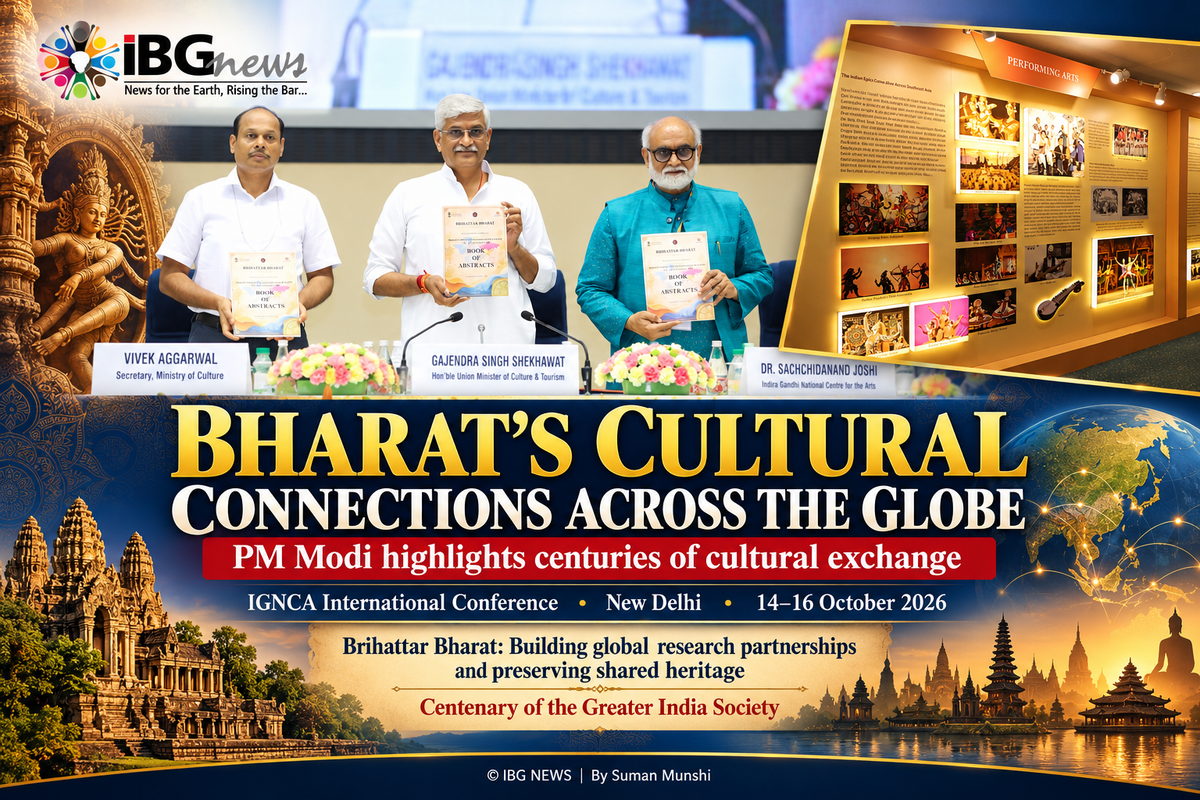
NEW DELHI, October 14, 2026: India’s centuries-old cultural links with Asia and other parts of the world are the focus of a three-day international conference inaugurated at Vigyan Bhawan, New Delhi, on October 14. Organised by the Indira Gandhi National Centre for the Arts (IGNCA) under the Ministry of Culture, the conference, titled Bharat’s Cultural Connections Across the Globe, will continue until October 16, bringing together scholars, researchers, diplomats and cultural experts from India and abroad.
Union Minister of Culture and Tourism Gajendra Singh Shekhawat inaugurated the conference, which seeks to renew international academic interest in India’s historical cultural relationships and promote collaborative research into shared civilisational heritage. Prime Minister Narendra Modi conveyed his best wishes to the participants through a message read by Vivek Aggarwal, Secretary, Ministry of Culture, who also delivered the introductory address.
PM Modi Highlights India’s Legacy of Cultural Exchange
In his message, the Prime Minister described India’s civilisational history as a long journey of cultural interaction, knowledge-sharing and intellectual exchange. He highlighted the contribution of ancient learning centres such as Nalanda in connecting India with other parts of Asia.
Buddhist monks, scholars, traders and travellers played a significant role in carrying Indian ideas and traditions across geographical boundaries through land and maritime routes. These exchanges helped shape relationships between societies and contributed to the movement of knowledge, philosophy and artistic traditions across regions.
The Prime Minister also noted that Indian philosophy, music, dance, literature, cinema and cuisine continue to connect people around the world. The international popularity of yoga and the celebration of Indian festivals in different countries demonstrate how India’s cultural traditions remain relevant across generations and societies.
Highlighting the importance of the conference, Modi referred to the centenary of the Greater India Society, established in Calcutta on October 14, 1926. The organisation contributed to the study of India’s historical cultural and intellectual relationships with Asia and other regions.
He expressed hope that the conference would deepen understanding of these connections and encourage stronger international cultural cooperation.
‘Brihattar Bharat’ to Promote Research and Global Partnerships
Addressing the inaugural gathering, Union Minister Gajendra Singh Shekhawat said the Brihattar Bharat initiative offers an opportunity to examine how historical knowledge and cultural exchanges can inform the future.
He emphasised that Brihattar Bharat should be understood as a sphere of historical and cultural connections, rather than a political or territorial claim. Its purpose is to explore the movement of ideas, traditions, knowledge and artistic practices between India and other civilisations.
Shekhawat stressed that culture should serve as a bridge between societies, even when political differences or language barriers complicate relations. Evidence-based research, academic dialogue and international collaboration, he said, can foster mutual respect and a better understanding of shared heritage.
He called for the development of a dynamic, internationally connected research framework that would encourage scholars to document cultural links, exchange findings and establish lasting academic partnerships. The centenary conference, he added, should serve not only as a commemoration of a historic scholarly initiative but also as the beginning of renewed international cooperation in cultural studies.
Five-Year Programme to Explore India’s Cultural Links
Vivek Aggarwal outlined the objectives of the Brihattar Bharat Project, which seeks to bring India’s historical cultural connections to wider international recognition through collaborative research involving scholars from approximately 51 countries.
The initiative aims to investigate India’s contributions to global knowledge systems, languages, sciences, art and cultural traditions. Planned activities include joint research, seminars, workshops and structured academic exchanges under a five-year programme.
The project also envisages exploring multinational nominations of shared intangible cultural heritage for inclusion in UNESCO’s Representative List. Such cooperation could help document traditions that have evolved through centuries of interaction between different communities and countries.
Rooted in the Indian philosophy of Vasudhaiva Kutumbakam—the world is one family—the initiative seeks to advance cultural understanding, peace, unity and shared prosperity through academic cooperation.
IGNCA Highlights the Journey of Ideas Across Borders
Dr Sachchidanand Joshi, Member Secretary of IGNCA, said civilisations are shaped not only by territorial boundaries but also by the movement of people, ideas and collective memories.
Throughout history, merchants crossed mountains and seas, Buddhist monks and pilgrims travelled between sacred sites, scholars translated texts and exchanged knowledge, and artisans carried their skills and artistic traditions to distant regions. These interactions enabled cultures to learn from one another and evolve over time.
Joshi explained that the Brihattar Bharat initiative, undertaken through the Ministry of Culture’s International Cultural Relations framework and implemented by IGNCA, seeks to identify, document, preserve and make accessible the shared cultural heritage of Indian civilisation and selected countries.
The programme aims to examine these connections beyond modern political boundaries and highlight the historical interactions that have contributed to the cultural development of societies across the world.
Diplomats and Experts Join the Deliberations
A plenary session preceding the inauguration was chaired by Ambassador Shashank, former Foreign Secretary of India and former president of Antar Rashtriya Sahayog Parishad.
The session featured Lithuania’s Ambassador to India Diana Mickevičienė, Fiji’s High Commissioner to India Jagnnath Sami, Joint Secretary in the Ministry of Culture Lily Pandeya, and former diplomat and author T.C.A. Raghavan. Priyanka Chandra, Director of the International Cultural Relations Division in the Ministry of Culture, moderated the discussion.
An accompanying exhibition, titled Common Cultural Heritage of Asia, showcased historical and cultural links between India and other Asian countries. Shekhawat, Aggarwal and other distinguished guests visited the exhibition.
Dr Arvind Kumar, Joint Secretary in the Ministry of Culture, delivered the vote of thanks at the inaugural session. Professor Dharm Chand Choubey, Head of IGNCA’s Brihattar Bharat Division, was also present.
Ten Themes to Examine Shared Heritage
The conference will explore ten broad themes covering the historical and cultural relationships between India and other regions. These include philosophy, religion, languages, visual arts, textiles, cuisine, performing arts, trade and diaspora communities.
Organised under the Brihattar Bharat Scheme for 2026–2031, the initiative aims to strengthen international academic partnerships and advance research, documentation, digitisation and preservation of shared cultural resources.
The larger objective is to renew the scholarly legacy of the Greater India Society while creating a contemporary framework for international cultural research.
By bringing together historical evidence, interdisciplinary scholarship and global cooperation, the conference seeks to demonstrate how centuries of cultural interaction have shaped societies and continue to provide opportunities for dialogue and mutual understanding.
Source: Ministry of Culture, Government of India; Indira Gandhi National Centre for the Arts (IGNCA).

