















Human Life Must Come Before Ego: A Case for Better Emergency Healthcare and Stronger Public Hospitals
By Dr. Dhires Choudhury, Editor, IBG NEWS
KOLKATA | Opinion | Bijaya Dashami, 1433
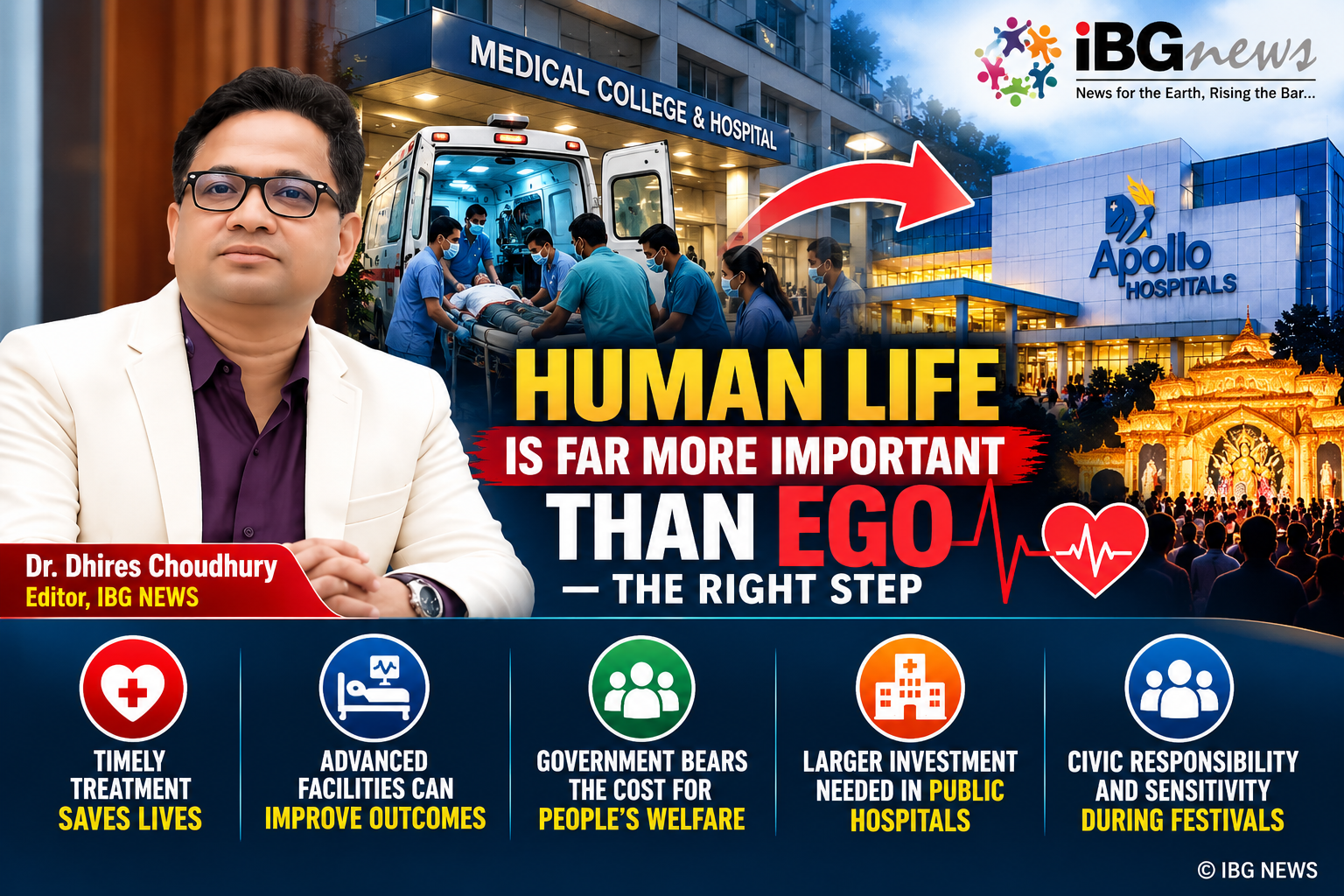
The controversy surrounding the transfer of injured victims of the Chorbagan incident from Medical College and Hospital to Apollo Hospital has sparked a wider debate about public healthcare, government responsibility and the role of private medical facilities during emergencies. While some have questioned the decision as a reflection of shortcomings in the state-run healthcare system, the more immediate question should be whether every possible step was taken to save the injured.
In my view, prioritising the lives of critically injured people over institutional pride or political considerations was a commendable and timely decision.
Saving Lives Must Be the First Priority
In a medical emergency, the foremost responsibility is to ensure that patients receive the best possible treatment without unnecessary delay. Even when highly qualified doctors are available, the absence of specialised equipment, advanced technology or adequate infrastructure can sometimes limit the treatment options available at a particular hospital.
Under such circumstances, transferring patients to a facility with more advanced capabilities should not automatically be interpreted as a failure. Rather, it should be seen as an effort to provide the best available chance of recovery.
If the government has taken responsibility for the cost of treatment at a private hospital, the central consideration should remain the welfare of the injured. When human lives are at stake, administrative boundaries and institutional egos must take a back seat.
The decision deserves to be judged primarily on whether it helped secure timely and appropriate medical care for the victims. Political disagreements should not overshadow this fundamental humanitarian principle.
Political Consistency and Equal Access to Healthcare
Those criticising the transfer, particularly political leaders, should also consider how they would respond if members of their own families faced a similar medical emergency.
People with financial resources and influence can often access specialised treatment at leading private hospitals, including facilities abroad. If they seek advanced medical care when necessary, why should ordinary citizens be denied comparable opportunities simply because they depend on the public healthcare system?
The issue is not whether government hospitals deserve confidence. They remain indispensable to millions of people. The issue is whether patients should be prevented from accessing better-equipped facilities when their medical condition demands it.
Ensuring access to appropriate treatment should transcend political affiliations. Supporting a decision on humanitarian grounds does not mean endorsing a political party; it means placing the value of human life above partisan considerations.
The Incident Highlights Gaps in Public Hospital Infrastructure
While the decision to transfer patients may deserve appreciation, it also raises an important question about the preparedness of government hospitals.
Excellent doctors need adequate infrastructure, modern diagnostic equipment, advanced life-support systems and sufficient emergency-care capacity to deliver the best possible outcomes. Medical expertise alone cannot compensate for every limitation in equipment and facilities.
The government must therefore treat this incident as an opportunity to strengthen the public healthcare system. Improvements should include modern medical technology, better-equipped emergency departments, critical-care capacity, trauma management facilities and coordinated arrangements for transferring patients when specialised treatment is required.
Previous administrations’ shortcomings cannot become a permanent justification for present-day deficiencies. The responsibility to improve healthcare infrastructure rests with the government in office, which must plan and act according to current public needs.
What If the Number of Injured Had Been Much Higher?
Another important consideration is the scale of the emergency. The transfer of patients may be manageable when the number of injured remains within the receiving hospitals’ available capacity. But what would happen if a similar incident resulted in hundreds of casualties?
Would the same strategy remain practical? Would sufficient beds, ambulances, specialists and critical-care facilities be available to accommodate everyone?
These questions underline the need for comprehensive emergency-response planning rather than relying solely on last-minute transfers between hospitals.
Government agencies and healthcare institutions must establish effective protocols for mass-casualty incidents, including patient triage, ambulance coordination, hospital-capacity assessment and rapid access to specialised treatment. Emergency preparedness must be designed for the possibility of a much larger disaster.
The lesson from this incident should extend well beyond the immediate response. Short-term arrangements are necessary, but lasting improvements in healthcare infrastructure are equally essential.
A Call for Greater Social Responsibility
There is also a broader social dimension that deserves attention. Despite the seriousness of the incident, public celebrations appeared to continue, with expressions of mourning seemingly limited to announcements over loudspeakers by the Puja organisers.
This observation is not a call to cancel religious festivals or prevent people from celebrating. Festivals are an important part of community life. However, when fellow citizens suffer a tragic incident, a degree of restraint, sensitivity and solidarity is surely reasonable to expect.
Public responsibility does not belong exclusively to the government, the police or the administration. Citizens, community organisations and event organisers also have a role in fostering a culture of empathy and civic awareness.
A society’s response to tragedy is reflected not only in official announcements but also in the conduct of its people. It is worth asking whether greater compassion and collective responsibility should become an integral part of our public culture.
The Way Forward: Compassion, Accountability and Reform
The Chorbagan incident presents several lessons that must not be lost amid political controversy.
First, emergency medical decisions must be guided by patients’ needs rather than institutional pride or political interests. Second, government hospitals must receive sustained investment in modern equipment, infrastructure and emergency-care capacity. Third, disaster-response systems must be prepared for incidents involving far greater numbers of casualties. Finally, society must recognise that compassion and civic responsibility are shared obligations.
The decision to transfer injured patients to a better-equipped facility, where appropriate, can be welcomed without overlooking the need to strengthen public hospitals. Both positions are compatible: saving lives immediately and improving the healthcare system for the future are complementary responsibilities.
Human life is more valuable than ego, political point-scoring or institutional prestige. The real measure of governance is not whether a decision avoids criticism, but whether it places people’s welfare first and leads to meaningful improvements.
The ultimate goal must be a healthcare system in which every citizen, regardless of financial status or political influence, can access timely, effective and high-quality emergency treatment.
© Dr. Dhires Choudhury | Bijaya Dashami, 1433
IBG NEWS | Opinion and Analysis
Add a stronger opening news hookReduce repetition around life-saving care

