















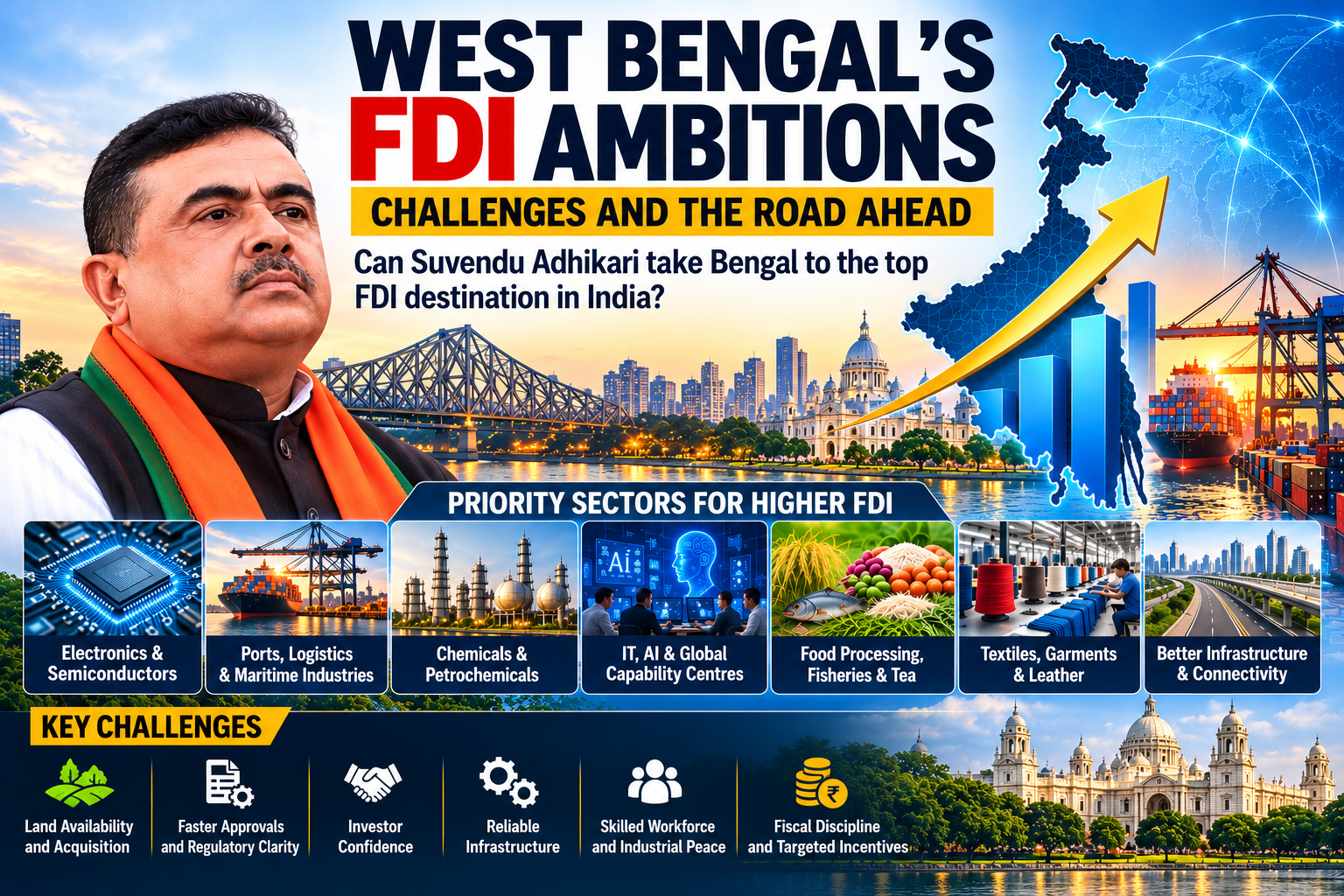

West Bengal’s FDI Ambitions: Key Challenges and Priority Sectors for Chief Minister Suvendu Adhikari
By Suman Munshi | IBG NEWS
KOLKATA, October 21, 2026: Attracting greater foreign direct investment (FDI) will be a major economic test for West Bengal Chief Minister Suvendu Adhikari as the state seeks to strengthen its industrial base, create employment opportunities and improve its position among India’s leading investment destinations. The challenge extends beyond attracting investor interest: the government must convert proposals into functioning industrial projects, sustained capital inflows, export growth and long-term employment.
West Bengal has several advantages that could support this ambition, including its strategic location in eastern India, access to the Bay of Bengal, Kolkata and Haldia port infrastructure, a large workforce, educational institutions and proximity to Bangladesh, Nepal, Bhutan and India’s northeastern region. However, these strengths need to be matched by efficient administration, reliable infrastructure, predictable policies and a business environment that gives investors confidence over the long term.
The central question for the new administration is how Bengal can compete more effectively with established investment destinations such as Maharashtra, Karnataka, Gujarat and Tamil Nadu.
West Bengal’s FDI position: A significant gap to address
The Department for Promotion of Industry and Internal Trade (DPIIT) publishes state-wise data on FDI equity inflows, offering an important indicator of foreign investment received in India.
According to the figures cited for April–June 2024, West Bengal received approximately ₹428.98 crore in FDI equity inflows, accounting for around 0.32% of the reported national total and placing the state ninth in that quarter’s state and Union Territory table. A separate cumulative series placed Bengal’s share at approximately 0.67% of recorded FDI equity inflows. These figures relate to different reporting periods and should not be interpreted as the state’s current annual ranking.
The comparison highlights the need for a sustained strategy to attract international capital. Maharashtra benefits from a strong financial and industrial ecosystem, Karnataka from its technology and research base, Gujarat from its manufacturing infrastructure, and Tamil Nadu from its diversified industrial supply chains.
West Bengal must develop a model suited to its own strengths while addressing the obstacles that influence investment decisions.
Investor confidence must become a government priority
Foreign investors assess policy stability, contract enforcement, regulatory transparency, labour relations, infrastructure and the time required to establish operations. Attractive incentives alone cannot compensate for uncertainty or prolonged administrative delays.
The state government should establish a clear industrial policy covering investment eligibility, land allotment, tax and other incentives, environmental approvals, utility connections and dispute resolution. Existing commitments should be handled transparently and in accordance with applicable law.
A dedicated investor-grievance mechanism, supported by fixed response deadlines and escalation to senior officials, could help businesses resolve administrative difficulties before they affect project implementation.
Building confidence will require consistent policy execution, not simply new announcements at investment summits.
Land availability and industrial development
Access to suitable industrial land remains a major consideration for large investment projects in West Bengal. High population density, fragmented ownership, agricultural dependence and the history of contentious land-acquisition disputes make the issue particularly sensitive.
The government should begin by identifying land already suitable for industrial development, including unused or underutilised industrial estates and sites that can be redeveloped. A verified digital land bank should disclose ownership status, permitted industrial use, access to utilities, environmental restrictions and transport connectivity.
Direct purchase, transparent land transactions, fair compensation and meaningful consultation with affected communities can help reduce conflict. Industrial expansion must also safeguard livelihoods and avoid treating agricultural land as an unlimited resource.
The objective should be to make industrial land more accessible without undermining public trust.
Electronics, semiconductors and advanced manufacturing
Electronics manufacturing offers West Bengal an opportunity to enter higher-value industrial supply chains. Potential areas include electronic components, printed circuit boards, electrical equipment, industrial sensors, telecommunications equipment, consumer electronics and electronics repair and refurbishment.
The state could also explore semiconductor-related opportunities in chip design, embedded systems, testing and packaging, subject to commercial feasibility and the availability of suitable infrastructure and partners.
Kolkata’s educational institutions and technical workforce could support design, engineering and research activities, while industrial locations with reliable power, water and transport connections could accommodate manufacturing and assembly.
Rather than attempting to establish an entire semiconductor manufacturing ecosystem immediately, the government should identify achievable entry points and prepare sector-specific proposals for prospective investors.
Ports, logistics and maritime industries
West Bengal’s geographical position and port infrastructure could provide a foundation for expanding logistics, export-oriented manufacturing and maritime services.
Kolkata and Haldia can support opportunities in cargo handling, warehousing, cold-chain logistics, ship repair, maritime engineering, freight services and port-linked industrial development. Improved multimodal connections could strengthen links between industrial centres, domestic markets and neighbouring countries.
In June 2026, discussions involving the Union government and the West Bengal Chief Minister referred to a proposed maritime investment pipeline of ₹19,209 crore by 2031, covering ports, inland waterways, shipbuilding, logistics and related infrastructure. The proposal was associated with more than 62,500 projected direct and indirect employment opportunities. These remain proposed investment and employment figures rather than confirmation that every project has been completed or fully funded.
The state should translate such proposals into a project-wise implementation plan with clear financing arrangements, construction milestones and accountability. Better last-mile road and rail connectivity, efficient cargo movement and modern warehousing will be essential to attracting investors.
Chemicals, petrochemicals and downstream industries
The Haldia industrial region offers potential for chemicals, petrochemicals, speciality chemicals, plastics, industrial materials and downstream manufacturing.
Investment promotion should focus on value-added production, local supplier development and the efficient use of existing industrial infrastructure. Reliable utilities, appropriate environmental safeguards, industrial safety systems and predictable regulatory procedures will be crucial.
A well-managed chemical and petrochemical ecosystem could attract both large companies and smaller manufacturers serving wider industrial supply chains.
Information technology, artificial intelligence and research
West Bengal can strengthen Kolkata’s position as a destination for information technology services, artificial intelligence, cybersecurity, financial technology, data analytics, software engineering and global capability centres.
These sectors offer opportunities for skilled employment and research-driven economic growth without the extensive land requirements associated with some heavy industries.
The government should work with universities, engineering colleges, research institutions and technology companies to create industry-linked training and recruitment programmes. Incentives should encourage substantial operations, local hiring and research and development rather than merely the registration of corporate offices.
Reliable electricity, high-speed connectivity, modern office infrastructure and a predictable business environment will be important to this effort.
Food processing, fisheries, tea and agro-industries
West Bengal’s agricultural and fisheries sectors provide a strong base for value-added investment. Potential opportunities include processed foods, seafood exports, dairy products, horticulture, packaged foods, cold storage and modern food-processing facilities.
North Bengal’s tea industry could benefit from premium packaging, branded products, value-added processing and expanded international distribution. Fisheries and aquaculture could attract investment in cold chains, traceability systems, quality testing and export-compliant processing.
Such investment should improve market access and raise the value earned by farmers, fishers, tea producers and small businesses, rather than relying primarily on the export of raw commodities.
Textiles, garments, leather and labour-intensive manufacturing
Industrial growth must generate employment across a broad range of skill levels. Textiles, garments, technical textiles, footwear, leather products, jute-based goods and related manufacturing could contribute to this objective.
The government should promote industrial clusters equipped with common facilities, testing laboratories, modern production infrastructure, design support and workforce training. Export assistance and reliable logistics would help local producers compete in domestic and international markets.
A balanced strategy combining technology-intensive sectors with labour-intensive manufacturing could expand employment opportunities for young people and strengthen small and medium-sized enterprises.
A genuinely effective single-window clearance system
A digital portal will have limited value if businesses still need to approach multiple departments separately to obtain routine permissions.
West Bengal should develop a coordinated approval system that assigns a responsible officer to each major project, establishes service timelines and provides transparent application tracking. Where possible, departments should process applications in parallel rather than sequentially.
The government could publish a dashboard showing approval times, pending applications, reasons for delays and the status of major projects. Simplified procedures and deemed approvals may be considered for legally eligible categories, while maintaining statutory environmental, safety and public-interest safeguards.
The performance of the system should be judged by how quickly compliant businesses can begin operations, not merely by the number of applications processed.
Skills, labour relations and industrial stability
Investors need access to skilled workers and confidence that industrial operations can continue without avoidable disruptions. The state should strengthen dialogue between employers and workers, improve dispute-resolution mechanisms and ensure consistent enforcement of labour laws.
Training programmes should be designed in consultation with employers and linked to actual vacancies in electronics, engineering, logistics, chemicals, food processing, textiles and information technology.
The government should measure the results through job placements, wages, training completion and employer feedback. This would help ensure that public spending on skills development translates into sustainable employment.
Fiscal discipline and infrastructure investment
Industrial infrastructure requires long-term funding, while the state must continue financing essential public services and welfare programmes. Investment priorities should therefore be selected according to their capacity to improve productivity, unlock private investment and generate employment.
Potential priorities include reliable electricity, industrial water supply, wastewater treatment, road and rail access, digital connectivity and climate-resilient infrastructure. Public-private partnerships could help finance suitable projects where the commercial model and allocation of risks are sound.
The government should avoid making incentive commitments that cannot be financed or sustained. A targeted and transparent incentive policy, linked to clear eligibility criteria and measurable economic benefits, would be more credible than an open-ended subsidy competition.
International outreach and strategic investor targeting
West Bengal needs a sustained investor-engagement programme focused on companies whose requirements match the state’s industrial strengths.
The government should prepare detailed investment proposals for prospective companies, providing verified information about land availability, infrastructure, suppliers, workforce skills, operating costs and market access. International outreach could focus on businesses involved in electronics, engineering, chemicals, logistics, food processing and digital services.
Existing foreign-invested companies should also be consulted regularly to identify operational problems and opportunities for expansion. Successful investors can become an important source of referrals and reinvestment.
The aim should be to attract companies that establish lasting operations rather than investors interested only in short-term incentives.
A five-year strategy with measurable targets
The government should introduce a five-year investment roadmap supported by annual targets and a publicly accessible performance dashboard.
The monitoring system should distinguish between investment proposals, signed memoranda of understanding, approved projects, projects under construction, actual investment disbursed and businesses that have commenced commercial production.
FDI equity inflows should be reported separately from domestic investment, loans, total project costs and announced commitments. Comparisons with other states should use the same reporting periods and definitions.
Additional indicators should include export growth, industrial land utilisation, approval times, new manufacturing capacity, participation by local suppliers and direct and indirect employment.
Such reporting would provide a more reliable picture of economic progress and help the government identify which policies are delivering results.
The first 100 days: Moving from policy to implementation
The administration could begin with a focused programme of practical reforms.
During the first 30 days, it could publish a verified inventory of industrial land, identify stalled projects and compile the most important regulatory obstacles reported by businesses.
Over the following 30 days, the government could define priority sectors, publish proposed incentive rules for consultation, assign responsibility for major projects and identify infrastructure gaps in key industrial clusters.
By the end of the first 100 days, it could establish an investor-grievance mechanism, publish approval timelines, begin structured outreach to target companies and disclose the implementation status of major proposed investments.
These steps would not transform the economy immediately, but they could provide tangible evidence of administrative commitment.
Conclusion: Converting Bengal’s potential into productive investment
Suvendu Adhikari’s economic challenge is to make West Bengal more competitive on the factors that determine whether investors commit capital: policy predictability, industrial land, efficient approvals, infrastructure, workforce skills, logistics and confidence in long-term operations.
The state has opportunities in maritime industries, chemicals, food processing, textiles, engineering and information technology, while electronics and advanced manufacturing could provide new avenues for diversification.
Industrial expansion must also deliver visible benefits to residents through employment, skills development, stronger local businesses and improved infrastructure. Economic growth will be more sustainable when investors and communities both see tangible results.
West Bengal need not promise to become India’s leading FDI destination overnight. It must demonstrate consistent improvement in attracting investment that is actually implemented, creating functioning businesses and generating sustainable jobs.
The ultimate measure of success will not be the number of investor meetings or MoUs signed. It will be the amount of productive capital invested, the number of projects that become operational, the growth of exports and the employment opportunities created for the people of West Bengal.
With transparent governance, carefully selected priority sectors and disciplined implementation, the state can work towards a stronger position in India’s investment landscape.
Data note: The FDI figures cited in this article relate to specific reporting periods and should not be treated as the latest full-year ranking. Investment announcements and projected employment are not equivalent to completed projects or realised investment.

