










Mumbai Airport Terminal 1 Redevelopment Targets 2030 Completion, Capacity to Reach 20 Million Passengers
By Suman Munshi | IBG NEWS
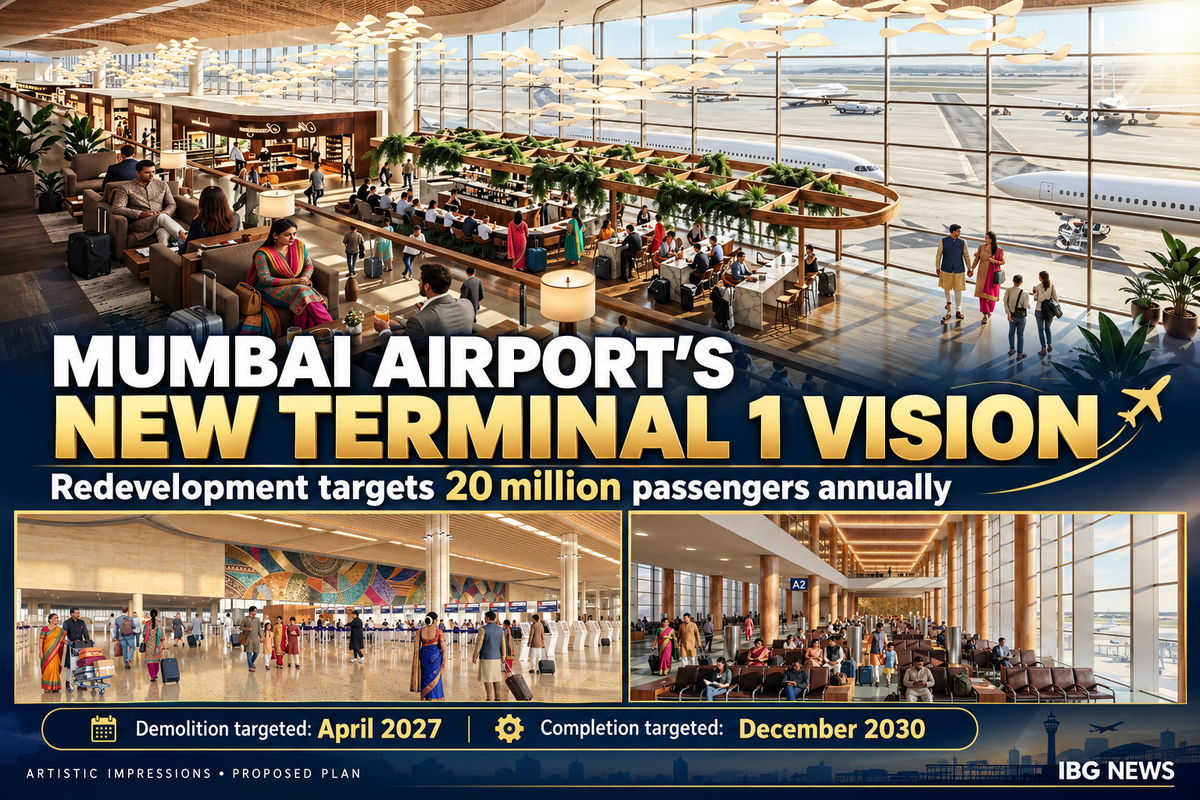
MUMBAI, October 29, 2026: Chhatrapati Shivaji Maharaj International Airport (CSMIA) has presented new artistic impressions of its proposed Terminal 1 (T1) redevelopment, outlining plans for expanded passenger facilities, improved processing capacity and architecture inspired by Mumbai’s cultural identity.
The visuals were shared during a meeting with the Airport Airline Operators Committee (AOC) on October 28, according to reports by Moneycontrol and other news organisations. The proposed redevelopment is intended to replace ageing infrastructure and increase Terminal 1’s annual passenger-handling capacity from 15 million to 20 million.
According to the latest project schedule reported on October 28, demolition is targeted to begin in April 2027, with the replacement terminal expected to be completed by December 2030. These are proposed milestones, not completed works.
The information reviewed by IBG NEWS includes a media note and supporting artistic materials received from an Adani Group corporate representative. The sender explicitly clarified that the attached note was not an official announcement from the company. Accordingly, the project details below are presented as reported plans rather than as an official press release issued by Adani Group.
Terminal Designed Around Passenger Experience
The proposed terminal is intended to provide a more spacious and integrated passenger environment. The artistic impressions depict a broad departure entrance, a large check-in hall with extensive natural lighting, and interior spaces incorporating elements of Mumbai’s cultural heritage.
The concepts also feature indoor greenery, premium lounges and expansive glass façades overlooking the airfield. A large flamingo sculpture is envisioned as a distinctive feature of the arrival area, reflecting the city’s association with natural biodiversity.
These images communicate the intended architectural character of the project. They should not be interpreted as final construction drawings or a guarantee that every illustrated feature will appear in the completed terminal.
Passenger Capacity to Increase by One-Third
The proposed redevelopment would raise Terminal 1’s annual passenger-handling capacity from 15 million passengers per annum (mppa) to 20 million. This represents an increase of approximately 33.3%, based on the stated figures.
The infrastructure changes outlined in the supplied material include:
- Check-in counters: An increase from 74 to 109, approximately 47%.
- Passenger security screening: 15 passenger screening lanes and five transfer lanes are proposed.
- Aircraft contact stands: An increase from seven to 25, allowing more aircraft to be connected directly to the terminal.
- Electronic gates: Twelve e-gates are proposed as part of the upgraded boarding infrastructure.
- Baggage reclaim: An increase from five belts to 11.
If delivered as planned, these improvements would expand the terminal’s passenger-processing facilities and increase its capacity to accommodate domestic aviation demand.
The figures represent the proposed configuration described in the materials reviewed by IBG NEWS; they are not evidence that the facilities have already been installed.
Why the Existing Terminal Is Being Replaced
Terminal 1 dates back to the 1960s and has undergone changes over the decades. Structural concerns have been cited in the case for redevelopment.
A regulatory consultation document published by the Airports Economic Regulatory Authority of India (AERA) records Mumbai International Airport Limited’s submissions concerning structural assessments and the proposed reconstruction of Terminal 1. The material discusses issues affecting different sections of the existing terminal complex and the need to evaluate redevelopment alongside airport capacity requirements.
The October 2026 project information specifically refers to a Structwel assessment from 2017 and an IIT Bombay study from 2024. IBG NEWS has not independently examined the complete underlying reports and therefore does not treat every safety claim in the supplied media note as an independently established finding.
The proposed replacement is intended to address infrastructure concerns while providing a modern terminal suited to the airport’s future requirements.
Construction Requires a Phased Aviation Transition
Redeveloping Terminal 1 while maintaining airport operations presents a significant logistical challenge. The latest schedule envisages an expansion of Terminal 2’s north-west pier to help accommodate passenger traffic during the construction period.
The expanded facilities are targeted to become operational by March 2029, ahead of the proposed December 2030 completion of the replacement Terminal 1.
The wider plan also involves temporarily redistributing some passenger traffic between CSMIA and Navi Mumbai International Airport (NMIA). Recent reporting indicates that the airport operator is seeking to transition approximately five million passengers annually to facilitate the redevelopment, with discussions involving airline operations and schedules.
The proposed transfer has implications for airlines and passengers, particularly where international operations and flight slots are concerned. The final arrangements depend on the transition plan agreed or implemented by the relevant airport operator, airlines and authorities.
The airport operator has indicated that CSMIA’s overall annual passenger-handling capacity could rise from approximately 55 million to 65 million following the Terminal 1 redevelopment and Terminal 2 expansion.
This projected airport-wide increase should be distinguished from Terminal 1’s own planned increase to 20 million passengers annually.
Project Timeline Has Changed From the Earlier Plan
The redevelopment schedule has evolved since the project was first announced publicly.
In January 2025, Adani Airports published a media release describing a Terminal 1 modernisation programme with a target completion period of 2028–29. The announcement outlined a broader vision encompassing passenger convenience, sustainable design and improved airport connectivity.
The schedule reported in October 2026 now points to demolition beginning in April 2027 and completion of the replacement terminal by December 2030.
The two timelines are materially different. The latest schedule should therefore be used when describing the current proposal, while the earlier announcement provides historical context. The reasons for the schedule change should not be assumed without further confirmation from the airport operator.
A Major Infrastructure Project for Mumbai
The proposed Terminal 1 redevelopment represents a substantial change to Mumbai’s domestic aviation infrastructure. Increased passenger capacity, additional screening facilities, more aircraft contact stands and expanded baggage-reclaim infrastructure are intended to support a more efficient terminal operation.
The artistic impressions also indicate an effort to combine operational improvements with architectural elements reflecting Mumbai’s identity.
The principal milestones to watch are the planned start of demolition in April 2027, the readiness of the Terminal 2 north-west pier expansion by March 2029, and the targeted completion of the new Terminal 1 in December 2030.
The final outcome will depend on implementation, coordination with airlines, regulatory requirements and any subsequent revisions to the project schedule.
Reporting and source note: This independently written report was prepared by Suman Munshi for IBG NEWS using the supplied media materials, publicly available regulatory documentation and cross-checked news reports. The October 2026 media note was supplied by an Adani Group corporate representative who explicitly stated that the attachment was not an official announcement from the company. Proposed designs, capacity figures and dates are therefore attributed to the project materials and reporting, rather than represented as independently verified commitments.

