













India Accelerates Domestic Cloud Infrastructure to Strengthen Data Sovereignty and AI Capabilities
New Delhi, October 29, 2026: India is strengthening its domestic cloud computing ecosystem as the growing use of digital public services, artificial intelligence and online platforms increases demand for secure, scalable and reliable computing infrastructure.
Government-backed cloud initiatives, expanding data-centre capacity, investments in artificial intelligence and the development of technology skills are emerging as key components of the country’s digital transformation strategy. These efforts are intended to improve digital service delivery, strengthen control over sensitive information and support India’s long-term technological ambitions.
Digital Expansion Drives Demand for Domestic Cloud Services
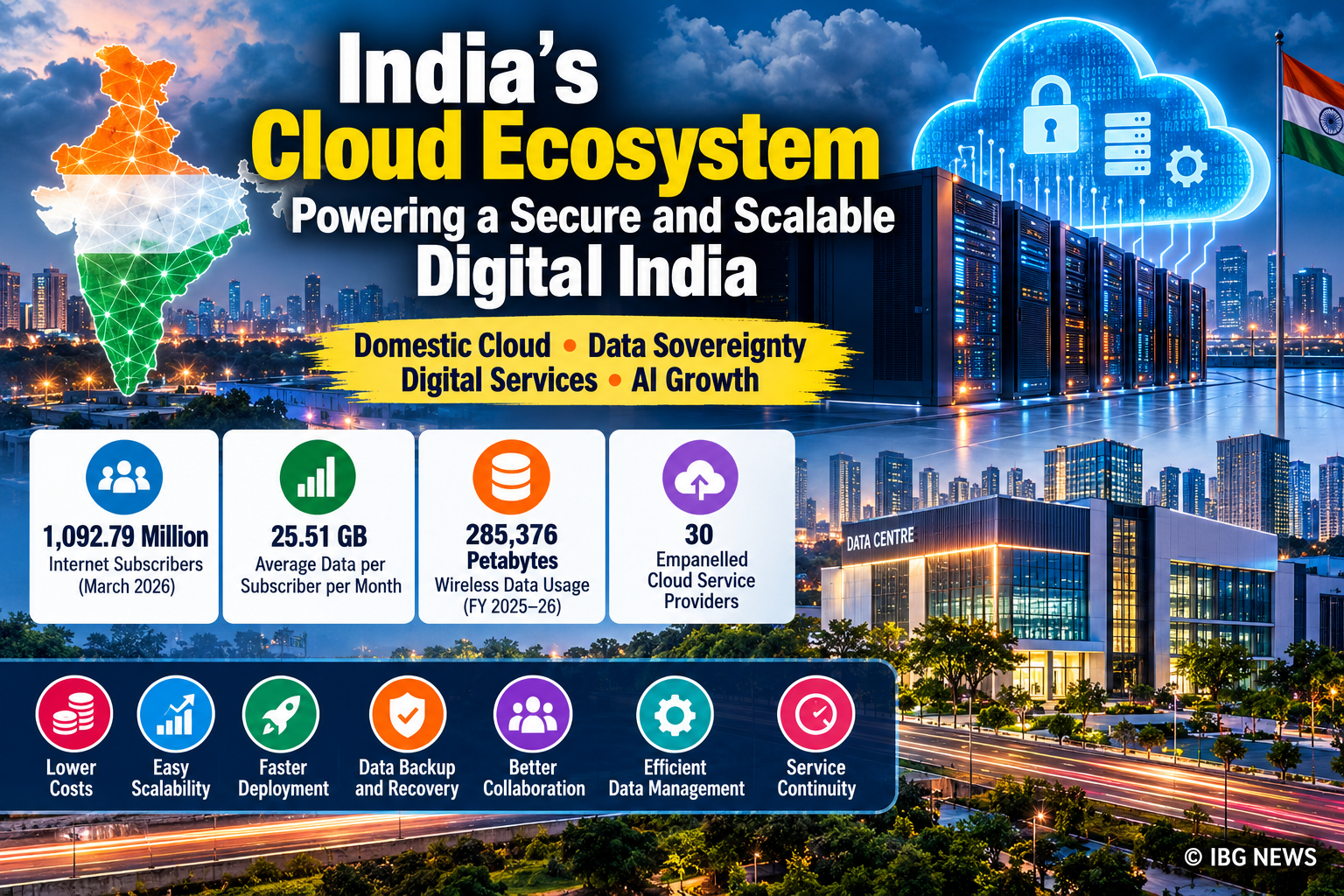
India’s expanding digital economy is generating substantial volumes of information across government services, financial transactions, communications and commercial activities. According to figures cited in the source document, the country had approximately 1,092.79 million internet subscribers in March 2026, while average monthly wireless data consumption reached 25.51 GB per subscriber.
The growing volume of digital information requires infrastructure capable of storing, processing and protecting data efficiently. Cloud computing addresses these requirements by providing computing power, storage, networking and software services over the internet, reducing the need for organisations to maintain extensive physical infrastructure independently.
Developing domestic cloud capabilities also has strategic significance. By strengthening infrastructure within India, organisations can improve their ability to manage sensitive information under applicable Indian laws and regulatory frameworks.
Government Cloud Initiatives Support Digital India
The Government of India’s MeghRaj initiative, launched in 2014 by the Ministry of Electronics and Information Technology (MeitY), was designed to promote cloud adoption across government departments and improve the efficiency of public-sector information technology expenditure.
Its second-generation framework, MeghRaj 2.0, aims to provide flexible cloud services that allow government organisations to deploy digital applications and infrastructure according to their operational requirements.
The document reports that the MeghRaj ecosystem had expanded to cover 2,330 government departments by September 2026. Government digital platforms, including DigiLocker, MyGov and the National Scholarship Portal, are among the services identified in the report as benefiting from cloud-based infrastructure.
The National Informatics Centre (NIC) also plays a significant role in this ecosystem. According to the document, NIC operates four National Data Centres and 24 Mini Data Centres, providing hosting, cloud and related infrastructure services to government departments.
These facilities support the delivery of digital public services at both central and state levels.
Data Centres Emerge as Critical Digital Infrastructure
India’s data-centre industry is expanding in response to rising demand for cloud services, digital transactions and AI computing.
The source document places India’s data-centre capacity at approximately 1.57 gigawatts in August 2026 and projects that it could approach 8 GW by 2030.
Mumbai, Navi Mumbai, Chennai, Hyderabad, Bengaluru, Delhi-NCR and Jamnagar are identified as important data-centre locations. Emerging hubs in Andhra Pradesh, Madhya Pradesh, Chhattisgarh and West Bengal are also attracting attention.
The report estimates that approximately US$70 billion in data-centre investments were underway, with an additional US$90 billion in announced projects. If implemented, these investments could substantially increase computing capacity and strengthen the country’s domestic cloud ecosystem.
However, the long-term benefits will depend on effective project execution, reliable power supplies, connectivity, water management, cybersecurity and the efficient use of infrastructure.
IndiaAI Mission Expands Access to Computing Power
Artificial intelligence development requires substantial computing resources, particularly graphics processing units (GPUs) capable of handling demanding workloads.
The IndiaAI Mission, approved with an outlay of ₹10,371.92 crore, is intended to broaden access to computing infrastructure for researchers, academic institutions and start-ups.
The document reports that more than 45,000 GPUs had been onboarded for a common AI computing facility. Wider access to such resources could help smaller organisations develop and test AI applications without having to invest heavily in their own computing equipment.
The availability of domestic cloud infrastructure may also support research, innovation and the development of applications suited to India’s linguistic and administrative requirements.
BHASHINI Demonstrates the Potential of Indigenous Cloud Infrastructure
The Digital India BHASHINI platform provides an example of how domestic cloud services can support language technology and public-facing digital applications.
According to the source document, the Ministry of Electronics and Information Technology reported in February 2026 that BHASHINI had migrated to an Indian cloud operated by Yotta Data Services.
The transition was described as keeping the platform’s language datasets, AI models and citizen interactions within India’s jurisdiction. The document also reports performance improvements of up to 40%, cost savings of 20–30% and 99.99% uptime following the deployment.
During Maha Kumbh 2025, BHASHINI supported real-time translation and voice-based assistance in more than 11 Indian languages, helping visitors access information despite language differences.
The example highlights the potential role of cloud computing in expanding access to multilingual digital services, although reported performance and cost benefits should be assessed against the relevant technical and operational benchmarks.
Cloud Skills and Workforce Development
The expansion of cloud infrastructure is increasing the need for professionals with expertise in cloud architecture, cybersecurity, artificial intelligence and data management.
The FutureSkills PRIME programme, launched in 2021 by MeitY in collaboration with NASSCOM, is intended to promote skills in emerging technologies. The source document reports that, by August 2026, the programme had registered approximately 34 lakh candidates, with more than 23 lakh enrolled or trained.
The National Institute of Electronics and Information Technology (NIELIT) also contributes to technology training through its network of centres and affiliated institutions.
Additionally, a 2026 report by the Cloud Native Computing Foundation cited in the document estimates that India has 2.25 million cloud-native developers. It also indicates that 44% of Indian developers use hybrid-cloud environments, combining public and private infrastructure.
A suitably trained workforce will be essential for operating complex cloud systems, protecting sensitive information and supporting the next generation of digital services.
Policy and Data Protection Shape Cloud Adoption
Government policy is another important factor influencing the development of India’s cloud ecosystem.
The source document highlights a Cloud Selection Framework issued by MeitY in March 2026. The framework provides guidance to ministries and departments on choosing cloud infrastructure according to data sensitivity, operational requirements and security considerations.
It also discusses the Digital Personal Data Protection Act, 2023, which establishes a legal framework for the processing of digital personal data, including requirements relating to consent, accountability and the obligations of data fiduciaries.
Organisations selecting cloud services must therefore consider more than cost and computing performance. Security controls, contractual responsibilities, applicable legal requirements, disaster recovery and the location and handling of data are also important factors.
For government departments and organisations handling sensitive information, the choice between public, private and hybrid-cloud environments should reflect the nature of the data and the level of control required.
ESTIC 2026 Highlights Emerging Technologies
The growing importance of cloud computing is also reflected in discussions on science and technology innovation.
The Emerging Science, Technology and Innovation Conclave (ESTIC) 2026, held from October 27 to 29 at Bharat Mandapam in New Delhi, focused on the theme “Creative Minds, Catalyzing Science, Empowering Technologies.”
Organised by the Council of Scientific and Industrial Research (CSIR), the conclave brought together discussions on emerging scientific and technological fields, strategic collaboration and India’s longer-term development ambitions.
Cloud computing, AI infrastructure and digital capabilities form part of the wider technological landscape supporting research, innovation and industrial development.
The Road Ahead
India’s cloud computing ecosystem is entering a period of significant expansion, supported by rising digital demand, government initiatives, data-centre investments and the growing use of artificial intelligence.
Domestic infrastructure can help improve the availability of computing resources and strengthen institutional control over sensitive information. However, sustainable growth will require robust cybersecurity, reliable infrastructure, skilled professionals and effective implementation of data-protection policies.
As India pursues its vision of Viksit Bharat 2047, cloud computing is likely to remain an important foundation for digital governance, scientific research, business innovation and the delivery of public services.
By Suman Munshi
IBG NEWS

