










West Bengal’s Infrastructure Moment: Can Centre–State Cooperation Transform Eastern India?
* A 50-Year Historical Assessment of Mega Projects, Industrial Investment and the Economic Future of Eastern India *
By Suman Munshi | Chief Editor, IBG NEWS
Economic Research | Infrastructure | Industrial Policy | Centre–State Relations | Eastern India
1. Introduction: An Emerging Economic Turning Point
West Bengal may be entering an important phase in its economic development. A convergence of large private-sector investment proposals, national infrastructure programmes and renewed administrative coordination has created an opportunity to reconsider the state’s role in India’s industrial and economic geography.
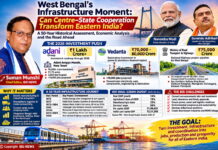
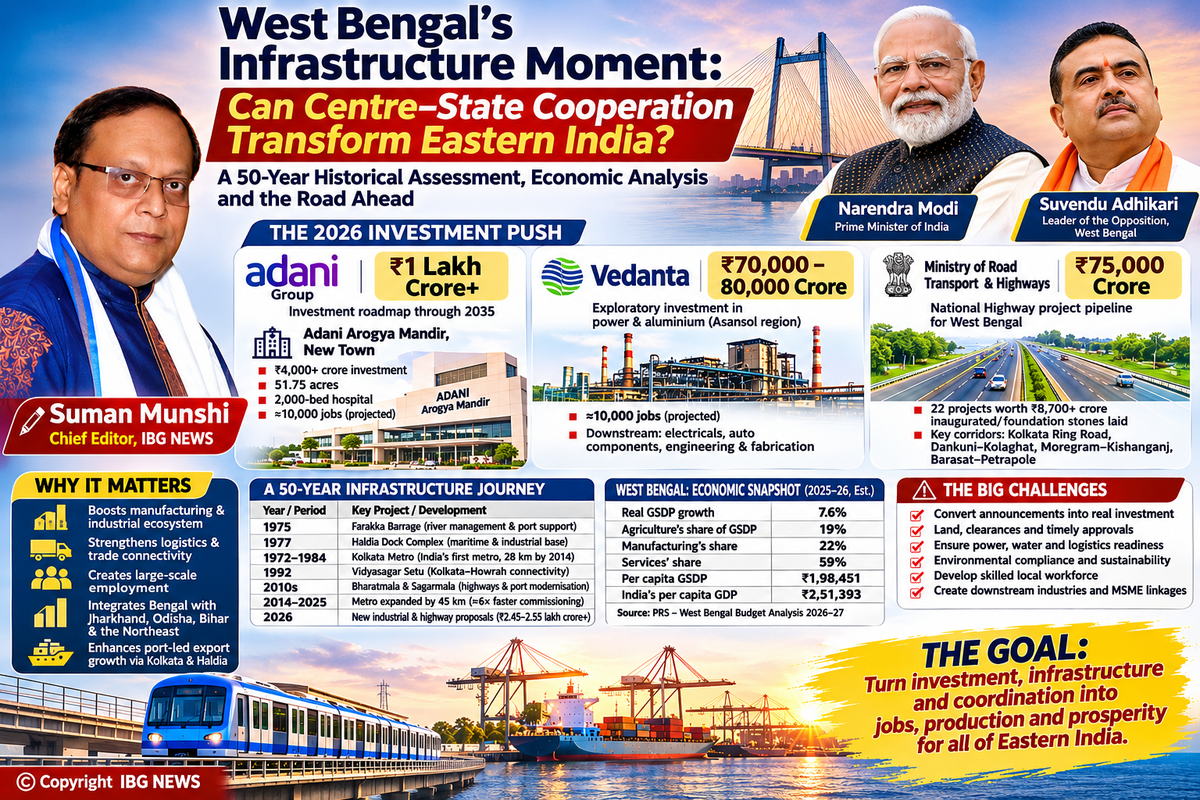
Three developments during 2026 deserve particular attention: the Adani Group’s investment roadmap exceeding ₹1 lakh crore through 2035, Vedanta’s exploratory ₹70,000–80,000 crore investment proposal in power and aluminium manufacturing, and the Union Government’s announcement of a ₹75,000 crore National Highway project pipeline for West Bengal.
These developments represent different stages of investment planning and must not be treated as equivalent financial commitments. Nevertheless, together they indicate the possibility of a development framework combining Central Government infrastructure, State Government facilitation and private-sector capital.
The significance extends beyond West Bengal. Its geographical position connects India’s mineral-rich eastern industrial belt with the Northeast, the Bay of Bengal and neighbouring countries including Bangladesh, Nepal and Bhutan.
The fundamental question is whether these proposals can become productive assets, competitive industries and sustainable employment opportunities.
2. Three Major Investment Developments of 2026
Adani Group: A long-term investment roadmap
On 24 September 2026, the Adani Group announced an investment roadmap exceeding ₹1 lakh crore in West Bengal by 2035. The proposed sectors include ports, logistics, power generation and distribution, roads, bridges, renewable energy, green cement and hyperscale data centres. Adani
A major component is the Adani Arogya Mandir project at New Town, Kolkata.
| Project specification | Announced details |
|---|---|
| Investment | Over ₹4,000 crore |
| Land | 51.75 acres |
| Hospital capacity | 2,000 beds |
| Employment potential | Approximately 10,000 |
| Additional facilities | Medical college and research facilities |
The foundation stone has been laid. The company also projects capacity to serve over 200,000 inpatients and more than two million outpatients annually. Adani
If implemented as announced, the institution could strengthen healthcare, medical education, research and associated services across eastern India. Its actual contribution must be measured through affordability, patient access, treatment quality and operational performance.
Vedanta: A potential industrial revival in Asansol
Vedanta Chairman Anil Agarwal announced that the company is exploring investments of approximately ₹70,000–80,000 crore in West Bengal for power generation and aluminium manufacturing. The Asansol–Bidhanbag area is being considered, subject to feasibility studies and infrastructure requirements.
The proposal could generate approximately 10,000 employment opportunities according to the State Government’s reported estimate. Vedanta has around 300 acres in the region that could be examined for the project, although additional requirements remain to be assessed. Telegraph India+1
The industrial importance lies in the potential downstream manufacturing ecosystem:
- Electrical conductors and equipment.
- Automotive components.
- Industrial machinery and fabrication.
- Construction materials.
- Aluminium-based engineering products.
- Consumer durables.
However, the proposal is still exploratory. Its feasibility will depend on electricity costs, coal and other energy arrangements, alumina supply, water availability, environmental approvals and financial closure.
There is also a historical lesson: an earlier Vedanta industrial proposal in the Asansol region did not materialise. The present initiative must therefore be judged by implementation milestones rather than headline investment figures.
Central Government: ₹75,000 crore highway programme
On 26 November 2026, Union Road Transport and Highways Minister Nitin Gadkari announced a National Highway infrastructure pipeline worth approximately ₹75,000 crore for West Bengal. At Kolaghat, 22 projects worth more than ₹8,700 crore were inaugurated or had their foundation stones laid. Press Information Bureau
Selected major proposals include:
| Highway project | Announced estimated cost |
|---|---|
| Kolkata Ring Road, approximately 250 km | ₹14,000 crore |
| Dankuni–Kolaghat eight-lane corridor | ₹20,000 crore |
| Moregram–Kishanganj corridor | ₹12,000 crore |
| Barasat–Petrapole highway | ₹8,000 crore |
These are selected components of the larger pipeline, not additional expenditure over and above the ₹75,000 crore announcement.
The programme could strengthen Kolkata’s urban connectivity, Haldia’s port access, industrial freight movement and interstate trade with Bihar, Jharkhand and the Northeast.
3. Fifty Years of Infrastructure Development: What History Teaches
West Bengal’s infrastructure history demonstrates considerable engineering achievement, but also the difficulty of converting infrastructure into sustained industrial expansion.
| Year / period | Major development | Economic significance |
|---|---|---|
| 1975 | Farakka Barrage commissioned | River management and Kolkata Port navigability |
| 1972–1984 | Kolkata Metro construction and first service | India’s first metro railway |
| 1977 | Haldia Dock Complex commissioned | Maritime and industrial development |
| 1992 | Vidyasagar Setu opened | Kolkata–Howrah commercial connectivity |
| 2000s onward | Eastern Dedicated Freight Corridor development | Modern freight transportation |
| 2010s onward | Bharatmala and Sagarmala | Highway and port-led infrastructure |
| 2019–2025 | East–West Metro phased commissioning | Urban transport integration |
| 2026 | New industrial and highway proposals | Potential regional economic transformation |
Sources: Ministry of Jal Shakti, Ministry of Railways, port documentation and PIB. jalshakti-dowr.gov.in+3
Kolkata Metro: A measurable lesson in execution speed
One of the strongest historical comparisons comes from the Ministry of Railways.
| Period | Metro commissioned | Average annual commissioning |
|---|---|---|
| 1972–2014 | 28 km | 0.67 km |
| 2014–2025 | 45 km | 4.09 km |
The reported annual commissioning rate in the latter period was approximately six times that of the earlier period. Press Information Bureau+1
This is evidence of a substantial acceleration in delivery. It should not, however, be interpreted as a direct comparison of engineering productivity because project scope, technology, funding and construction conditions differed.
Farakka and Haldia: Infrastructure beyond state boundaries
The Farakka Barrage, commissioned in 1975 according to Ministry of Jal Shakti records, was designed partly to support the navigability of the Bhagirathi–Hooghly system and Kolkata Port. It illustrates the national strategic importance of infrastructure located within West Bengal. jalshakti-dowr.gov.in
Haldia Dock Complex, commissioned in 1977, strengthened the state’s maritime and industrial capabilities. The Kolkata Port system serves a hinterland extending across eastern and northeastern India and neighbouring landlocked countries. Environment Clearance Online+1
The freight connectivity opportunity
The Eastern Dedicated Freight Corridor from Ludhiana to Sonnagar has been completed and commissioned. Importantly, the Union Budget 2026 announced a new Dankuni–Surat Dedicated Freight Corridor, for which DPR preparation or updating has been initiated. Press Information Bureau+1
This could provide West Bengal with an important future connection between eastern manufacturing centres and western industrial and commercial markets.
The historical conclusion is clear: infrastructure creates opportunity, but sustained manufacturing, investment and employment require coordinated economic planning.
4. West Bengal’s Economic Baseline: Why Industrial Expansion Matters
The proposed investments must be examined against the existing economic structure of the State.
According to PRS Legislative Research’s analysis of the West Bengal Budget 2026–27, the estimated 2025–26 economic indicators are:
| Economic indicator | Estimated value |
|---|---|
| Real GSDP growth | 7.6% |
| Agriculture’s share of GSDP | 19% |
| Manufacturing’s share | 22% |
| Services’ share | 59% |
| Per capita GSDP | ₹1,98,451 |
| India’s per capita GDP | ₹2,51,393 |
PRS Legislative Research
These figures highlight an important economic challenge. West Bengal has a substantial services economy, but manufacturing accounts for an estimated 22% of GSDP.
The objective should not be to reduce the importance of services or agriculture. It should be to increase manufacturing productivity, industrial exports, technology adoption and higher-value employment.
The difference between economic growth and economic transformation lies in the creation of productive capacity.
5. Industrial Investment: The Multiplier Beyond the Factory
The proposed Vedanta project offers a useful example of how anchor investment can generate wider industrial activity.
An aluminium smelter requires energy, raw materials, transport, maintenance and engineering services. Its output can support a network of downstream manufacturers.
The economic chain could include:
Raw materials and energy → Aluminium production → Electrical equipment, automotive components, engineering, fabrication and construction products.
The State should therefore negotiate a downstream industrial development programme alongside the main investment.
Similarly, the Adani investment roadmap could support port logistics, warehousing, digital infrastructure, healthcare and associated service industries.
The real economic multiplier will depend on the extent to which local MSMEs, suppliers, technical institutions and workers participate.
Employment projections must also be separated into temporary construction jobs, permanent operational jobs, direct employment and indirect employment. Corporate announcements should not be presented as verified job creation.
6. Why Eastern India Must Be Treated as One Economic Region
West Bengal’s geographical position provides an opportunity to connect several complementary regional economies.
| Region | Principal economic strengths | Potential integration with Bengal |
|---|---|---|
| Jharkhand | Coal, minerals, steel and heavy industry | Industrial supply chains and freight |
| Odisha | Aluminium, steel, minerals and ports | Raw materials and downstream manufacturing |
| Bihar | Agriculture and emerging manufacturing | Food processing and distribution |
| Northeast | Agriculture, energy, tourism and natural resources | Market access and transport connectivity |
| Sikkim | Pharmaceuticals, hydropower and tourism | Regional trade and services |
| Bangladesh | Manufacturing and export industries | Cross-border commerce, subject to bilateral arrangements |
| Nepal and Bhutan | Hydropower, agriculture and trade | Transit and commercial connectivity |
This regional model has three particularly important dimensions.
First, the mineral-to-manufacturing connection. Jharkhand and Odisha possess substantial mineral and industrial capabilities. West Bengal can provide additional manufacturing capacity, engineering services, logistics and access to maritime trade.
Second, the agricultural-to-consumer connection. Improved road, rail and warehousing infrastructure can strengthen agricultural distribution, food processing and market access across Bihar, North Bengal and the Northeast.
Third, the maritime-to-international connection. Kolkata and Haldia ports can serve a wider industrial hinterland, provided navigational conditions, cargo handling, rail connectivity and logistics costs remain competitive.
The Comptroller and Auditor General’s assessment of Kolkata Port confirms its extensive hinterland across eastern India, the Northeast and neighbouring landlocked countries. Comptroller and Auditor General of India
This makes West Bengal’s infrastructure development a matter of national economic significance, not merely a state-level investment exercise.
7. Centre–State Cooperation: The Administrative Opportunity
A particularly important development occurred in July 2026, when a high-level review examined 19 major infrastructure projects worth more than ₹82,000 crore.
The projects covered roads, railways, metro, petroleum and natural gas, coal and labour. The review identified land acquisition, rehabilitation, utility shifting, forest clearances and interdepartmental coordination as major implementation challenges.
A State-level Project Monitoring Group was proposed to accelerate project execution. Press Information Bureau+1
Centre–State cooperation is not new in West Bengal. Farakka, Kolkata Metro, railways, highways and port infrastructure have all depended on cooperation between different levels of government.
What could distinguish the present phase is the possibility of more systematic coordination across multiple large infrastructure and private investment programmes.
A successful administrative structure should establish clear responsibilities:
| Institution | Responsibility |
|---|---|
| Central Government | National highways, railways, ports, national policy and Central funding |
| State Government | Land, local infrastructure, utilities, approvals and facilitation |
| Private investors | Capital, technology, construction and industrial operation |
| District administration | Local implementation, rehabilitation and field monitoring |
The State should establish an empowered Mega Infrastructure Mission with direct oversight, dedicated project officers and quarterly progress reviews.
Every project should have a documented approval schedule, land-readiness assessment, financial plan, environmental compliance record and construction timetable.
The objective should be to reduce administrative uncertainty without compromising statutory requirements.
8. Fiscal Sustainability and Environmental Responsibility
Large infrastructure programmes must be evaluated not only by their investment value but also by their financing structure and long-term obligations.
PRS estimates that West Bengal’s fiscal deficit target for 2026–27 is 2.9% of GSDP, while the revenue deficit target is 1%. PRS Legislative Research
This makes it important to distinguish Central expenditure, State expenditure, private equity, institutional borrowing and public-private partnership financing.
The ₹75,000 crore highway pipeline must not be treated as equivalent to private corporate investment. Similarly, an investment roadmap does not establish that funds have been deployed.
Environmental sustainability is equally important.
The proposed aluminium and power complex will require careful assessment of:
- Electricity source and energy efficiency.
- Carbon emissions and air quality.
- Water consumption.
- Industrial waste and ash management.
- Land use and rehabilitation.
- Compliance with environmental conditions.
The State should encourage cleaner energy, modern pollution-control systems and measurable environmental performance.
Industrial development must not create long-term environmental liabilities for surrounding communities.
9. Risks and Implementation Challenges
West Bengal’s industrial history provides important lessons from projects that faced delays, uncertainty or failure to progress.
| Major risk | Recommended safeguard |
|---|---|
| Announcements without implementation | Binding agreements and milestone disclosure |
| Land acquisition disputes | Transparent consultation and fair rehabilitation |
| Financial uncertainty | Verified financial closure |
| Environmental objections | Independent assessment and monitoring |
| Delayed approvals | Empowered interdepartmental coordination |
| Limited local employment | Industry-linked skill development |
| Weak downstream manufacturing | MSME and industrial cluster incentives |
| Policy discontinuity | Long-term contractual and institutional stability |
The experience of Singur and the earlier Vedanta proposal in Asansol demonstrates why investor confidence, community acceptance and administrative preparedness must work together.
No major industrial project can be considered successful if it ignores either economic viability or public interest.
10. Measuring Development Speed: From Announcements to Actual Results
The success of these initiatives should not be measured through MoU values, investment projections or foundation-stone ceremonies alone.
West Bengal needs a publicly accessible infrastructure and investment monitoring dashboard.
The following indicators should be disclosed quarterly:
| Performance indicator | What should be measured |
|---|---|
| Investment realisation | Announced value versus actual capital expenditure |
| Land readiness | Land available against project requirements |
| Financial closure | Equity and debt arrangements completed |
| Approval status | Statutory clearances obtained |
| Construction | Physical progress against schedule |
| Employment | Verified permanent and temporary jobs |
| Industrial production | Output and value addition |
| Exports | Growth in manufactured and regional exports |
| Environmental performance | Compliance and independent monitoring |
Projects should be classified into six stages:
- Announcement.
- Feasibility assessment.
- Formal agreement.
- Statutory approvals and financial closure.
- Construction.
- Commercial operation.
A 100-day administrative programme should establish the monitoring authority, complete project information dossiers, identify land and utility requirements, coordinate Central and State approvals and publish implementation schedules.
This would make development speed measurable rather than rhetorical.
11. Conclusion: From Infrastructure Investment to Economic Transformation
West Bengal stands before a potentially significant economic opportunity.
The Adani Group’s long-term investment roadmap, Vedanta’s exploratory industrial proposal, the Union Government’s highway expansion programme and the renewed focus on Centre–State administrative coordination collectively create the possibility of a new phase of infrastructure-led development.
The historical record of the past 50 years shows that West Bengal has never lacked geographical advantages, engineering capabilities, industrial heritage or human resources. What has remained challenging is the conversion of infrastructure into sustained industrial competitiveness, private investment and employment.
The present opportunity must therefore be approached differently.
Roads must reduce freight costs. Ports must improve export competitiveness. Industrial projects must generate downstream manufacturing. Healthcare investments must improve public access. Educational institutions must produce industry-ready professionals. Local entrepreneurs and MSMEs must become active participants in the new economic ecosystem.
Centre–State cooperation could become the institutional foundation of this transformation, provided it is supported by administrative efficiency, transparency, fiscal discipline and policy continuity.
Most importantly, the benefits must extend beyond Kolkata and the major industrial centres to districts, smaller towns and neighbouring eastern states.
West Bengal must not merely become a destination for investment. It must become the economic engine connecting eastern India with the rest of the country and the world.
The ultimate measure of development will not be the value of investments announced, but the speed at which capital becomes infrastructure, infrastructure becomes productive capacity, and productive capacity becomes employment, income and prosperity.
Bengal’s progress should not be measured only by the investments it attracts, but by the economic opportunities it creates for the people of eastern India.
Suman Munshi
Chief Editor, IBG NEWS
Research references and evidence register
- PIB — National Highway projects worth ₹75,000 crore announced for West Bengal, 26 November 2026.
- Adani Group — West Bengal investment roadmap and foundation stone of Adani Arogya Mandir, 24 September 2026.
- The Telegraph — Vedanta’s proposed ₹80,000 crore power and aluminium investment, October 2026.
- PIB — Review of 19 infrastructure projects worth over ₹82,000 crore, July 2026.
- PRS Legislative Research — West Bengal Budget Analysis 2026–27.
- Ministry of Railways — Kolkata Metro commissioning statistics, 1972–2025.
- Ministry of Jal Shakti — Farakka Barrage Project historical information.
- Kolkata Port / Haldia Dock Complex — Historical port development documentation.
- PIB — Dedicated Freight Corridors and the proposed Dankuni–Surat corridor.
- CAG — Kolkata Port’s regional hinterland and infrastructure assessment.
Editorial methodology: Government statistics, corporate announcements and published reporting have been distinguished from projections and editorial assessments. Financial figures refer to announced or estimated amounts unless explicitly identified as expenditure or completed investment. Budget estimates are not audited outcomes.