











Russia Commissions Nuclear-Powered Submarine Perm Equipped with Zircon Hypersonic Missiles
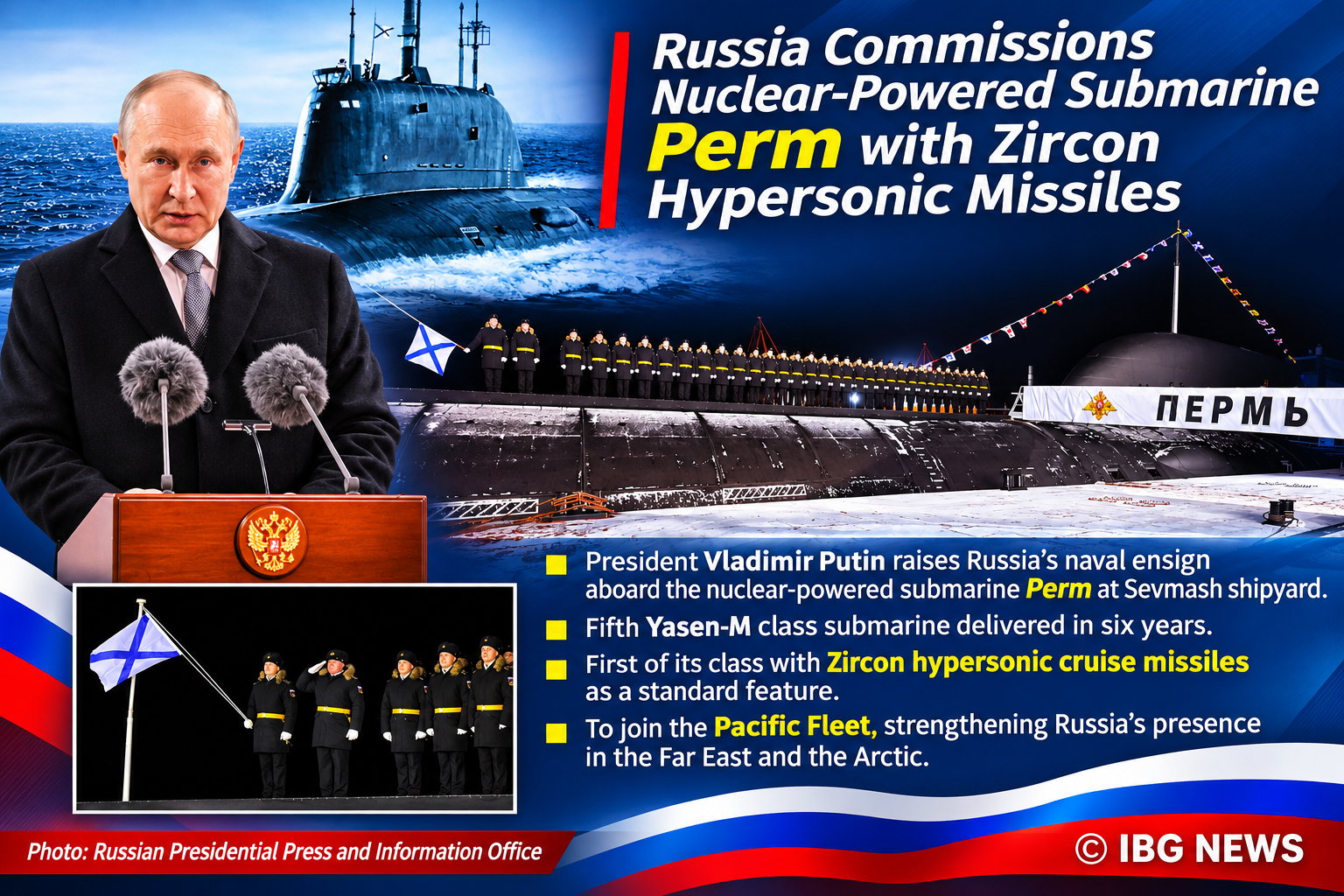
Severodvinsk, November 27, 2026: Russian President Vladimir Putin attended the flag-raising ceremony aboard the nuclear-powered submarine Perm at the Sevmash shipyard in Severodvinsk, formally marking the commissioning of the advanced submarine into the Russian Navy.
The commissioning represents another significant development in Russia’s naval modernisation programme, particularly its efforts to strengthen underwater warfare capabilities and expand its strategic presence across major maritime regions.
First Yasen-M Submarine with Standard Zircon Missile Capability
The Perm is a fourth-generation, multipurpose nuclear-powered missile submarine belonging to Russia’s Yasen-M class. Its most notable technological distinction is that it is the first submarine of this class to be equipped with Zircon hypersonic cruise missiles as a standard feature.
According to the Russian President’s announcement, the submarine is designed to undertake a wide range of naval missions across the world’s oceans, combining stealth capabilities with advanced missile systems.
The Yasen-M class submarines are designed to deploy different types of submarine-launched cruise missiles. The integration of the Zircon hypersonic missile adds another dimension to their strike capabilities, offering high-speed precision-strike options.
Fifth Yasen-M Submarine Delivered in Six Years
Addressing the ceremony, Putin described the commissioning of Perm as an important achievement for Russia’s naval forces and its defence-industrial sector.
He noted that Perm was the fifth Yasen-M class nuclear-powered submarine delivered to the Russian Navy over the preceding six years.
The President also acknowledged the contribution of the Sevmash shipyard workforce, engineering and design organisations, defence manufacturing enterprises, research institutions and technology companies involved in the submarine’s development, construction, equipment and testing.
He emphasised that only a limited number of countries possess the technological infrastructure, engineering expertise and industrial capabilities required to design and manufacture nuclear-powered submarines of this complexity.
Deployment to the Pacific Fleet
Following its commissioning, the Perm is scheduled to join Russia’s Pacific Fleet in the near future.
Its deployment is expected to strengthen Russia’s naval presence in the Far East and the Arctic, two strategically important maritime regions for the country.
The submarine is intended to contribute to maritime security, protect Russia’s maritime approaches and support the country’s wider naval operational requirements.
Russia’s Submarine Modernisation Programme
Putin reiterated that Russia intends to continue modernising its Navy, with particular emphasis on expanding and upgrading its nuclear-powered submarine fleet.
According to the programme outlined during the ceremony, five missile-carrying submarines are scheduled for delivery to the Russian Navy by 2030, including three additional Yasen-M class vessels.
He also highlighted the importance of expanding serial production and modernising naval weapon systems to maintain a stable industrial workload for shipyards and their suppliers.
The programme, he said, would support technological development, strengthen the defence-industrial economy, attract skilled personnel and advance Russia’s technological sovereignty.
Strategic Significance
The commissioning of Perm highlights the continuing importance of nuclear-powered submarines in contemporary maritime security and strategic military planning.
The combination of nuclear propulsion, stealth-oriented operations and advanced missile capabilities makes the Yasen-M programme an important element of Russia’s naval modernisation efforts.
The introduction of standard Zircon missile capability aboard Perm also underlines Moscow’s emphasis on integrating hypersonic weapons into its naval platforms.
However, the submarine’s operational effectiveness and wider strategic impact will ultimately depend on its deployment, crew readiness, supporting infrastructure and performance in actual naval operations.
For Russia, the commissioning is not merely the delivery of another submarine; it represents a further step in developing a technologically advanced underwater fleet designed to protect its maritime interests across the world’s oceans.
Reported by Suman Munshi | IBG NEWS
Source: Official statement and speech by the President of Russia, Kremlin, November 27, 2026.