










“Globalisation of Compassion is the Need of the Hour” – Dr. Mohan Bhagwat
· RSS Sarsanghchalak Dr. Mohan Bhagwat releases Karunanayak Ram, a book by Nobel Peace Prize Laureate Kailash Satyarthi
· Princess Sonam Dechan Wangchuk of Bhutan attends as Guest of Honour; Union Minister for Culture and Tourism Gajendra Singh Shekhawat is the Chief Guest
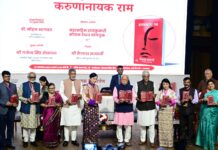
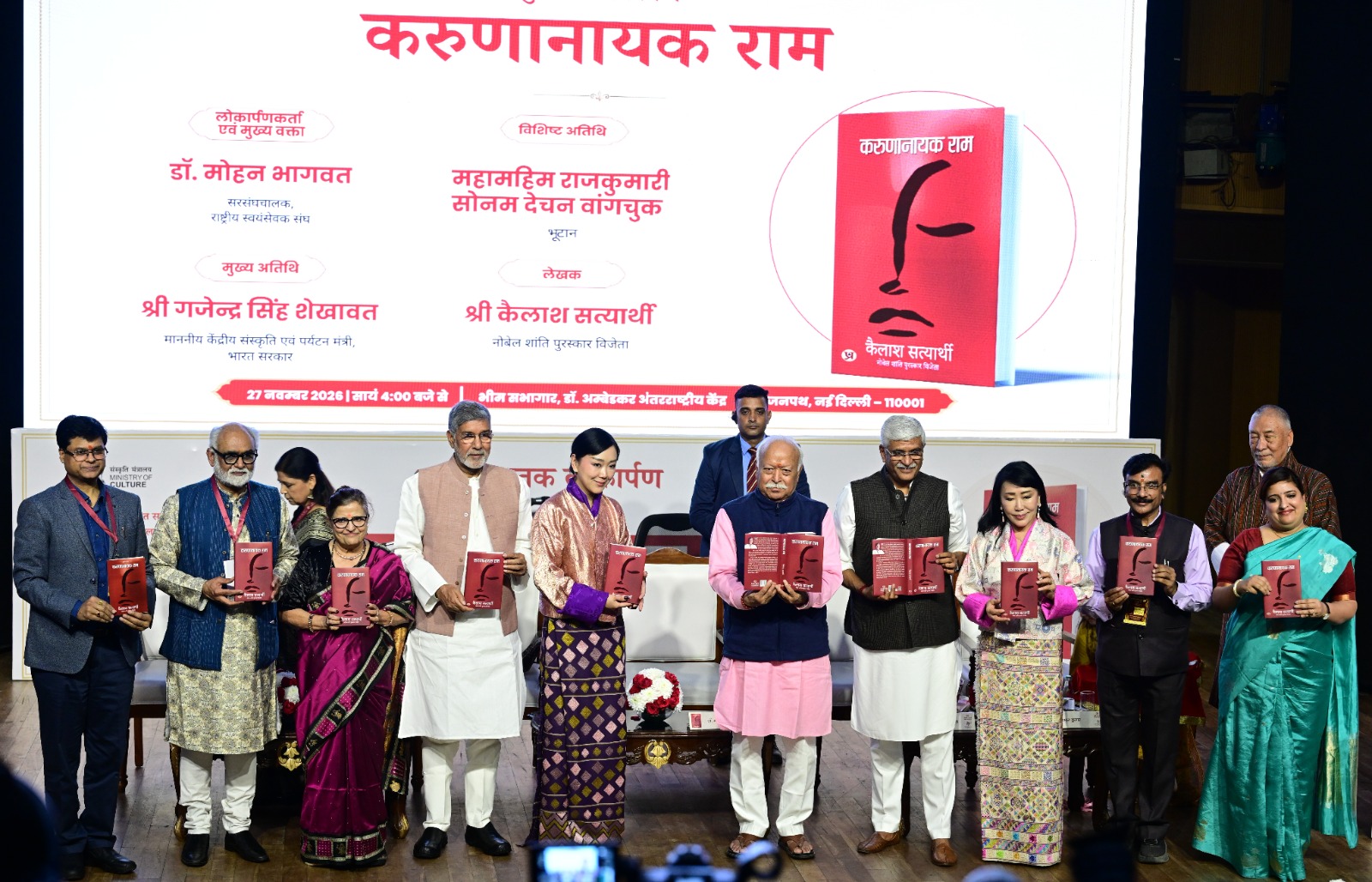
27th November, New Delhi: Dr. Mohan Bhagwat, Sarsanghchalak of the Rashtriya Swayamsevak Sangh (RSS), today released Karunanayak Ram, the latest book by renowned social activist and author Shri Kailash Satyarthi, who is a Nobel Peace Prize Laureate, at the Bhim Auditorium of Dr. Ambedkar International Centre, New Delhi. Published by Prabhat Prakashan, the book presents the personality, life philosophy and ideals of Lord Ram in the broader context of compassion, human sensitivity, social justice and moral responsibility. The programme was organised by the Media Centre of the Indira Gandhi National Centre for the Arts (IGNCA).
Her Highness Princess Sonam Dechan Wangchuk of Bhutan attended the event as the Guest of Honour. Union Minister for Culture and Tourism Shri Gajendra Singh Shekhawat graced the occasion as the Chief Guest. The author and Nobel Peace Prize Laureate Shri Kailash Satyarthi, IGNCA Member Secretary Dr. Sachchidanand Joshi, publisher Shri Prabhat Kumar and several other distinguished personalities were also present.
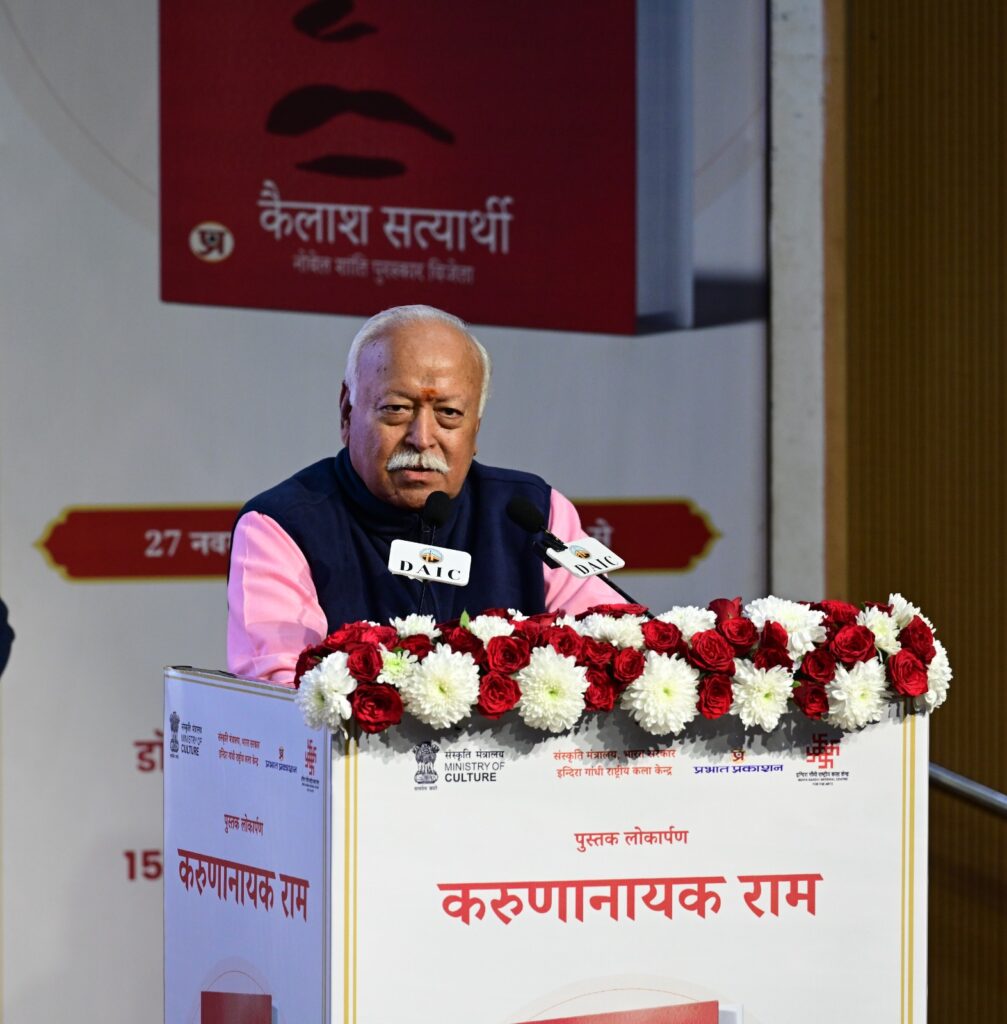
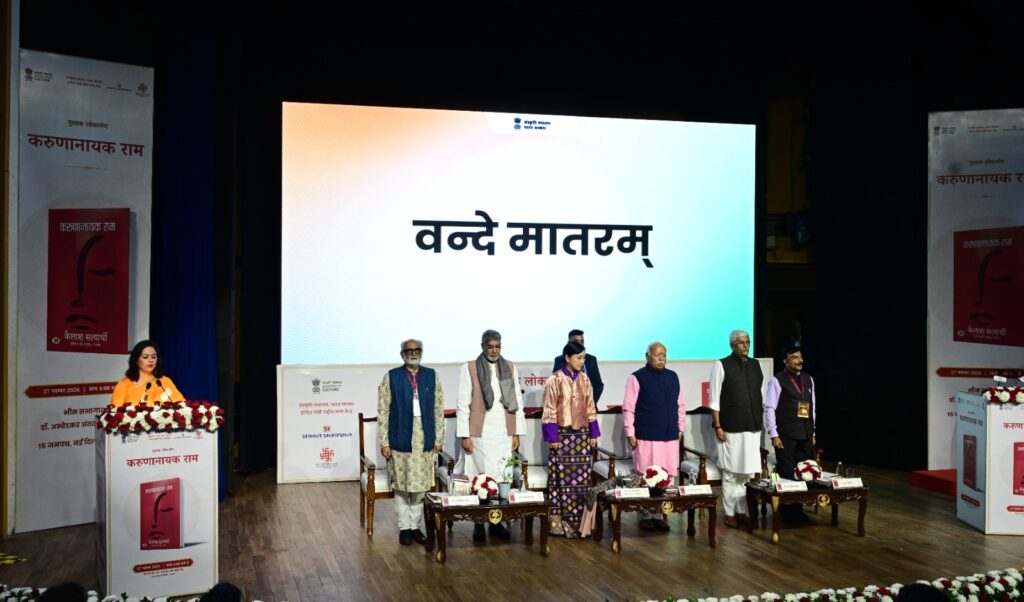
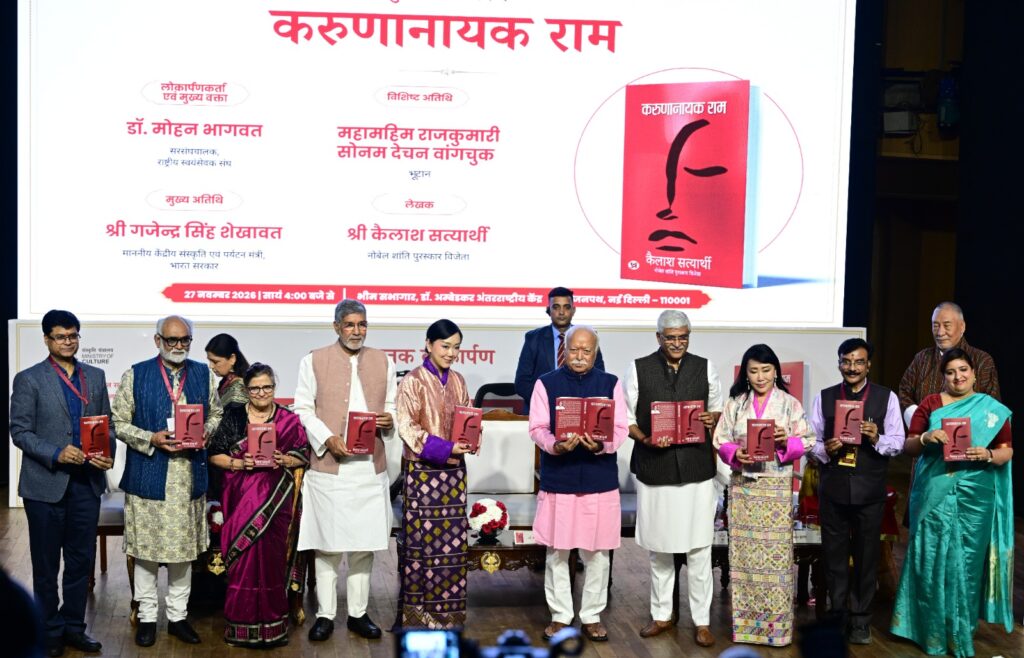
Dr. Mohan Bhagwat, who released the book and delivered the keynote address, spoke about the compassion embodied by Lord Ram and its relevance in the present times. He said that there is an innate feeling within each of us that inspires us to do something to alleviate another person’s suffering, and that is compassion.
Dr. Mohan Bhagwat said, “Compassion, dignity and the spirit of public welfare are inherent in the character of Lord Ram. The fundamental difference between Rama and Ravana was that Ravana remained confined to the ego of ‘I’ and ‘mine’, whereas Ram’s life represents the ideal of compassion and the practice of Dharma. Ego means being unable to look beyond ‘I’ and ‘mine’. Until we rise above this attachment, we cannot experience the eternal truth that we are all interconnected at our core.”
He further said, “Compassion is not a special virtue, but a natural expression of humanity. It manifests when another person’s suffering becomes our own and we act, to the best of our ability, to alleviate it. Merely expressing sympathy is not compassion; compassion inspires us to serve and work for the welfare of all. We can never be happy in isolation; our happiness is intrinsically linked to the well-being of society, nature and the world.”
He added, “Therefore, it is not enough merely to believe in Ram; it is equally important to follow Ram’s ideals. Drawing inspiration from his character, and practising dignity, a sense of duty and compassion in our own lives, is the true expression of faith. Many of the problems facing the country and the world today stem from the insistence on ‘I’ and ‘mine’ and the absence of compassion. In such times, the globalisation of compassion is essential. Only when we rise above our limited self-interest and develop a sense of belonging towards the entire creation can we truly move towards humanity and global welfare.”
Her Highness Princess Sonam Dechan Wangchuk of Bhutan said that it was a matter of great pride for Bhutan that Shri Kailash Satyarthi had described the country as a good example of Rama Rajya. She also appreciated the young people who are coming forward to understand the ideals of Lord Ram.
Shri Gajendra Singh Shekhawat said, “The title Karunanayak Ram is, in itself, a profound philosophical expression. Power becomes meaningful only when it is inspired by compassion”. The character of Rama presents an ideal synthesis of duty and sensitivity. Rama is an inspiration for India’s culture, ideals and public life, and a symbol of the collective consciousness that connects individuals and society. To understand Rama is to understand India. His leadership is reflected not merely in power or strength, but in the wholeness of his character. Compassion is not merely a tender emotion, but a transformative force within us. The character of Rama embodies a remarkable synthesis of dignity, duty and sensitivity. It is also important to understand his leadership, fearlessness, exemplary conduct as a son and the manner in which he upheld the dignity of relationships. Taking up even a single thread of Rama’s character and pursuing it can set us on a journey towards the infinite dimensions of his personality.
On the occasion, Shri Kailash Satyarthi highlighted the intellectual background and central idea of his book Karunanayak Ram. He emphasised the need to understand the life of Lord Ram through the wider perspective of compassion. The central idea of the book is that compassion is not merely an expression of kindness or sentiment, but an active moral force capable of bringing positive change in individuals, society and systems of governance.
He said, based on my limited knowledge and personal experiences, I have arrived at the conclusion that the most significant and practical aspect of Ram’s life is that he is a compassionate hero. ” For me, compassion is not merely an emotion, but a force that arises when we regard another person’s suffering as our own and inspires us to take action to alleviate it. The book explores this very dimension of compassion in Ram’s life at four levels – family, society, systems and the self.”
In his welcome address, Dr. Sachchidanand Joshi said that no human being could be considered complete without the integration of culture and compassion. “At least in India, we cannot imagine a complete human being without culture and compassion. This is the land from which compassion, love and goodwill have emerged for the world,” he said.
At the conclusion of the programme, Shri Prabhat Kumar proposed the vote of thanks and expressed his gratitude to the dignitaries and guests.
About the Book
Karunanayak Ram is an original attempt to understand the personality, life values and ideals of Lord Ram from a new perspective. Rather than limiting Lord Ram to the traditional understanding of him solely as an incarnation of God or Maryada Purushottam, the book presents him as a hero whose most significant and practical quality is his compassion.
According to the author, compassion was the inner strength that enabled Lord Ram to remain patient, balanced, sensitive and committed to justice even in adverse circumstances. From this perspective, the book explores four major dimensions of compassion – personal compassion, social compassion, self-compassion and transformative compassion.
Through Lord Ram’s family relationships, his affectionate interactions with Nishadraj and Kevat, his affection towards forest-dwelling communities, his art of dialogue and the concept of Ram Rajya, the book explains the diverse manifestations of compassion. It also highlights how Lord Ram’s personality reflects the highest ideals of social harmony, equality, justice and human dignity.
The book also analyses the fundamental difference between the personalities of Ram and Ravan in the context of compassion and sensitivity. According to the author, despite possessing knowledge, power and prosperity, an individual is bound to fall if compassion is absent from their life. In contrast, conduct inspired by compassion, dialogue, social justice, equality, accountability and respect for nature can form the foundation for building a better society and a sensitive system of governance.
At a time when the world is confronted with challenges such as violence, intolerance, social divisions and the breakdown of dialogue, Karunanayak Ram draws attention to the timeless human values embodied in the life of Lord Ram, which remain relevant to all humanity. The message of the book is that compassion is not an idea confined to the boundaries of any religion, community, country or era, but a universal force that can make human life and civilization more sensitive, just and harmonious.