












Exposition of Buddha’s Sacred Relics from India to Russia’s Kalmykia Republic
The Holy Relics exposition will be held in the capital city of Elista from 11th to 18th October, 2025
By PIB Delhi
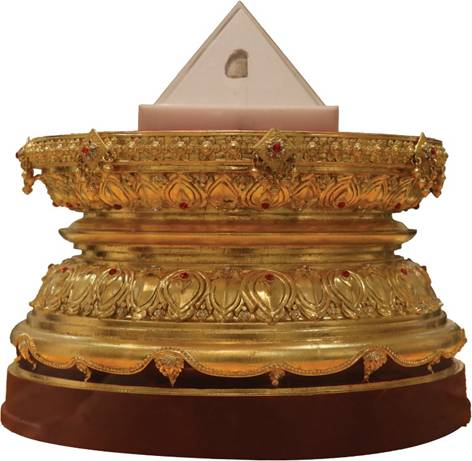
The sacred Relics of the Buddha enshrined in the National Museum, New Delhi, will travel to Russia’s Kalmykia Republic for an exposition, accompanied by a high-level delegation of 11 senior Indian monks who will bless the local devotees and conduct religious service for the predominantly Buddhist population of the region.
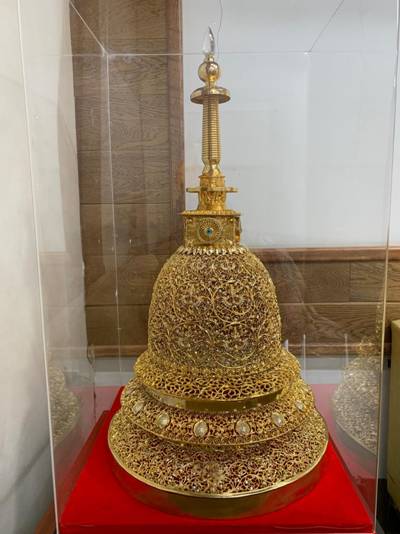
The Holy Relics will be received by the Head of the Buddhists of Kalmykia, Shajin Lama of Kalmykia, Geshe Tenzin Choidak, Mr. Batu Sergeyevich Khasikov, Head of the Republic of Kalmykia, and other eminent Buddhist Sangha members.
It may be recalled that it was the 19th Kushok Bakula Rinpoche, the revered Buddhist monk and diplomat from Ladakh, who played a pivotal role in reviving Buddhism in Mongolia and, subsequently, was also instrumental in reintroducing interest in Buddha dharma in the three regions of Russia, namely Buryatia, Kalmykia, and Tuva.
The Holy Relics exposition, a first in the Russian Republic, is organised by the Ministry of Culture, Government of India, in collaboration with the International Buddhist Confederation (IBC), the National Museum, and the Indira Gandhi National Centre for the Arts (IGNCA). It will be held in the capital city of Elista from 11-18 October 2025.
The Sacred Relics will be enshrined in the main Buddhist monastery in Elista, known as the Geden Sheddup Choikorling Monastery, also called the “Golden Abode of Shakyamuni Buddha.” This is a significant Tibetan Buddhist centre, opened to the public in 1996, and is surrounded by the Kalmyk steppe.
The delegation that is led by the Deputy Chief Minister of UP, Mr Keshav Prasad Maurya, will host other activities during the week. These include teachings and discourse by His Holiness the 43rd Sakya Trizin Rinpoche, Head of the Sakya Order; the presentation of the Holy ‘Kanjur’, the Mongolian religious texts, with a Set of 108 volumes that were originally translated from the Tibetan language. The Kanjur will be presented by IBC to nine Buddhist Institutes and a University. These are from the Manuscripts division of the Ministry of Culture.
A Memorandum of Understanding (MOU) is likely to be signed between the Central Spiritual Administration of Buddhism and the International Buddhist Confederation.
A unique exhibition of Buddhist stamps, curated by Mr. Vinod Kumar of Dharwad, Karnataka, featuring around 90 countries, will also be displayed.
Another exhibition by IBC titled the “Sacred Legacy of the Shakyas: Excavation and Exposition of Buddha’s Relics” will be presented through panel displays. It traces the remarkable journey of the Buddha’s relics from their ancient enshrinement to their rediscovery. It opens with a map locating Piprahwa, identified with the ancient city of Kapilavastu, the capital of the Shakya clan. The panels guide visitors through the sacred geography in India of the Buddha’s final days and the regions that hold the legacy of his timeless teachings.
An exhibition on ‘Bodhicitta’- Treasures of Buddhist Art from the National Museum of India and the National Mission for Manuscripts in India will also be displayed at the venue. It offers a unique opportunity for visitors to engage deeply with India’s rich Buddhist cultural heritage, spanning over two millennia.
Accompanying the Sacred Relics are other officials and Buddhist academicians. The Holy Relic will be transported from the National Museum with great reverence, escorted by senior monks with full religious sanctity and protocol, to Kalmykia by a special Indian Air Force aircraft.
Kalmykia is a region that is characterized by vast grasslands, though it also includes desert areas, and it is in the southwestern part of the European territory of Russia, bordering the Caspian Sea.
The Kalmyks are descendants of the Oirat Mongols who migrated from Western Mongolia in the early 17th century. Their history is deeply tied to nomadic lifestyles, which influences their culture.
They are the only ethnic group in Europe that practices Mahayana Buddhism. Kalmykia had the 3rd International Buddhist Forum from September 24-28, 2025, in the Capital, Elista.
Relic expositions in the recent past:
The holy relics of the Buddha have been taken to Mongolia, Thailand, and Vietnam in recent past. The Piprahwa relics at the National Museum were taken to Mongolia in 2022, whereas the holy relics of the Buddha and his two disciples enshrined at Sanchi were taken for exposition to Thailand in 2024. This year, in 2025, the holy relics of the Buddha from Sarnath were taken to Vietnam. The relics for Russia are enshrined in the ‘Buddhist Gallery’ of the National Museum in New Delhi for veneration. The holy relics being taken to Kalmykia belong to this same family of relics based in the National Museum.
Earlier, in late July, Prime Minister Narendra Modi celebrated the repatriation of the sacred Jewel Relics, one of the most spiritually and archaeologically significant treasures ever discovered of Lord Buddha. In a message, he said, ” it would make every Indian proud that the sacred Piprahwa relics of Bhagwan Buddha have come home (to India) after 127 long years. These sacred relics highlight India’s close association with Bhagwan Buddha and his noble teachings. It also illustrates our commitment to preserving and protecting different aspects of our glorious culture.”
It may be mentioned that India was able to successfully bring back the jewels associated with the Piprahwa relics from Hong Kong, where they were being auctioned. In a move led by the Ministry of Culture, the relics were returned to India with fanfare and enthusiasm among Buddhists in India and across the world. Buddha belonged to the Shakya clan, whose capital was located at Kapilavastu. During an excavation in 1898, William Claxton Peppe discovered five small vases containing bone fragments, ashes, and jewels in a long-forgotten stupa in Piprahwa, near Birdpur in the Basti district of Uttar Pradesh.
Later, a team led by K.M. Srivastava performed further excavations at the Piprahwa site between 1971 and 1977. The team discovered a casket containing fragments of charred bone and dated them to the 4th or 5th century BCE. Based upon the findings of these excavations, the Archaeological Survey of India (ASI) has identified Piprahwa as Kapilavastu.

