












Satluj in Context: What the World’s Banned Films Tell Us About Power, History and Cinema
An Investigative Analysis
By Suman Munshi | Chief Editor, IBG NEWS
Kolkata | IBG NEWS
The recent removal of Satluj (formerly Punjab ’95) from Indian streaming platforms has reignited one of democracy’s oldest debates: Should governments restrict historical films that revisit politically sensitive events, or should societies confront uncomfortable chapters of their past through open artistic expression?
The controversy surrounding Satluj, based on the life of human rights activist Jaswant Singh Khalra, is not unique. Across continents and political ideologies, governments have, at different times, restricted films that challenged official narratives, revisited painful historical episodes, or questioned state institutions. The reasons have ranged from national security and public order to morality, religion, and diplomatic sensitivity.
The central question is not whether censorship exists—it clearly does—but why governments, irrespective of ideology, often intervene when cinema intersects with history and politics.
Satluj: The Latest Flashpoint
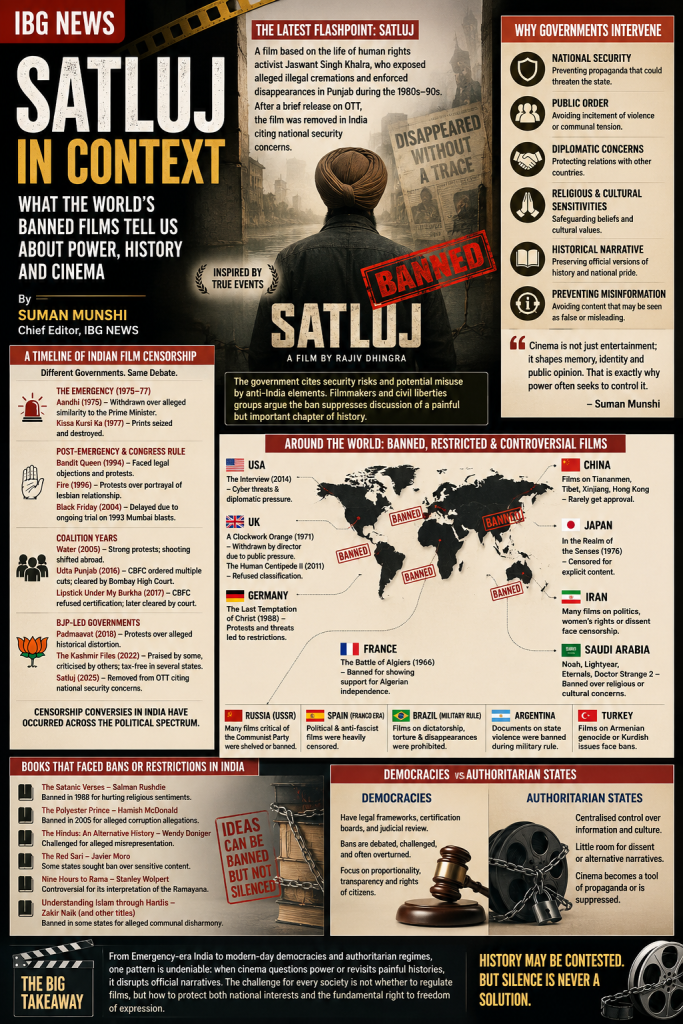
Satluj chronicles the work of Jaswant Singh Khalra, who documented allegations of illegal cremations and enforced disappearances during Punjab’s insurgency in the 1980s and 1990s. After years of certification disputes and title changes—from Ghallughara to Punjab ’95 and finally Satluj—the film briefly appeared on an OTT platform before being removed in India.
According to media reports, the Union Government cited national security concerns, arguing that certain portrayals could be exploited by anti-India elements or reignite separatist narratives. Meanwhile, the filmmakers, civil liberties advocates, and several legal experts contend that the removal suppresses discussion of an important historical period and limits artistic freedom. The issue is now the subject of legal scrutiny, illustrating the continuing tension between constitutional freedoms and state interests.
A Debate Older Than Independent India
The Satluj controversy is not unprecedented. Successive Indian governments of different political ideologies have faced criticism over controversial books and films.
During the Emergency (1975–1977) under Prime Minister Indira Gandhi, Aandhi was withdrawn because of perceived similarities between its protagonist and the Prime Minister, while Kissa Kursi Ka, a political satire, became one of India’s most famous censorship cases after its film prints were seized and later destroyed.
In later decades, Congress-led, coalition, and BJP-led governments have all witnessed disputes involving films such as Bandit Queen, Black Friday, Fire, Water, Udta Punjab, Padmaavat, Lipstick Under My Burkha, The Kashmir Files, and now Satluj. In several cases, courts ultimately determined whether films should be released, modified, or temporarily withheld.
This historical pattern demonstrates that film censorship controversies in India have occurred under governments across the political spectrum rather than being confined to any one party or ideology.
Books Have Faced Similar Challenges
Cinema has not been the only medium to attract official scrutiny.
Different governments have restricted or challenged books, including The Satanic Verses by Salman Rushdie, The Polyester Prince, The Red Sari, Nine Hours to Rama, The Hindus: An Alternative History, and Understanding Islam through Hadis. Some were formally banned under legal provisions, while others faced import restrictions, litigation, or withdrawal by publishers.
These cases reveal a recurring dilemma: how should governments balance freedom of expression with concerns relating to religion, public order, diplomacy, or national security?
The Global Pattern of Film Censorship
India’s experience reflects a broader international trend.
In Nazi Germany, Charlie Chaplin’s The Great Dictator was banned because it ridiculed Adolf Hitler and undermined Nazi propaganda.
The Soviet Union suppressed numerous films that questioned Communist Party leadership or challenged official historical narratives.
During Francisco Franco’s dictatorship in Spain, political films and anti-fascist works were routinely censored.
In China, films dealing with Tiananmen Square, Tibet, Xinjiang, Hong Kong, or criticism of Communist Party policies frequently fail to receive approval for domestic release. Authorities maintain that such regulation protects national unity and social stability.
Iran has produced internationally acclaimed filmmakers whose works often receive recognition abroad while facing domestic restrictions because of themes involving political dissent, women’s rights, or state authority.
Between 1983 and 2018, Saudi Arabia effectively prohibited commercial cinemas altogether. Although cinemas have reopened under Vision 2030 reforms, films continue to undergo content review, with several international releases reportedly denied exhibition because of religious or cultural concerns.
Democracies Also Restrict Films
Even established democracies have imposed limits.
In the United Kingdom, the British Board of Film Classification has, over different periods, refused certification or required substantial cuts for films such as Cannibal Holocaust, The Texas Chain Saw Massacre, and The Human Centipede II. During the “Video Nasties” era of the 1980s, many violent films were restricted before later being reclassified.
The United States presents a different model. Since the landmark Supreme Court ruling in Joseph Burstyn, Inc. v. Wilson (1952), films enjoy First Amendment protection, making nationwide content bans extremely rare. Nevertheless, controversial films such as The Birth of a Nation, The Last Temptation of Christ, and The Interview have faced local restrictions, legal disputes, or political pressure, demonstrating that debates over cinema and public interest continue even in jurisdictions with strong constitutional protections.
In Japan, In the Realm of the Senses encountered censorship because of explicit sexual content despite receiving international critical acclaim, highlighting the country’s balance between artistic freedom and obscenity laws.
Why Governments Intervene
Across different political systems, governments have generally justified restrictions on historical or controversial films using similar arguments:
- National security and protection against extremist propaganda.
- Prevention of communal or ethnic violence.
- Protection of public order.
- Safeguarding diplomatic relations.
- Protection of religious sentiments.
- Preservation of cultural values.
- Preventing misinformation or historical distortion.
Conversely, filmmakers, historians, constitutional scholars, and freedom-of-expression advocates argue that confronting difficult historical episodes through cinema strengthens democratic accountability and preserves collective memory.
The Role of the Courts
In democratic societies, the judiciary frequently becomes the final arbiter in disputes over artistic freedom.
Indian courts have repeatedly affirmed that freedom of expression is a constitutional right while also recognising that reasonable restrictions may apply under Article 19(2) of the Constitution in matters concerning sovereignty, security, public order, decency, morality, or incitement.
This judicial balancing act explains why many controversial films eventually reach audiences, albeit sometimes after edits, delays, or prolonged litigation.
Editorial Perspective
The history of cinema demonstrates that censorship is not exclusive to any single nation, ideology, or political party. Democratic governments, military regimes, monarchies, communist states, and authoritarian systems have all, at different times, sought to regulate films that challenged official narratives or revisited contested historical events.
The controversy surrounding Satluj therefore belongs to a much larger global conversation.
The real question is not whether governments should regulate cinema—every nation establishes some legal framework for film certification—but where the line should be drawn between legitimate public interests and the constitutional protection of artistic expression.
History suggests that films may be delayed, edited, restricted, or even banned, but public interest in contested historical events rarely disappears. As archives open, courts deliberate, scholars research, and filmmakers continue to tell difficult stories, societies are repeatedly called upon to reconcile freedom of expression with national responsibility.
The debate surrounding Satluj is therefore not merely about one film. It is part of a continuing global struggle over who interprets history, how nations remember their past, and what role cinema should play in shaping that memory.
(This article is an investigative analysis based on publicly reported information, historical records, court decisions, and documented examples of film censorship from India and around the world. It does not endorse any political viewpoint but examines the broader historical and constitutional issues surrounding film regulation.)