












West Bengal Must Aggressively Attract High-Tech Industries to Drive Economic Revival: Finance Minister Dr. Swapan Dasgupta
By Antara Tripathy, Editor, IBG NEWS
Kolkata, July 24, 2026: West Bengal Finance Minister Dr. Swapan Dasgupta has called for an aggressive push to attract high-technology industries, stating that sectors such as artificial intelligence, quantum computing, and data centres will play a crucial role in accelerating the state’s economic transformation and generating long-term employment.
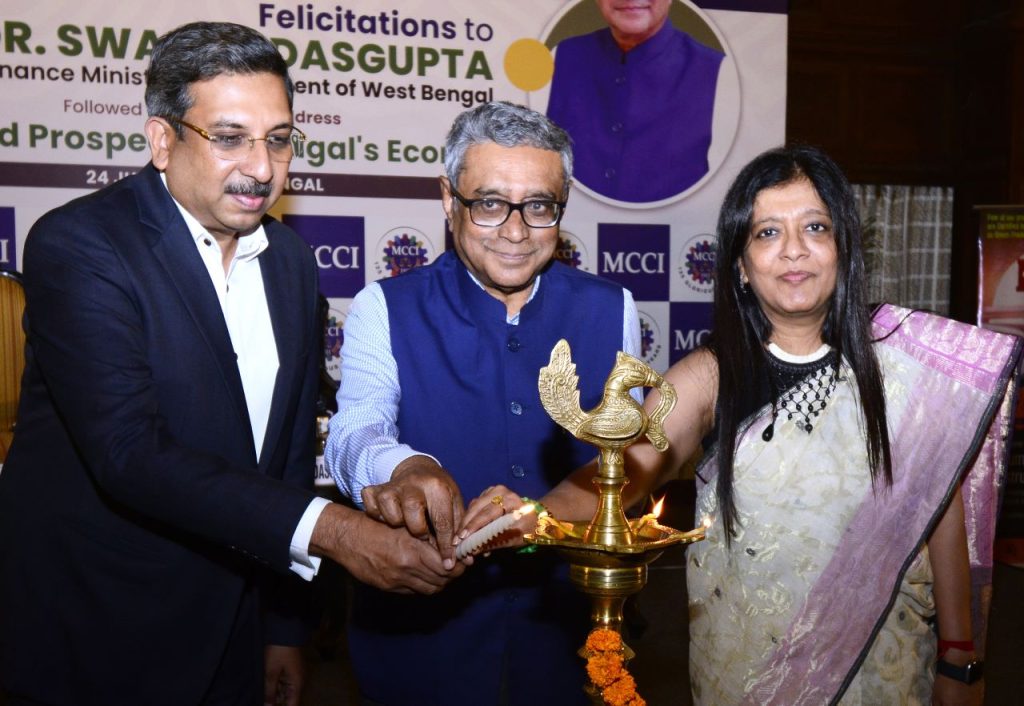
Addressing an interactive session on “Improved Prospects of Bengal’s Economy”, organised by the Merchants’ Chamber of Commerce & Industry (MCCI) at Taj Bengal on Friday, Dr. Dasgupta said the state government is committed to creating a business-friendly ecosystem backed by proactive industrial policies.
High-Tech Industries Key to Growth
The Finance Minister stressed that West Bengal must actively compete to bring in investments in emerging technologies with strong multiplier effects on the economy.
According to him, sectors such as AI, quantum computing, and data centres have the potential to stimulate innovation, create high-value jobs, and strengthen the state’s industrial ecosystem. He noted that while these industries require significant power and water resources, renewable energy, particularly solar power, could help meet future demand sustainably.
Restoring Bengal’s Industrial Image
Dr. Dasgupta acknowledged that reviving the manufacturing sector would take time, citing the long-term impact of the Singur controversy on investor confidence.
He remarked that the episode had contributed to the perception of West Bengal as an anti-industry destination, adding that rebuilding the state’s reputation remains a priority for the new government.
Pro-Industry Policy Framework
Highlighting the government’s economic agenda, the Finance Minister said the administration is preparing proactive policies to encourage investments while ensuring a level playing field for businesses across eastern India.
He stated that the government intends to facilitate land acquisition for industries and major infrastructure projects, recognising land availability as one of the biggest challenges to industrial expansion. He also reiterated that the administration is firmly committed to promoting industry and improving the overall ease of doing business.
Bringing Talent Back Home
Dr. Dasgupta observed that West Bengal has lost a significant share of its skilled workforce over the past five decades, particularly in high-technology sectors.
He expressed confidence that the state’s changing economic environment would encourage professionals who migrated elsewhere to return as new opportunities emerge.
Fiscal Challenges and Growth Strategy
The Finance Minister acknowledged that West Bengal continues to face a substantial debt burden but said the state’s latest budget is built around a growth-oriented strategy aimed at expanding the economy.
He emphasized that maintaining law and order, improving governance, and unlocking land tied up in closed industrial units are essential steps toward sustainable industrial growth.
Dr. Dasgupta also asserted that the government has taken a firm stand against the “Syndicate Raj” and is focused on creating a transparent, investor-friendly environment.
Employment and Infrastructure Remain Priorities
Employment generation will remain one of the government’s principal objectives, the Minister said, adding that improved industrial investment would directly contribute to job creation.
He also pointed out that the previous state administration had not fully leveraged Central Government schemes and stressed the importance of integrating West Bengal more closely with national development initiatives.
The government, he said, supports a moderate tax regime that encourages greater compliance while strengthening public finances.
Support for Traditional Industries
While outlining the government’s broader industrial strategy, Dr. Dasgupta said sectors such as jute and tea may receive temporary government support but emphasized that long-term sustainability depends on their commercial viability.
He also announced that the West Bengal Power Development Corporation is expected to be listed, signalling progress in the state’s disinvestment initiatives.
MCCI Calls for Modern Economic Reforms
Earlier in the programme, Priti A. Sureka, President of MCCI, welcomed the Finance Minister and highlighted the urgent need to reverse West Bengal’s economic slowdown through modern, investment-oriented policies.
She emphasized that economic revival would require a balanced approach combining welfare programmes, investment incentives, employment generation, infrastructure development, and skill enhancement to improve youth employability.
The session concluded with a vote of thanks by Munish Jhajharia, Senior Vice President of MCCI, who expressed optimism about the state’s renewed economic prospects under the new policy direction.
IBG NEWS Analysis
The Finance Minister’s address signals a clear shift towards positioning West Bengal as a competitive destination for advanced technology industries. By focusing on AI, quantum computing, data centres, infrastructure development, governance reforms, and investment-friendly policies, the government aims to rebuild investor confidence while laying the foundation for sustainable economic growth and high-quality employment across the state.