














501 Bengali Techno-Rhymes on Electrical Technology Earn India Book of Records Recognition
By Suman Munshi | IBG NEWS
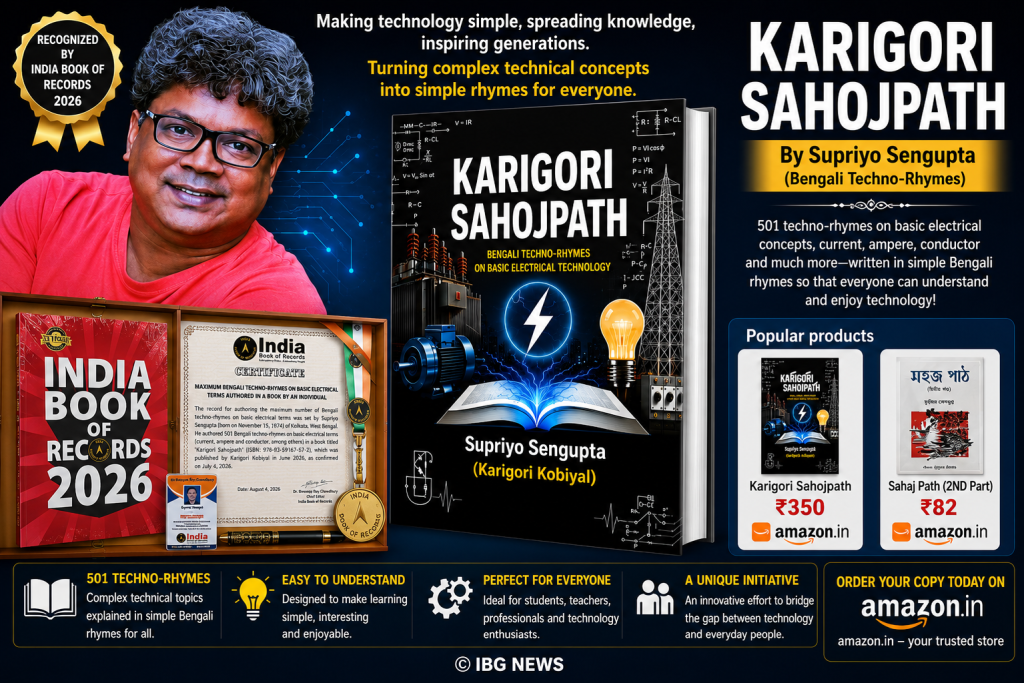
Kolkata: What if complicated electrical and technological concepts could be explained through simple Bengali rhymes? That unusual idea has taken a distinctive literary form in “Karigori Sahojpath” (কারিগরি সহজপাঠ), a book of Bengali techno-rhymes authored by Supriyo Sengupta, which has now earned a place in the India Book of Records 2026.
The recognition celebrates Sengupta’s achievement of authoring 501 Bengali techno-rhymes on basic electrical terms in a single book. According to the certificate shown with the award, the record covers Bengali techno-rhymes on basic electrical terminology, including subjects such as current, ampere and conductor, among others.
Turning Technology into Rhymes
Sengupta’s work comes from an unusual intersection of technology and literature. After more than three decades of professional experience in technology, he felt that technical knowledge was often presented in a way that could discourage people without formal technical education from asking questions or understanding the subject.
His answer was simple: if a technical concept can genuinely be understood, it should also be possible to explain it in language that an ordinary person can follow.
That thought eventually evolved into Karigori Sahojpath, a collection that attempts to bring technical subjects closer to readers through the familiar and entertaining format of Bengali rhyme.
From Electrical Basics to Everyday Technology
The book begins with fundamental electrical concepts and attempts to explain them through short, accessible verses. Instead of relying exclusively on technical terminology and conventional textbook-style explanations, Sengupta uses rhyme, humour and everyday language to make difficult ideas easier to approach.
The concept is particularly relevant at a time when technology has become inseparable from everyday life. Electricity, electronics, computers, communication systems and digital devices are no longer subjects confined to engineering laboratories—they influence almost every aspect of modern society.
The author seeks to bridge that gap between technical knowledge and everyday understanding.
501 Rhymes Become a Book
What started as individual experiments in writing gradually grew into a much larger collection. One rhyme led to another, and eventually the number crossed five hundred.
The result was a collection of 501 techno-rhymes, brought together in Karigori Sahojpath, published by Karigori Kobiyal in June 2026.
The book cover describes it as Bengali techno-rhymes dealing with basic electrical technology, presenting technical concepts in an accessible literary form.
India Book of Records 2026 Recognition
The achievement received formal recognition through the India Book of Records 2026.
The certificate accompanying the recognition records the achievement as:
“Maximum Bengali techno-rhymes on basic electrical terms authored in a book by an individual.”
The certificate identifies Supriyo Sengupta, born on 15 November 1974 in Kolkata, West Bengal, as the author of the 501 Bengali techno-rhymes.
The recognition was confirmed on 4 July 2026, according to the certificate displayed with the award.
A Different Approach to Technology Education
The significance of Karigori Sahojpath goes beyond the number 501.
The project proposes a different way of communicating technical knowledge—one that combines education, language and creativity.
For students, teachers and technology professionals, technical terminology is a familiar part of education and work. For many others, however, words such as current, ampere, conductor and other electrical concepts can appear intimidating.
By converting such concepts into Bengali rhymes, Sengupta attempts to make the first encounter with technical subjects less intimidating and more enjoyable.
Inspired by the Power of Bengali Rhyme
The project also reflects the enduring influence of Bengali rhyme and children’s literature, particularly the tradition associated with Sukumar Ray.
Rather than treating rhyme merely as entertainment, Karigori Sahojpath uses its rhythm and accessibility as a communication tool.
The underlying philosophy is straightforward:
Technology should not remain the language of specialists alone.
If technical knowledge can be expressed clearly in the language people naturally understand, it can reach a much wider audience.
More Than a Record
The India Book of Records recognition gives the project a formal distinction, but the larger achievement lies in attempting to create a bridge between technical education and Bengali literary expression.
At a time when technology is advancing rapidly and concepts such as artificial intelligence, electronics, automation and digital systems are becoming increasingly common, innovative methods of communicating technical knowledge in regional languages could have considerable educational value.
Karigori Sahojpath represents one such experiment—using 501 Bengali techno-rhymes to make electrical technology simpler, more approachable and more engaging.
For Supriyo Sengupta, the India Book of Records recognition is therefore not merely an award for completing a numerical target. It is also an acknowledgement of an idea: complex technology can be taught through simple language, creativity and the universal appeal of rhyme.
Supriyo Sengupta, better known as Karigori Kobiyal, who brought back the aura of Mahishasurmardini (Popular as Mahalaya) in English, is not only a talented person in technology but perhaps a more cherished cultural icon of Bengal for overseas people who want to understand the Durga Puja fragrance of Bengal in English. This recognition is just a milestone, and many more will come on the way. IBG NEWS is proud to have him as one of our editorial board members. ~ Suman Munshi, Chief Editor, IBG NEWS.
Suman Munshi
IBG NEWS

