











Book Review | Micky and The Magic App: A Delightful Journey Where Technology Meets Childhood Imagination
Varun’s Enchanting Children’s Fantasy Reminds Us That the Greatest Magic Lies in Kindness, Courage and Believing in Ourselves
By Suman Munshi
Chief Editor, IBG NEWS
Kolkata, 8 November 2026
In an age when childhood is increasingly shaped by smartphones, tablets, video games and digital entertainment, a simple question deserves our attention: What happens when technology becomes a doorway to imagination rather than merely another screen demanding attention?
Varun’s Micky and The Magic App offers a charming answer.
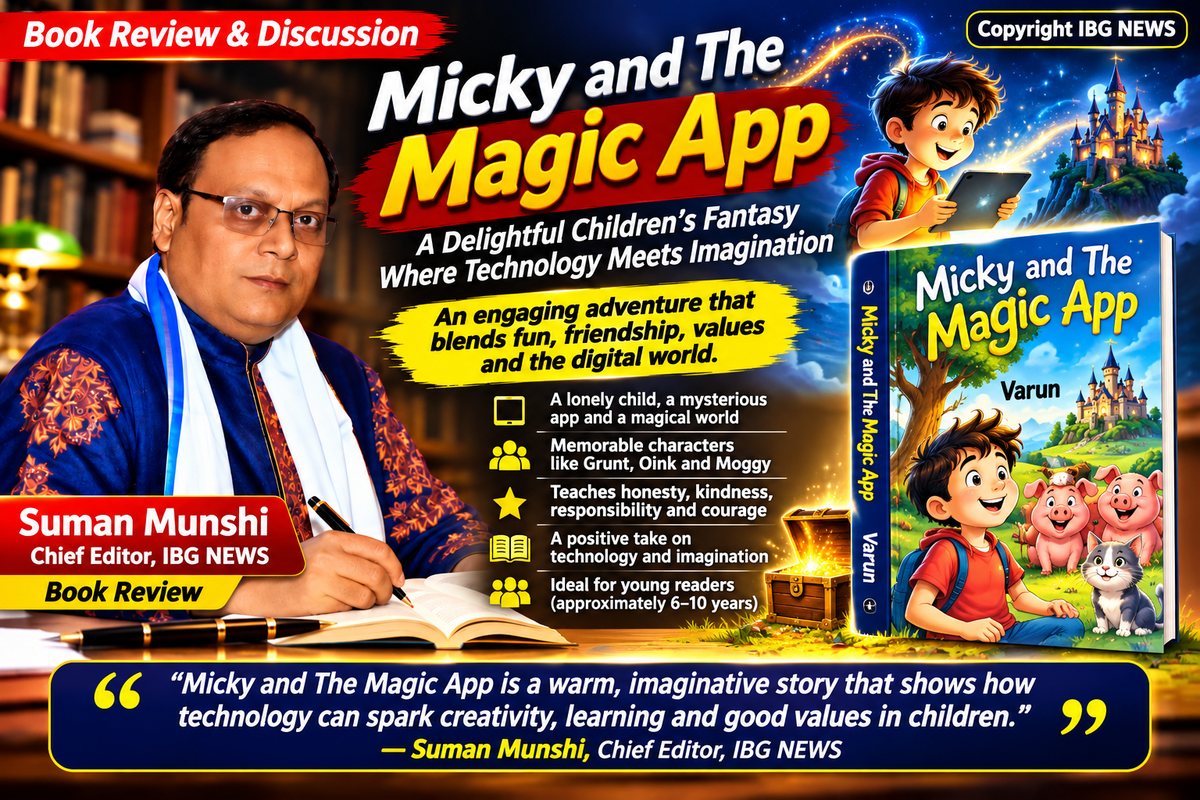
Published by Notion Press in 2017, this illustrated children’s fantasy takes readers into a colourful world where an ordinary application on an iPad becomes the entrance to an extraordinary adventure. Yet beneath its playful storytelling lies a thoughtful message about happiness, honesty, courage, humility and the importance of learning something new every day.
What makes this book particularly appealing is its ability to communicate familiar childhood values through a distinctly contemporary setting.
A Lonely Child, an iPad and an Unexpected Adventure
At the centre of the story is Micky, a six-year-old boy temporarily staying with his Aunt Maggie while his parents are away on a work-related trip.
Like many children, Micky misses his parents. Although surrounded by family, he struggles with loneliness. His older cousin Sarah is usually occupied with her mobile phone, while Aunt Maggie prefers television.
Micky finds companionship in his iPad.
One day, he discovers an application called the Magic App and downloads it. What initially appears to be another digital amusement soon develops into something wonderfully unexpected.
The application begins communicating with him, introducing him to an imaginative universe where ordinary rules no longer apply.
Here, technology does not replace imagination. It awakens it.
That distinction forms one of the book’s most engaging ideas.
Welcome to Magic Land: Where Happiness Is the Real Currency
Micky’s adventure introduces him to Grunt and Oink, two amusing magical pigs who welcome him into a world filled with extraordinary possibilities.
The young reader encounters talking animals, mysterious rooms, magical transformations and delightful characters, including Moggy, Cherub and other inhabitants of Magic Land.
One particularly interesting creation is the Fun Measurer, a magical device containing a mysterious substance called Omni.
In this imaginary world, happiness is not merely an emotion. It becomes a valuable resource that sustains the magical environment.
The inhabitants do not demand conventional money from Micky. Instead, they expect him to share happiness and follow a set of simple principles: respect his parents, speak the truth, help others, remain humble, maintain cleanliness, trust himself and continue learning.
It is a clever narrative device.
Rather than presenting moral education as a lecture, Varun builds these values into the rules of an adventurous fantasy world.
For young readers, the lessons emerge naturally from the story.
When Wishes Go Wrong: A Lesson in Responsibility
The story takes an entertaining turn when Sarah discovers the Magic App and attempts to use its powers for personal benefit.
Her wishes involving mobile phone balances and money produce consequences she never anticipated.
What begins as an amusing experiment quickly becomes a problem requiring Micky’s intervention.
This episode introduces an important lesson about careless decisions and the unintended consequences of greed.
It also provides one of the book’s more effective comic situations.
For adult readers, Sarah’s experience offers an additional interpretation: possessing powerful technology does not necessarily mean understanding its consequences.
In a world increasingly influenced by artificial intelligence, automated financial systems and digital applications, that message feels particularly relevant.
Of course, the book is a fantasy rather than a commentary on modern technology. Nevertheless, its central idea invites readers to consider the importance of judgment when using powerful tools.
The Treasure Hunt: Courage Beyond Magical Powers
The narrative becomes more adventurous when Micky undertakes a treasure hunt to help Sarah.
His journey through the Magic Forest introduces mysterious guides, difficult obstacles and Khoksh, the formidable guardian of an ancient treasure.
This section shifts the story from whimsical exploration towards a more traditional children’s adventure.
Micky must overcome fear, think independently and demonstrate perseverance.
Importantly, the solution does not come from magical power alone.
He must learn to trust his abilities, recognise his mistakes and confront challenges with determination.
The encounter with Khoksh is particularly significant because it transforms the idea of treasure into something larger than material wealth.
Micky’s real achievement lies in discovering his courage, developing confidence and understanding the value of helping someone in difficulty.
The treasure is the reward. Personal growth is the accomplishment.
The Emotional Heart of the Story
Although the book is filled with magical creatures and imaginative situations, its emotional foundation remains Micky’s longing for his parents.
This gives the fantasy a recognisable human dimension.
The reader understands why a lonely child might become fascinated by an imaginary world where friendship, excitement and affection are readily available.
The concluding chapters bring the adventure back to the family, connecting the mysterious application with Micky’s parents and offering a playful explanation for its existence.
The ending also introduces the idea of invention and patents, subtly encouraging curiosity about how new technologies are created.
It is a satisfying conclusion that brings together family affection, imagination and the excitement of discovery.
The Writing: Simple, Playful and Accessible
Varun adopts a conversational storytelling style suited to younger readers.
The language is generally straightforward, while the frequent exchanges between Micky and the magical characters create a lively atmosphere.
The story makes extensive use of humour, repetition and exaggerated expressions. These elements can work particularly well when the book is read aloud by parents or teachers.
The illustrations add another dimension to the experience.
Bright colours, cartoon-style characters and playful backgrounds help visualise the magical world. For children beginning to develop independent reading habits, these illustrations provide useful visual engagement.
The book’s greatest strength is its uncomplicated storytelling.
It does not attempt to overwhelm readers with complicated fantasy mythology. Instead, it allows ordinary childhood emotions and familiar moral choices to guide the adventure.
Where the Book Could Have Been Stronger
A meaningful review should also acknowledge the limitations of a work.
At times, the story explains its moral lessons rather directly. The rules governing Magic Land, for example, are presented explicitly rather than always being discovered through the characters’ actions.
Older or more experienced young readers may prefer greater subtlety.
Certain magical episodes also unfold conveniently, with problems resolved through imaginative interventions rather than extended conflict.
The dialogue occasionally becomes repetitive, and tighter editing could have improved the narrative pace.
However, these observations must be considered in the context of the book’s intended readership.
For younger children, repetition can reinforce understanding, while clear moral messages and reassuring resolutions can make a story more accessible.
The book is best approached as an introductory fantasy adventure rather than a complex work of children’s literature.
A Contemporary Message for Parents and Educators
Perhaps the most interesting aspect of Micky and The Magic App is its treatment of technology.
Children today encounter digital devices at increasingly young ages. Parents and educators frequently debate whether screens encourage creativity or discourage real-world interaction.
Varun’s story offers a different perspective.
The problem is not necessarily the presence of technology, but how it is used.
Micky’s iPad becomes a gateway to imagination, problem-solving, friendship and learning.
This is an especially valuable idea when digital literacy is becoming an essential part of childhood education.
The book also reinforces several principles relevant to emotional development: empathy, self-confidence, curiosity, honesty and responsibility.
Its central message is that happiness becomes more meaningful when it is shared.
Final Verdict: A Small Book with a Warm Heart
Micky and The Magic App is an affectionate children’s fantasy that successfully combines digital-age curiosity with traditional storytelling values.
Its imaginative characters, colourful illustrations and accessible language make it suitable for younger readers, particularly those who enjoy magical adventures and humorous situations.
The narrative may be simple, but its emotional intentions are sincere.
Varun reminds us that childhood imagination remains a powerful force, even in an era dominated by electronic screens.
More importantly, the story suggests that genuine magic does not depend on extraordinary devices or supernatural powers.
It begins with the courage to believe in oneself, the willingness to learn, the humility to acknowledge mistakes and the kindness to help others.
For parents looking for a gentle, imaginative story that can encourage conversations about technology, values and emotional growth, Micky and The Magic App is a worthwhile addition to a young reader’s bookshelf.
And perhaps its most enduring message is also its simplest:
The greatest magic is not in the app we download, but in the imagination, kindness and confidence we develop within ourselves.
Book Information
Title: Micky and The Magic App
Author: Varun
Publisher: Notion Press
First Published: 2017
Genre: Illustrated Children’s Fantasy / Adventure
Recommended Readership: Young children, especially approximately 6–10 years old, with parental guidance for emerging readers
Review: Suman Munshi, Chief Editor, IBG NEWS
Editor’s Note: This independent literary review is based on the supplied 47-page edition of the book. Interpretations and critical observations are those of the reviewer.

