











India’s GST Revenue Surges 22.9% to ₹2.31 Lakh Crore in October 2026; Import-Linked Collections Drive Nearly Half the Increase
Domestic GST Revenue Grows 15.8%, While Import-Related Tax Collections Jump 42.2%; West Bengal Records 17% Growth as Assam Leads Major States
By Anil P. Kastuar | Editor, IBG NEWS
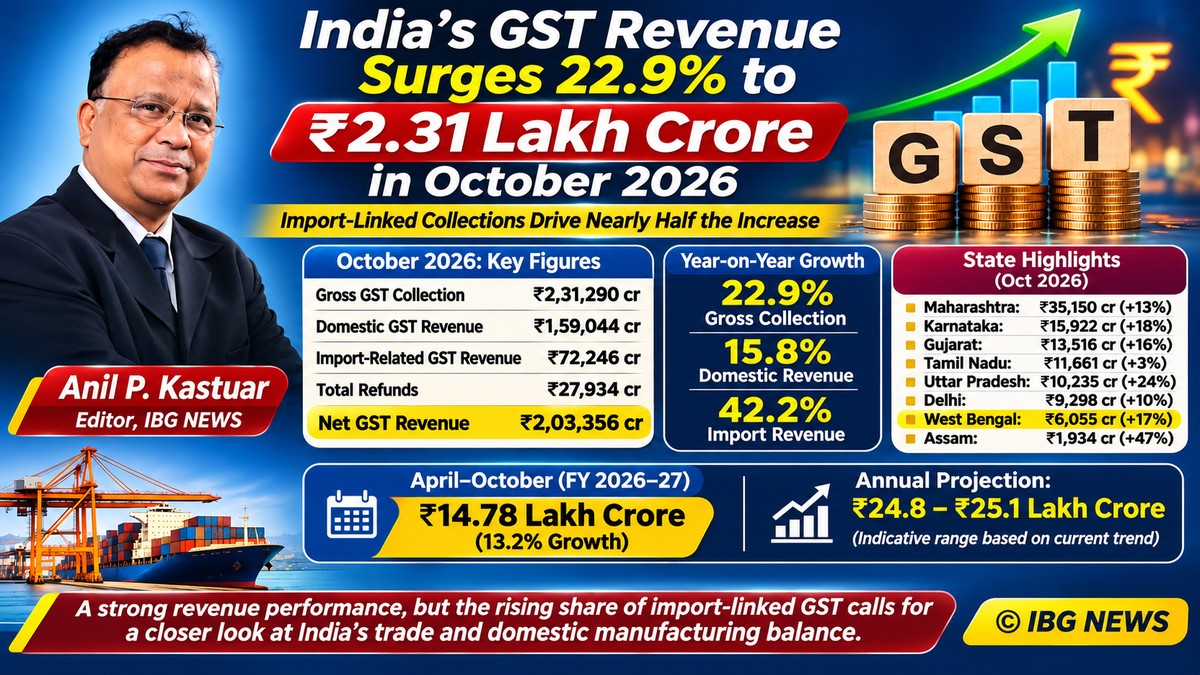
NEW DELHI, November 7, 2026: India’s Goods and Services Tax (GST) collections delivered a powerful performance in October 2026, with gross revenue reaching ₹2,31,290 crore, registering a 22.9% increase over ₹1,88,125 crore collected in October 2025. The latest figures indicate strong revenue mobilisation across the country, although a closer examination reveals that the sharp acceleration was driven almost equally by domestic transactions and a substantial increase in import-related tax collections.
According to provisional government figures released on November 1, October’s gross GST collection represents the second-highest monthly revenue since the introduction of GST in July 2017, on a comparable basis after accounting for the earlier compensation cess.
The performance comes amid continuing economic activity, festive-season demand expectations, improved tax administration and significant growth in imports.
However, the composition of the revenue increase deserves particular attention. While domestic GST collections rose by a healthy 15.8%, revenue from imports expanded by 42.2%, indicating that international trade and import-linked transactions played an unusually significant role in the month’s overall performance.
The development presents a positive picture for government revenue mobilisation while raising important questions about the balance between domestic production, consumption and import dependence in India’s evolving economy.
October 2026 GST Collections: The Numbers Behind the Growth
The principal figures highlight the scale of the October revenue performance.
| Revenue Indicator | October 2026 |
|---|---|
| Gross GST collection | ₹2,31,290 crore |
| Domestic GST revenue | ₹1,59,044 crore |
| Import-related GST revenue | ₹72,246 crore |
| Total refunds | ₹27,934 crore |
| Net GST revenue | ₹2,03,356 crore |
| Gross year-on-year growth | 22.9% |
| Net year-on-year growth | 25.6% |
Domestic revenue increased by 15.8% compared with the corresponding month of the previous year, while import-related collections registered growth of 42.2%.
After adjusting for refunds amounting to ₹27,934 crore, net GST revenue stood at ₹2,03,356 crore, representing a 25.6% annual increase.
The distinction between gross and net collections is important because refunds, particularly those associated with exports and eligible business transactions, influence the amount of revenue ultimately retained.
Import-Related GST: A Major Contributor to the Revenue Surge
One of the most significant findings in the October data is the unusually strong growth in import-related GST revenue.
Import-linked collections increased from approximately ₹50,796 crore in October 2025 to ₹72,246 crore in October 2026.
This represents an additional ₹21,450 crore in revenue within a year.
Domestic GST collections increased from approximately ₹1,37,328 crore to ₹1,59,044 crore, adding another ₹21,716 crore.
The total increase in gross GST collections was approximately ₹43,165 crore.
Consequently, the additional revenue was almost evenly divided between domestic and import-related collections.
In percentage terms:
- Domestic GST contributed approximately 50.3% of the additional revenue.
- Import-related GST contributed approximately 49.7%.
Import-related GST also increased its share of total gross collections from approximately 27% in October 2025 to 31.2% in October 2026.
This development deserves closer economic examination.
Higher import-linked revenue may reflect increased import volumes, rising values of imported goods, changes in international commodity prices, exchange-rate movements and a different composition of imported products.
Imports of industrial machinery, intermediate materials, electronic components, energy products and consumer goods can have very different implications for the domestic economy.
Therefore, the increase should not automatically be interpreted as a sign of declining domestic manufacturing. Equally, it should not be treated as conclusive evidence of strengthening domestic industrial capacity.
A detailed examination of import composition would provide a clearer picture of the economic forces behind the increase.
Domestic Economic Activity Shows Strong Revenue Growth
Despite the faster increase in import-related collections, domestic GST revenue also demonstrated considerable strength.
Domestic collections of ₹1,59,044 crore, representing 15.8% year-on-year growth, indicate continued expansion in the tax base associated with domestic economic transactions.
Several factors may contribute to this performance:
- Increased consumer spending and commercial transactions.
- Improved tax compliance and reporting.
- Expansion of the formal business economy.
- Greater use of digital invoicing and tax administration systems.
- Changes in prices and the value of taxable transactions.
- Industrial and service-sector activity.
However, GST revenue growth should not be confused directly with real GDP growth.
Tax collections are influenced by nominal transaction values, inflation, changes in consumption patterns, import activity, tax rates and compliance.
Consequently, the 15.8% increase in domestic GST revenue is an encouraging indicator of tax mobilisation, but it cannot independently establish the actual rate of expansion in real domestic economic output.
A comprehensive assessment would require comparison with industrial production, manufacturing output, retail consumption, services activity, employment and other macroeconomic indicators.
West Bengal Records 17% Growth in October GST Revenue
West Bengal delivered a positive performance, with GST revenue reaching ₹6,055 crore in October 2026, compared with ₹5,175 crore in October 2025.
The increase represents year-on-year growth of approximately 17%.
The State’s April–October SGST collections also recorded growth of 9%, reaching ₹29,608 crore against ₹27,109 crore during the corresponding period of the previous financial year.
This performance is significant for West Bengal’s economic and fiscal outlook.
The State’s revenue performance is influenced by its manufacturing base, trade networks, transport and logistics activity, services sector, retail markets and wider commercial transactions.
Kolkata’s role as an important commercial and distribution centre for eastern India also makes regional business activity relevant to the State’s indirect tax performance.
However, a single month’s collection cannot establish a sustained improvement in the State’s economic competitiveness. Continued monitoring of industrial investment, MSME activity, employment and the seven-month revenue trend will be important.
The October figures nevertheless provide an encouraging signal for West Bengal’s revenue mobilisation.
State-Wise GST Performance: Maharashtra Leads, Assam Records the Fastest Growth
Maharashtra remained the largest contributor among the States listed in the October collection data, with revenue of ₹35,150 crore.
Karnataka and Gujarat occupied the next positions.
Assam recorded the highest growth among the major States highlighted in the comparison, with a remarkable 47% increase.
The following figures show the performance of selected States:
| State | October 2026 Collection | YoY Growth |
|---|---|---|
| Maharashtra | ₹35,150 crore | 13% |
| Karnataka | ₹15,922 crore | 18% |
| Gujarat | ₹13,516 crore | 16% |
| Tamil Nadu | ₹11,661 crore | 3% |
| Haryana | ₹11,529 crore | 17% |
| Uttar Pradesh | ₹10,235 crore | 24% |
| Delhi | ₹9,298 crore | 10% |
| West Bengal | ₹6,055 crore | 17% |
| Telangana | ₹5,958 crore | 14% |
| Rajasthan | ₹4,937 crore | 16% |
| Odisha | ₹4,744 crore | 10% |
| Andhra Pradesh | ₹4,307 crore | 24% |
| Madhya Pradesh | ₹3,768 crore | 29% |
| Kerala | ₹3,486 crore | 23% |
| Punjab | ₹2,856 crore | 25% |
| Jharkhand | ₹2,821 crore | 31% |
| Assam | ₹1,934 crore | 47% |
| Bihar | ₹1,827 crore | 24% |
The figures indicate considerable differences in revenue growth across the country.
Assam’s 47% increase is particularly noteworthy, while Jharkhand, Madhya Pradesh, Punjab and Kerala also recorded strong growth.
By contrast, Tamil Nadu’s 3% increase was relatively modest.
These variations may reflect differences in industrial activity, consumption, the composition of taxable transactions, imports and the effectiveness of tax compliance.
The figures should therefore be interpreted within each State’s economic context rather than as a simple ranking of overall economic performance.
GST Collections from April to October: A Strong Fiscal Trajectory
India’s cumulative gross GST collections for April–October 2026 reached ₹14,77,569 crore, registering 13.2% growth over the corresponding period of the previous financial year.
This seven-month performance provides a more comprehensive picture than any individual month’s collection.
October’s 22.9% growth was substantially higher than the cumulative 13.2% increase, suggesting a particularly strong month within the financial year’s revenue trajectory.
Nevertheless, a single month’s performance should not be projected mechanically across the remaining financial year.
The average monthly gross collection during April–October stood at approximately ₹2.11 lakh crore.
If this average were maintained throughout the financial year, the annual gross collection would approach ₹25.33 lakh crore.
This is a mathematical annualisation, not an official government forecast.
A more cautious assessment would consider the remaining five months, seasonal variations, refund movements, import activity, consumption trends and possible changes in tax compliance.
An annual collection range of approximately ₹24.8–25.1 lakh crore can be considered an illustrative scenario, provided monthly revenue moderates somewhat from the seven-month average.
Actual performance will depend on economic conditions and the continuation of the present revenue trend.
GST Rate Rationalisation: Can Lower Tax Rates Support Higher Collections?
Another important factor in understanding the revenue performance is the GST rate rationalisation introduced in September 2025.
The transition towards a simplified two-principal-rate structure of 5% and 18%, alongside a special 40% rate for specified luxury and sin goods, was intended to simplify the tax framework and improve compliance.
The policy also sought to reduce the tax burden on selected categories of goods and services while making the system easier for businesses and consumers to understand.
The October 2026 collections suggest that revenue mobilisation has remained resilient despite the changes.
However, the year-on-year comparison must be interpreted carefully because the September 2025 rate changes influenced the base against which October 2026 is being measured.
The full impact of tax rationalisation should be assessed through a longer period of data covering consumption, taxable turnover, compliance, refunds and sector-wise revenue.
The objective should not merely be higher tax collection. It should be a tax system that encourages economic activity, improves compliance and provides predictable revenue to governments.
Digital Tax Administration and Compliance: An Important Structural Factor
India’s GST framework has undergone substantial digital transformation since its introduction.
Electronic invoicing, online return filing, automated reconciliation, data analytics and technology-supported risk assessment have helped improve the administration of indirect taxation.
These systems can assist authorities in identifying discrepancies, reducing certain forms of tax evasion and improving compliance.
The development of GST Appellate Tribunals is also important for strengthening dispute resolution and providing businesses with a more structured mechanism for addressing tax-related disagreements.
However, the contribution of individual digital enforcement initiatives to October’s additional ₹43,165 crore in revenue has not been separately quantified in the figures examined.
It would therefore be premature to attribute the entire increase to automated enforcement or fraud detection.
The long-term success of GST administration will depend on balancing effective enforcement with simplicity, transparency and reduced compliance costs for legitimate businesses, particularly micro, small and medium enterprises.
What Does the GST Performance Mean for India’s Economy?
The October collection figures provide several important economic signals.
First, government revenue mobilisation remains strong.
Gross collections exceeding ₹2.31 lakh crore demonstrate the scale of the country’s indirect tax base and the continuing importance of GST to public finances.
Second, domestic commercial activity remains resilient.
Growth of 15.8% in domestic GST revenue indicates a substantial expansion in the value of taxable domestic transactions.
Third, imports have become a major contributor to the latest revenue increase.
The 42.2% rise in import-related collections requires closer examination of India’s external trade structure and the role of imported inputs in domestic production.
Fourth, regional revenue performance remains uneven.
Strong growth in Assam, Jharkhand and several other States contrasts with more moderate expansion in Tamil Nadu and other regions.
Fifth, the quality of economic growth matters more than the tax collection figure alone.
For a sustainable economy, stronger tax revenues must ultimately be supported by productive investment, manufacturing competitiveness, employment generation, domestic value addition and improved household purchasing power.
The Road Ahead: From Revenue Mobilisation to Productive Economic Expansion
India’s GST framework has become an important instrument for formalising economic transactions and strengthening the country’s fiscal architecture.
The October 2026 performance is encouraging, but the next stage of development requires a broader focus.
Policymakers should examine how to:
- Strengthen domestic manufacturing and value addition.
- Improve the competitiveness of Indian MSMEs.
- Encourage investment in technology and industrial infrastructure.
- Reduce unnecessary compliance burdens on smaller businesses.
- Improve the efficiency of exports and logistics.
- Monitor the relationship between import growth and domestic production.
- Ensure that GST rate rationalisation delivers sustainable economic benefits.
- Strengthen the predictability and transparency of tax administration.
The objective should be to transform strong revenue mobilisation into a foundation for higher productivity, employment and economic opportunity.
Conclusion: A Strong GST Month, but the Quality of Growth Will Define India’s Economic Future
India’s October 2026 GST collection of ₹2,31,290 crore is an important achievement in revenue mobilisation.
The 22.9% annual increase, combined with a cumulative April–October growth rate of 13.2%, reflects a resilient tax system and substantial economic activity across domestic and international transactions.
West Bengal’s 17% growth and Assam’s 47% increase also demonstrate the encouraging performance of several regional economies.
Yet, the composition of the revenue increase offers an important lesson.
Almost half of the additional GST revenue came from import-related collections. This makes it necessary to look beyond the headline figure and examine the relationship between imports, domestic production, consumption and industrial competitiveness.
Higher GST collections strengthen the government’s capacity to finance infrastructure, public services and development programmes. But long-term economic strength depends on creating productive employment, expanding domestic industries, encouraging innovation and improving the purchasing power of citizens.
India’s October GST performance is a positive fiscal milestone. The greater national objective, however, must be to convert this revenue strength into stronger domestic production, wider economic opportunity and sustainable prosperity.
By Anil P. Kastuar
Editor, IBG NEWS
Business, Economy & National Affairs
Editorial note: October 2026 GST figures are based on provisional government revenue data. State-wise collections and year-on-year growth rates may undergo minor revisions. Annual projections in this report are illustrative calculations, not official government estimates.

