











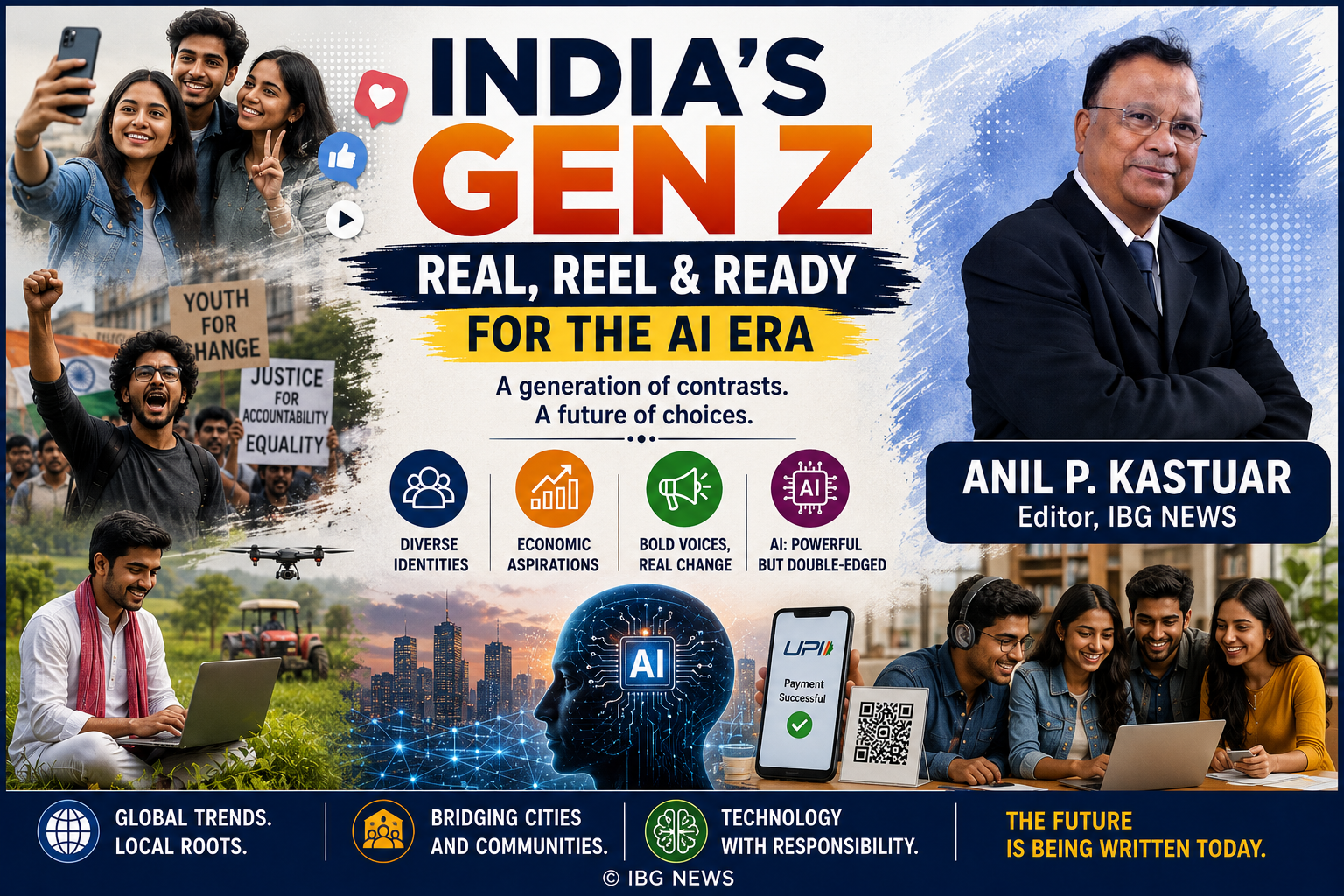
India’s Gen Z: Navigating the “Real” and “Reel” Worlds in the Age of AI
By Anil P. Kastuar, Editor | IBG NEWS
India’s Generation Z is emerging as one of the country’s most influential demographic groups, shaped simultaneously by smartphones, social media, economic pressures, regional identities and rapidly advancing artificial intelligence.
Far from being simply a generation obsessed with digital entertainment, Indian Gen Z appears to be negotiating a complicated relationship between its online identity and offline reality. Social-media platforms expose young Indians to global trends, while family structures, employment challenges, political concerns and regional realities continue to influence their everyday lives.
The “Reel” Versus the “Real”
The contrast between the digital and physical worlds is particularly visible in the lifestyle of young Indians.
Online, young people may present carefully curated fashion, lifestyle and entertainment content. Offline, many continue to navigate traditional family expectations and social structures. Similarly, political engagement can appear online through memes and short videos but may translate offline into activism and demands for greater accountability.
National pride also exists alongside dissatisfaction. Young Indians can celebrate technological achievements such as India’s digital-payment ecosystem while simultaneously expressing frustration over unemployment, corruption and institutional shortcomings.
This combination suggests that patriotism among Gen Z does not necessarily mean unquestioning support for institutions. For many, criticism of governance can itself be viewed as an expression of civic responsibility.
India’s Gen Z Is Not One Uniform Community
The country’s enormous regional and socioeconomic diversity produces very different Gen Z experiences.
Young people in metropolitan and Tier-1 cities are heavily exposed to international fashion, niche online communities, café culture and global entertainment trends. At the same time, they face high living expenses, workplace stress and the pressures associated with rapidly changing social relationships.
For rural and Tier-3 youth, digital platforms often serve a different purpose. Regional-language entertainment, local humour, music and newly acquired digital skills provide avenues for expression and visibility. Yet these young people may also face weaker physical infrastructure, intense competition for government employment and strong community or social pressures.
The same smartphone, therefore, can represent very different things: a lifestyle window for one young person and a potential pathway to economic mobility for another.
Regional Languages Are Reshaping Digital India
One of the most significant developments highlighted in the report is the expansion of India’s vernacular digital culture.
Hindi, Tamil, Telugu, Bhojpuri, Punjabi and other Indian languages are increasingly becoming powerful vehicles for online content. Young creators from smaller cities and rural communities are using short-form video to promote local festivals, cuisine, music and dialects.
This trend is also encouraging cultural hybridity. Traditional Indian clothing and music are increasingly being combined with contemporary fashion and digital culture. Instead of simply replacing local traditions with global influences, Gen Z is creating a hybrid identity that brings both worlds together.
The shift challenges the older, predominantly Bollywood-centred understanding of Indian popular culture.
From Smartphone to Economic Opportunity
For rural and Tier-3 youth, the smartphone is increasingly becoming an economic instrument rather than merely a source of entertainment.
Creators can use digital platforms to market agricultural knowledge, handicrafts, regional food and other local products, potentially reaching customers without depending entirely on traditional urban intermediaries.
Urban youth, meanwhile, are increasingly participating in freelance work, content creation and the gig economy. But these opportunities come with financial uncertainty, particularly amid rising living costs and limited availability of traditional entry-level corporate jobs.
Digital payments have added another dimension to this transformation. Instant cashless transactions have helped create a common digital consumption environment connecting young consumers across geographical and economic boundaries.
Gen Z Could Become a Political Wildcard
The political influence of India’s young generation is likely to become increasingly important.
The report suggests that younger voters may be less attached to rigid political loyalties and more responsive to local economic conditions, digital transparency, cultural identity and concerns over institutional performance.
Political parties are therefore facing a new communication environment.
Traditional, highly scripted political messaging may have less impact on an audience accustomed to spontaneous short-form content. Young voters are increasingly exposed to political narratives through memes, videos, interviews and algorithmically selected content.
Issues surrounding recruitment examinations, employment and alleged institutional irregularities could become especially influential among young voters, particularly outside major metropolitan centres.
Regional political organisations may also gain an advantage by communicating directly with voters in local languages and addressing highly specific regional concerns.
Artificial Intelligence: Opportunity and Risk
Artificial intelligence could become one of the defining technologies of Gen Z’s future.
The report describes AI as a potential equaliser capable of reducing barriers to skills, education, entrepreneurship and digital creativity. Tools for automated video editing, captioning and translation could help creators from smaller towns produce sophisticated content without extensive technical resources.
Education is another major area of potential transformation. Personalised AI tutoring could provide affordable assistance to students who cannot access expensive coaching programmes, including those preparing for competitive examinations such as JEE, NEET and UPSC.
Generative AI could also accelerate professional upskilling. Coding assistants and automated design tools may allow young people to experiment with software development, digital businesses and local entrepreneurship more rapidly.
AI-based financial tools are similarly presented as a potential means of improving financial literacy by making complex information easier to understand. However, financial decisions involving investments still require independent verification and appropriate risk assessment.
The Darker Side of the AI Revolution
The opportunities come with significant risks.
Automation could reduce the availability of some traditional entry-level jobs in areas such as basic coding, data processing, content production and customer support. For young graduates entering the labour market, this could intensify competition and increase dependence on less stable forms of employment.
Another major concern is the rapid development of deepfakes.
AI-generated images, videos and cloned voices can make fabricated material appear authentic. The report specifically highlights the danger of non-consensual deepfakes targeting women, as well as the potential for political manipulation, fraud and targeted propaganda.
The distinction between what is genuine and what is artificially generated could consequently become increasingly difficult for ordinary users to determine.
The Mental Health and Attention Challenge
AI-driven platforms can also influence how Gen Z interacts with information and other people.
Highly personalised algorithms may create increasingly narrow information environments, reinforcing existing opinions and producing digital echo chambers. The growing availability of human-like AI companions also raises questions about whether excessive dependence on artificial interaction could weaken real-world relationships.
The report further raises the issue of cognitive outsourcing—the possibility that excessive reliance on AI for writing, coding, analysis and problem-solving could reduce opportunities to develop independent reasoning skills.
The Choice Between Empowerment and Dependence
The document’s concluding framework presents AI as a technology capable of producing sharply contrasting outcomes.
In employment, AI could help individuals establish technology-based businesses, but it could also increase competition for traditional knowledge-sector jobs. In information, automated research and verification could improve access to knowledge while synthetic media could undermine confidence in digital evidence. At the psychological level, AI could expand access to information and support tools while simultaneously intensifying screen dependence, echo chambers and social isolation.
The Generation That Could Redefine India’s Digital Future
India’s Gen Z cannot be reduced to social-media trends.
It is a generation negotiating traditional family structures and global culture, regional identities and international influences, economic ambition and employment uncertainty, political pride and institutional criticism.
The growing power of AI adds another layer to this transformation.
Used responsibly, AI could democratise education, creativity, entrepreneurship and access to information. Used without adequate safeguards or critical thinking, it could contribute to job displacement, misinformation, deepfake abuse, social isolation and declining independent reasoning.
The central challenge for India’s Gen Z will therefore not be whether to embrace technology. It will be learning how to remain human, independent and critically minded while technology becomes increasingly capable of thinking, creating and communicating on its behalf.
India’s next digital chapter may ultimately be shaped not by the most powerful algorithm, but by the generation that learns how to use those algorithms without surrendering its judgement to them.
— Anil P. Kastuar
Editor, IBG NEWS