







Nawab Akbar Khan Bugti Remembered: A Lasting Symbol in Baloch Political History
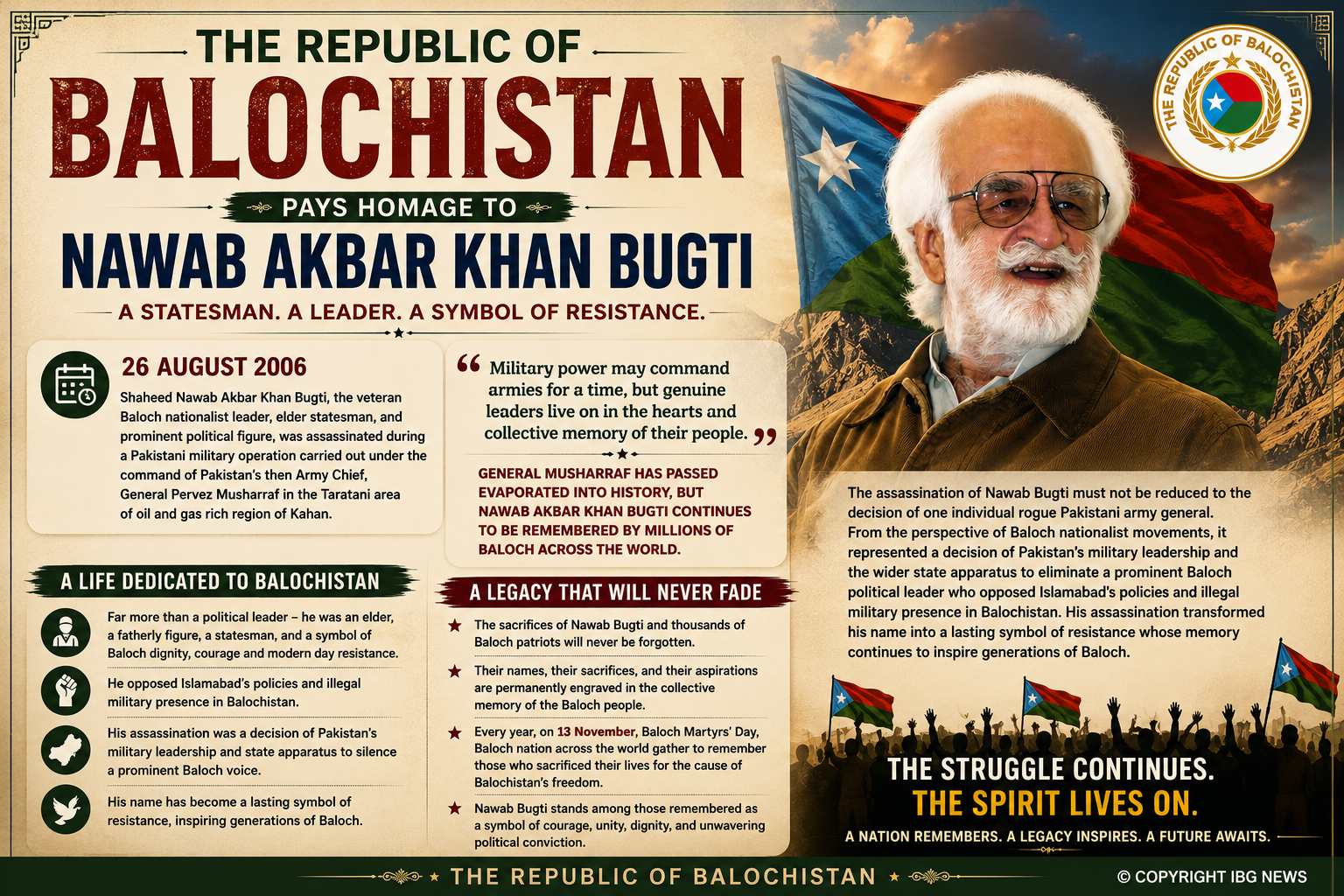
August 26: The death anniversary of Nawab Akbar Khan Bugti continues to hold deep significance for Baloch nationalist groups and communities who regard the veteran politician and tribal leader as an enduring symbol of Baloch identity, political conviction and resistance.
Nawab Akbar Khan Bugti was killed on August 26, 2006, during a Pakistani military operation in the mountainous region of Balochistan. His death marked a major turning point in the province’s already turbulent political history and intensified the conflict between Baloch nationalist forces and the Pakistani state.
Bugti was a prominent political figure who had served as Governor and Chief Minister of Balochistan and remained an influential voice on issues concerning provincial autonomy, political rights and the distribution of the province’s natural resources.
From Statesman to Symbol
For his supporters, Bugti represented much more than his formal political positions. He was regarded as an elder statesman and an important figure in the Baloch political movement. His opposition to Islamabad’s policies and his increasingly confrontational position during the conflict made him one of the most recognisable faces of Baloch resistance.
His death subsequently acquired a significance that extended beyond the circumstances of the military operation itself. Among Baloch nationalist circles, Bugti came to be remembered as a symbol of political determination and resistance to what they describe as the domination of Balochistan by Pakistan’s central authorities.
The circumstances surrounding his death remain politically contested. Pakistani authorities presented his death as the outcome of a military operation, while Baloch nationalist organisations have consistently described it as the killing of a prominent political leader who had challenged the state’s policies in the province.
Balochistan’s Long-Standing Grievances
Bugti’s political legacy is closely connected with longstanding disputes over Balochistan’s political autonomy, control of natural resources and the distribution of economic benefits.
The province possesses substantial deposits of natural gas and other mineral resources, while nationalist groups have repeatedly argued that local communities have not received an adequate share of the benefits generated from those resources.
These grievances, combined with allegations of military operations, disappearances and restrictions on political activity, have remained central to the wider Baloch nationalist narrative.
A Memory That Endures
The passage of time has not diminished Bugti’s importance among his supporters. Instead, his death has become an important part of the political memory surrounding the Baloch national movement.
Every year, Baloch nationalist organisations and supporters commemorate those they consider martyrs of the Baloch cause. Baloch Martyrs’ Day, observed on November 13 by sections of the Baloch nationalist movement, is one such occasion on which the sacrifices of those killed during the decades-long conflict are remembered.
Within that narrative, Bugti occupies a particularly prominent position because of his background as both a senior political leader and a powerful tribal figure.
A Contested Chapter in Balochistan’s History
Nawab Akbar Khan Bugti’s legacy remains interpreted differently by different sides. His supporters view him as a defender of Baloch political rights, dignity and autonomy, while his critics associate him with the armed conflict that accompanied his final years.
What remains undeniable is the impact his death had on Balochistan’s political landscape. The events of August 2006 deepened an already serious confrontation and turned Bugti into a lasting symbol within Baloch nationalist politics.
Nearly two decades after his death, debates over political representation, provincial autonomy, natural-resource ownership, human rights and the role of the military continue to shape discussions about Balochistan.
For those who continue to honour his memory, Nawab Akbar Khan Bugti represents a political legacy built around courage, identity and an unwavering demand for recognition of Baloch aspirations.
By Suman Munshi | IBG NEWS