











India’s Hilsa Trade Flow Turns: Gujarat Emerges as a Key Source for Bangladesh
By Anil P. Kastuar
Editor, IBG NEWS
NEWS DESK | EXCLUSIVE ANALYSIS
Surat/Kolkata, September 19, 2026
SPECIAL REPORT: The 2026 India-Bangladesh Hilsa Trade Reversal – Ecological Realities vs. Geopolitical Myths
BHARUCH TO CHATTOGRAM: INSIDE THE HISTORIC 500 TONNE HILSA TRADE REVERSAL
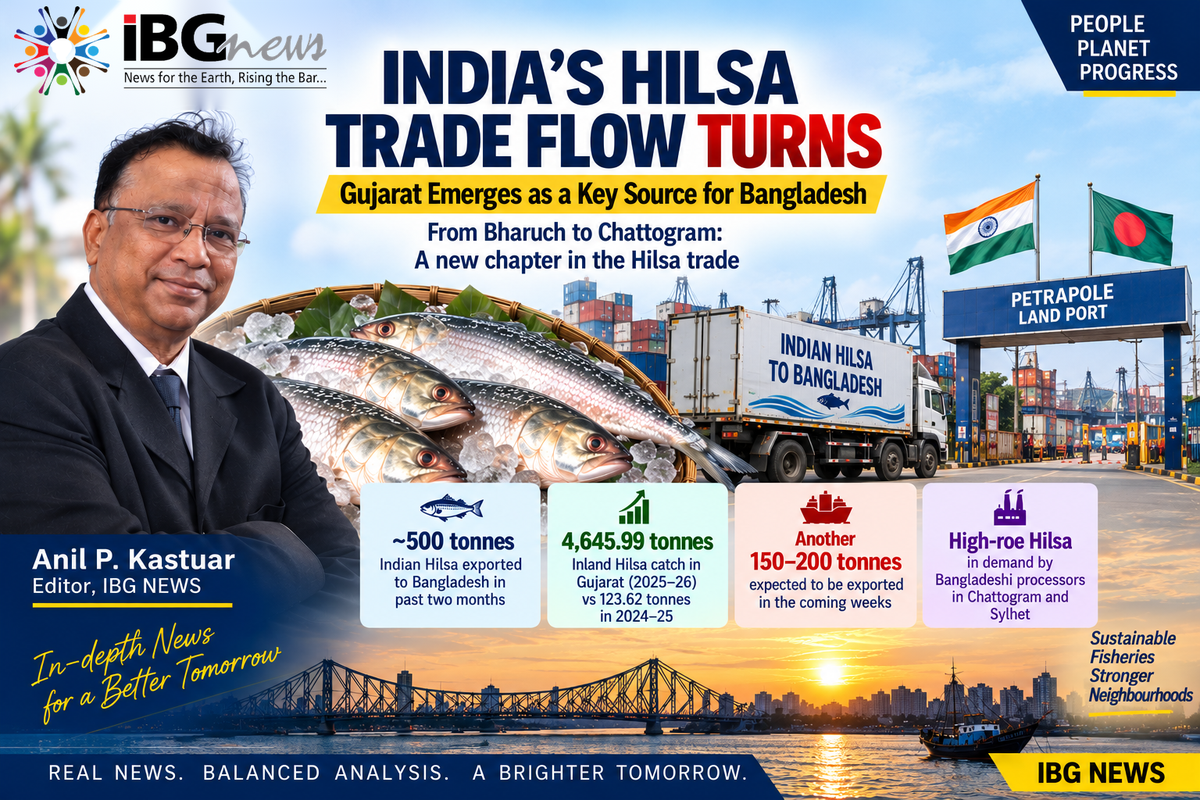
KOLKATA — In a historic shift that has caught regional market analysts by surprise, India has exported approximately 500 tonnes of Hilsa fish to Bangladesh over the last two months. For decades, the cross-border trade of the highly prized “Ilish” moved exclusively in the opposite direction—flowing from Bangladesh’s major rivers into the festive markets of West Bengal as a cornerstone of bilateral cultural diplomacy. However, a combination of localized domestic deficits in Bangladesh and a massive biological run on India’s west coast has flipped the traditional supply chain on its head.
According to latest shipping data from the Petrapole land port and wholesale records at the Howrah fish market, an additional 150 to 200 tonnes of Hilsa are expected to clear customs in the coming weeks, bringing the total seasonal export volume to nearly 700 tonnes.
While online opinion pieces and unverified reports have sensationalized this trade reversal as an aggressive macroeconomic coup or an asymmetric lever in transboundary water sharing negotiations, the on the ground reality is rooted purely in commercial supply and demand mechanics, ecological shifts, and specific regional processing needs.
The Gujarat Supply Surge: Anatomy of a Monsoonal Miracle
The backbone of this reverse trade pipeline sits thousands of kilometers away from the Bay of Bengal. India’s recent export volume was driven by an unprecedented surge in wild, inland Hilsa landings along the Narmada River basin in the Bharuch region of Gujarat.
Hilsa is an anadromous species, meaning it migrates from the marine environment into clean, freshwater river systems to spawn during heavy monsoon flushes. Over the 2024–2025 and 2025–2026 cycles, while eastern rivers like the Hooghly and Padma faced heavy siltation and upstream ecological pressures, the Narmada and Tapi rivers in western India experienced optimal freshwater discharge. This ecological alignment drew millions of wild Hilsa into Gujarat’s river networks, causing documented inland catches to skyrocket from a baseline of just 123 metric tonnes in previous cycles to an astonishing peak of over 4,600 tonnes.
 The 'Roe' Dynamic and Processing Demand in Chattogram
The sudden flow of Gujarat Hilsa into Bangladesh highlights an intricate, value-added trade loop governed by distinct consumer preferences:
- The Domestic Disconnect: The Hilsa caught along India’s west coast is exceptionally heavy with roe (fish eggs). For the traditional consumer base in Kolkata and broader West Bengal, roe-heavy Hilsa is historically less favored, as local culinary preferences strongly favor the leaner, distinct texture of eastern river catches.
- The Bangladeshi Processing Fit: Conversely, this exact high roe characteristic made the Gujarat catch highly attractive to industrial seafood processors in Bangladeshi hubs like Chattogram and Sylhet. Facing severe raw material shortages due to a temporary 5.5% dip in their local river yields, Bangladeshi merchants eagerly moved to import the Indian surplus.
- The Value Loophole: In Chattogram’s processing plants, workers extract and separate the lucrative roe, which is meticulously preserved, packaged, and re-exported to global gourmet markets for premium foreign currency. The remaining fish meat is then salted, dried, and distributed domestically across Bangladesh’s domestic markets as a highly stable, affordable food source. Grounding the Geopolitical Context.
- For IBG NEWS readers and regional policymakers, separating hyperbole from hard economic data is essential. This commercial trade reversal does not signal a permanent dismantlement of Bangladesh’s long-standing position as the global epicentre of Hilsa production, nor does it structurally rewrite the diplomatic dynamics governing complex cross-border agreements like the Teesta River water sharing framework or the Ganges Water Treaty.
Instead, the 500-tonne export proves the agility of Indian trade channels. By seamlessly routing excess western coast catches through the Howrah wholesale grid to fulfill a critical, temporary supply gap across the border, Indian merchants have stabilized their own internal prices while successfully tapping into an international, value-added manufacturing supply chain.
But this definitely shows that proper Fisheries and Trade can leverage the Hilsa global market for Gujarat and India too.
Comparative Analysis: Gujarat Hilsa vs. Padma Hilsa
| Feature / Attribute | Gujarat Hilsa (West Coast / Narmada) | Padma Hilsa (East Coast / Bangladesh) |
|---|---|---|
| Primary Habitat & Origin | Migrates from the Arabian Sea into the clean, massive monsoon freshwater flushes of the Narmada and Tapi rivers (Bharuch region). | Migrates from the Bay of Bengal into the Padma, Meghna, and Hooghly river systems. |
| Physical Characteristics & Weight | Tends to be heavier and broader, frequently packed with highly lucrative roe (eggs) during the peak catch season. | Typically sleeker, elongated, and possessed of a higher fat-to-body ratio when caught before spawning. |
| Flavor Profile & Texture | Has a slightly firmer texture and a milder flavor. The meat is leaner because a significant portion of its nutritional energy is diverted into egg production. | Renowned for its rich, buttery, and oily texture. The melting fat infuses the meat with the highly prized, distinct “Ilish” aroma. |
| Roe (Egg) Content | Exceptionally high. The vast majority of the catch consists of mature, roe-heavy fish. | Variable. Strict conservation and seasonal fishing bans in Bangladesh aim to catch the fish before they spawn to preserve meat quality. |
| Domestic Market Preference | Facing lower demand in West Bengal, as local culinary traditions strongly favor the oily, tender texture of eastern river catches. | The gold standard in Bengali cuisine. It commands the highest premium prices in retail markets across Kolkata and Dhaka. |
| Commercial Processing & Destination | Transported via Howrah to Chattogram and Sylhet (Bangladesh), where processing hubs extract the lucrative roe for global export and salt/dry the meat. | Primarily consumed fresh or frozen in domestic Bangladeshi and Indian markets; highly restricted for international trade. |
| Supply Dynamics (2025–2026) | Experienced an ecological boom, with inland landings in Gujarat skyrocketing to over 4,600 metric tonnes. | Faced localized catch deficits due to heavy river siltation and upstream pollution, triggering a temporary supply shortage. |
The New Biological Corridor of the Bay Trade
The quiet reversal of the Hilsa trade pipeline—sending hundreds of tonnes of Gujarat-harvested fish across the border into Bangladesh—is a stark reminder that nature and market forces will always outpace rigid political positioning. For decades, the Ilish has been treated as an instrument of soft-power diplomacy, a seasonal lever pulled to gauge bilateral warmth. However, the closing chapters of the 2026 monsoon season have proven that supply chains are living, breathing ecosystems that route around artificial blocks.
What we are witnessing is not a hostile takeover of the market, but a brilliant, pragmatic alignment of ecological luck and commercial agility. Driven away by the heavy siltation and mounting pollution of its traditional eastern sanctuaries, the wild Hilsa has carved out a new biological corridor along India’s West Coast. The massive freshwater flushes of the Narmada River have effectively decentralized a global monopoly.
Yet, the true genius of this shift lies in the commercial compromise between taste and utility. By routing the roe-heavy, lean Gujarat catch straight to the processing hubs of Chattogram and Sylhet, traders have turned a variant traditionally sidelined by West Bengal’s culinary purists into a high-value manufacturing asset for Bangladesh. The roe funds global foreign exchange, while the salted meat stabilizes local markets.
Ultimately, this reverse trade flow defangs the narrative of the Hilsa as a geopolitical weapon. It shows that India’s domestic supply lines are highly diversified and deeply resilient. As cross-border water and trade talks continue to evolve, the message from the sea is clear: resource management can no longer be dictated by historical assumptions. In the modern global economy, adaptability is the ultimate currency.
Reported by the IBG NEWS Desk.
Sources: Petrapole Customs Clearing Agent Records, Howrah Fish Importers Association Annual Briefing, Ministry of Fisheries Data (September 2026).
By Anil P. Kastuar
Editor, IBG NEWS