














IGNCA Hosts International Round Table on Sindhu Sarasvati Civilisation, Exploring Archaeological Evidence and Cultural Continuity
By Suman Munshi,IBG NEWS
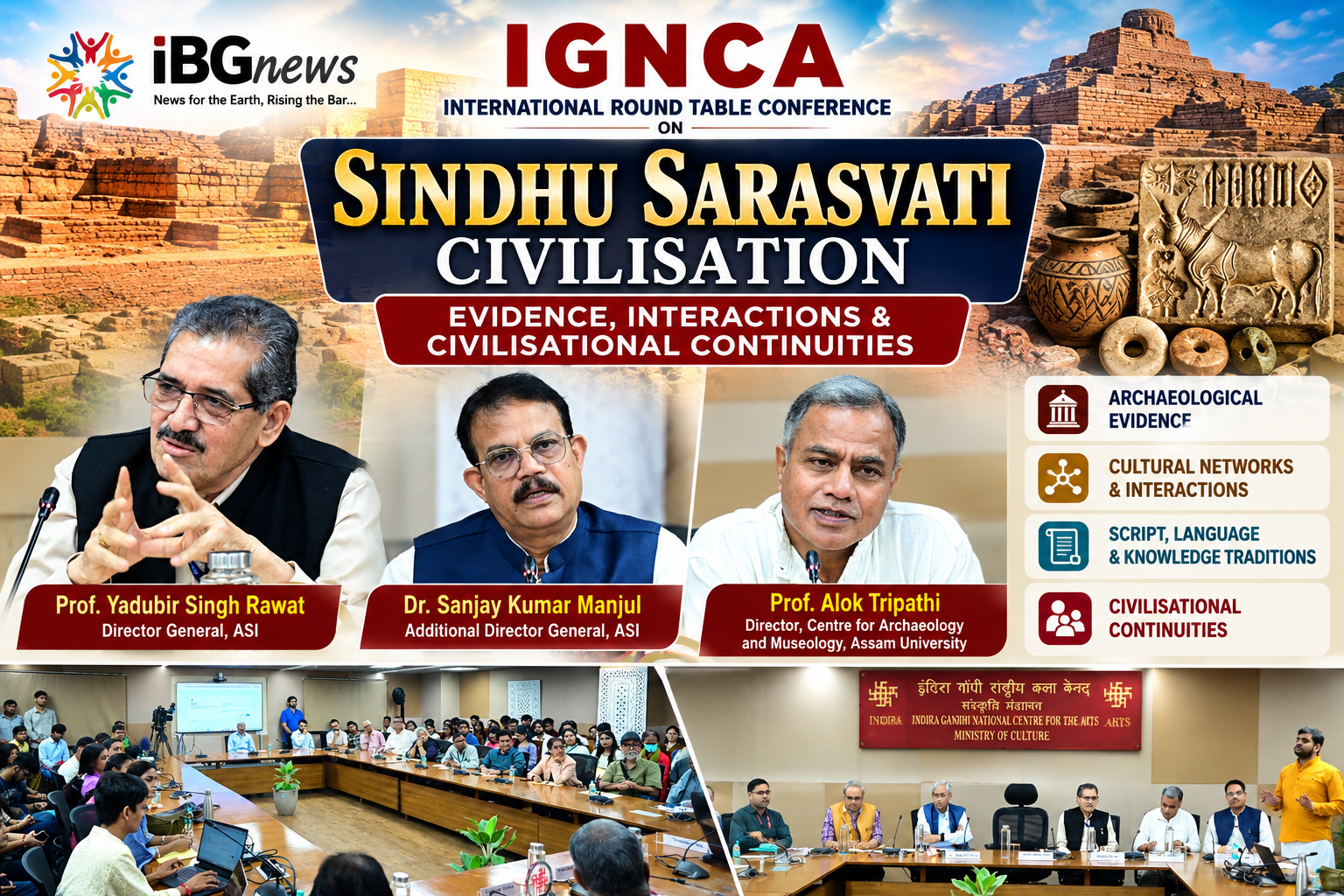
New Delhi, October 1, 2026: The Indira Gandhi National Centre for the Arts (IGNCA) organised an International Round Table Conference on “Sindhu Sarasvati Civilisation: Evidence, Interactions & Civilisational Continuities” in New Delhi, bringing together leading archaeologists, historians, epigraphists, palaeographers, geologists and scholars of Indian knowledge traditions to examine the archaeological evidence, cultural networks and historical legacy of one of the ancient world’s significant civilisations.
The conference was organised through IGNCA’s Bharata Vidya Prayojana and the Sindhu Sarasvati Cell of the National Mission on Cultural Mapping, in collaboration with the Department of History, Shaheed Bhagat Singh Evening College, University of Delhi. The discussions focused on reassessing established historical interpretations and exploring the possible connections between the Harappan civilisation and subsequent cultural traditions of the Indian subcontinent.
The conference was inspired by the broader civilisational perspective of Dr. Sachchidanand Joshi, Member Secretary of IGNCA, who emphasised the importance of examining India’s ancient intellectual and cultural heritage through interdisciplinary and evidence-based research.
The event featured scholarly contributions from Prof. Vasant Shinde, former Vice Chancellor of Deccan College, Pune; Prof. Alok Tripathi, Director of the Centre for Archaeology and Museology, Assam University; Prof. Nagaraj Paturi, former Vice Chancellor of INDICA; Dr. Sanjay Kumar Manjul, Additional Director General, Archaeological Survey of India (ASI); Dr. Karuna Shankar Shukla, archaeologist; Dr. Puneet Gupta, Harappan epigraphist and oncologist; and Dr. Mayank Shekhar, Mission Director, National Mission on Cultural Mapping. Prof. Yadubir Singh Rawat, Director General of the Archaeological Survey of India, was also present and highlighted the importance of academic dialogue on the subject.
Re-examining the Historical Understanding of the Civilisation
A major focus of the conference was the need to look beyond the conventional narrative that the Harappan civilisation emerged, flourished and eventually disappeared. Participants discussed archaeological discoveries, settlement patterns, river systems, inscriptions, material culture and living traditions to explore whether the civilisation underwent a gradual transformation rather than a complete collapse.
The question of the civilisation’s nomenclature also received considerable attention. Prof. Alok Tripathi examined how colonial-era archaeological research contributed to the widespread use of the term Indus Valley Civilisation. He called for a fresh examination of primary archaeological evidence and the historical frameworks through which discoveries have been interpreted, while acknowledging the importance of earlier scholarship.
The discussions also addressed the geographical scope of ancient Indian civilisation. Dr. Sachchidanand Joshi highlighted the importance of understanding ancient cultural and intellectual networks beyond the present-day political boundaries of India and Pakistan. Referring to Shalatur, the birthplace of the ancient grammarian Panini, located in present-day Pakistan, he underlined the significance of Panini’s Ashtadhyayi as a source for understanding the linguistic, educational, philosophical and social traditions of the wider ancient Indian intellectual world.
Archaeological Discoveries and Evidence of Cultural Continuity
Drawing on excavation-based research, Prof. Vasant Shinde highlighted the importance of studying archaeological objects within their wider context, including habitation patterns, technological developments, craft production, trade and everyday life.
The discussions referred to archaeological sites such as Banawali, Rakhigarhi and Dholavira, where evidence of urban planning, architecture and material culture offers insights into the organisation of ancient settlements. Certain structural features observed at Dholavira were also discussed in relation to patterns that remain recognisable in some contemporary village settlements.
Dr. Sanjay Kumar Manjul raised questions about the interpretation of the decline of Harappan urban centres, observing that the civilisation may have transformed rather than simply ended. He discussed archaeological evidence, changing river systems and settlement patterns, including the Sarasvati and Sutlej river systems, as important factors in understanding the transition.
The conference also considered the role of environmental changes, migration and the movement of populations in shaping settlement patterns. Participants highlighted the importance of rural settlements, noting that urban centres represented only a small proportion of the wider Harappan settlement network. The continued presence of rural communities and cultural practices was discussed as a significant area for further research into civilisational continuity.
Ancient Crafts, Cultural Traditions and the Harappan Script
The relationship between archaeological artefacts and living cultural practices was another important theme. Discussions on the Dancing Girl figurine from Mohenjo-daro, the use of bangles, bead-making and traditional dyeing techniques explored possible connections between ancient craftsmanship and practices that continue in various forms today.
Prof. Nagaraj Paturi emphasised that traditional craft processes could provide valuable perspectives for understanding excavated objects, particularly when material evidence is studied alongside living knowledge traditions.
Dr. Puneet Gupta presented a discussion on the decipherment of the Harappan writing system, emphasising that individual signs cannot be interpreted in isolation. He highlighted the importance of recurring sequences, positional patterns, directionality and the structural organisation of signs. His proposed BAP model approaches the script through epigraphic, linguistic and analytical methods, pointing to the potential value of interdisciplinary and computational research.
Reconsidering History, Itihasa and the Interpretation of the Past
The conference also explored how historical narratives are formed and transmitted. Prof. Alok Tripathi discussed the contribution of Indian archaeologists, including Daya Ram Sahni and Rakhal Das Banerji, while examining the influence of colonial institutions on archaeological interpretation.
Participants stressed the importance of distinguishing between established archaeological facts and the interpretations assigned to them. The context in which an artefact is discovered, its relationship with other findings and the limits of available evidence were identified as essential considerations in historical research.
The distinction between History and Itihasa also formed part of the academic discussion. While historical research often relies on chronology and documentary or material evidence, Itihasa also considers cultural memory, traditions and the transmission of knowledge across generations.
Prof. Nagaraj Paturi emphasised the importance of teaching students how history is researched and written, rather than presenting established narratives as unchangeable conclusions. He also highlighted the value of direct engagement with archaeological sites and interaction with specialists.
Dr. Karuna Shankar Shukla examined the nomenclature of the Indus Saraswati Civilisation and its relationship with wider Indian and Vedic civilisational frameworks. His discussion drew on archaeological materials, including painted pottery, terracotta and steatite seals, metal objects, jewellery and figurines, alongside textual and linguistic interpretations.
Call for Interdisciplinary Research and Academic Collaboration
Prof. A. B. Shukla stated that the Round Table aimed to examine the Sindhu Sarasvati Civilisation through archaeological, textual, linguistic and scientific evidence, explore its possible cultural continuities with later Indian traditions, and discuss the nature and decipherment of the Indus Script. The conference also sought to encourage critical engagement with emerging research and strengthen collaboration among specialists from different academic disciplines.
The deliberations highlighted the need for continued examination of archaeological, epigraphic, linguistic, geological and textual evidence rather than treating inherited historical interpretations as final. The discussions also underlined the importance of studying material discoveries, written traditions and living cultural practices together to develop a broader understanding of the ancient past.
The conference reaffirmed IGNCA’s role as a platform for interdisciplinary research and academic dialogue on India’s cultural heritage. By bringing together experts from diverse fields, the Round Table created an opportunity to examine complex questions surrounding the Sindhu Sarasvati Civilisation and encouraged sustained scholarly engagement with the civilisational history of the Indian subcontinent.
By Suman Munshi
IBG NEWS

