











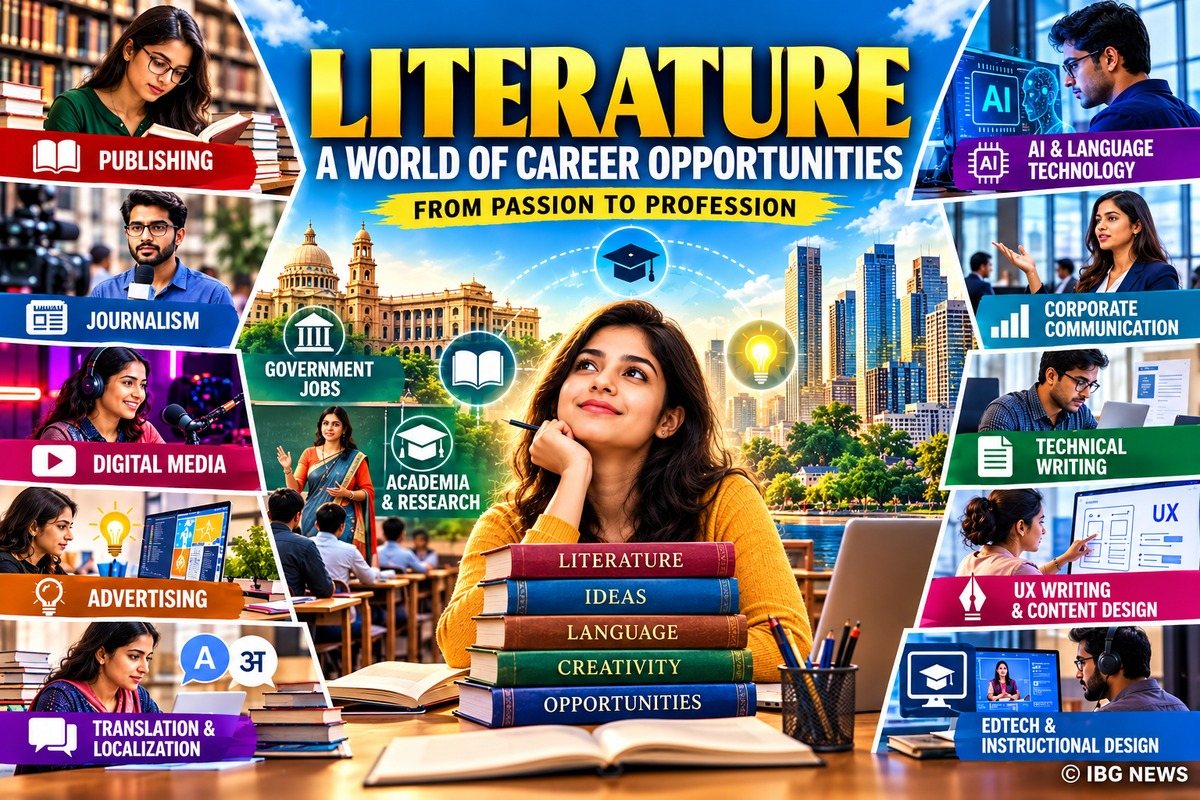
Literature Is No Longer a Conventional Career: New-Age Opportunities Expand Across India
From Publishing and Academia to AI, Digital Media, Corporate Communication, Translation and UX, Literature Graduates Can Build Diverse Careers with the Right Skill Set
By Suman Munshi, Chief Editor, IBG NEWS
For generations, students choosing literature have often been told that their career options are limited to teaching, writing or traditional publishing. That perception is increasingly out of step with the modern employment market.
India’s rapidly expanding digital economy, multilingual internet population, media industry, publishing ecosystem and artificial-intelligence-driven workplaces are creating new opportunities for people who can understand language, analyse information, write clearly and communicate ideas effectively.
The important change, however, is that a literature degree by itself is no longer enough to guarantee a strong career. Students who combine literary education with technology, digital communication, artificial intelligence, research, marketing or specialised domain knowledge can access a much wider employment market.
India’s Expanding Content Economy
The transformation of India’s media and entertainment industry provides an important indication of where language and storytelling skills are heading.
According to the FICCI-EY 2026 report, India’s media and entertainment industry grew 9% in 2025 to ₹2.78 trillion, while digital media crossed the ₹1 trillion revenue mark for the first time. Digital advertising reached ₹947 billion after growing 26%. The overall sector is projected to reach approximately ₹3.3 trillion by 2028. EY
This expansion creates demand not only for filmmakers and software professionals but also for writers, editors, researchers, script developers, content strategists, language specialists and communication professionals.
The growth of regional-language content is particularly important for literature graduates. India’s publishing sector has more than 9,000 publishers and 21,000 retailers, while at least 45% of trade books are sold in regional languages, according to EY’s analysis of the Indian publishing industry. EY
This means that Bengali, Hindi, Tamil, Telugu, Marathi, Malayalam, Kannada, Assamese, Odia and other Indian-language specialists can find opportunities beyond traditional classrooms.
The Biggest Career Change: Literature + Another Skill
The modern employment market increasingly rewards combinations of capabilities.
A student should therefore think beyond:
“I have a degree in English/Bengali/Hindi Literature.”
The stronger professional proposition is:
“I understand literature and language, and I can apply that knowledge to a commercial or technological problem.”
Examples include:
| Literature + Skill | Potential Career |
|---|---|
| Literature + SEO | SEO Content Specialist |
| Literature + AI | AI Language Specialist |
| Literature + Marketing | Copywriter / Brand Strategist |
| Literature + Business | Corporate Communications |
| Literature + Technology | Technical Writer |
| Literature + UX | UX Writer / Content Designer |
| Literature + Education | Instructional Designer |
| Literature + Translation | Translator / Localization Specialist |
| Literature + Journalism | Reporter / Digital Editor |
| Literature + Research | Research Associate |
| Literature + Video | Scriptwriter / Content Producer |
| Literature + Public Administration | Government Services |
This combination-based approach can substantially increase employability.
1. Publishing Is Changing, Not Disappearing
Publishing remains one of the most natural career destinations for literature students, but the industry has expanded beyond printed books.
Today’s publishing organisations require:
- Editors
- Copy editors
- Proofreaders
- Digital editors
- Manuscript evaluators
- Commissioning editors
- Children’s-content specialists
- Academic editors
- E-book specialists
- Audiobook content professionals
- Translation editors
- Social-media content managers
The growth of regional-language publishing also creates opportunities for students who possess strong Indian-language skills.
A student who understands literature and learns digital publishing, SEO, WordPress, copyright basics, metadata and audience analytics can become considerably more valuable than someone who possesses only traditional literary knowledge.
2. Journalism and Digital Media Offer a Large Market
Digital media has fundamentally changed the role of the writer.
A literature graduate can enter journalism as a:
- Reporter
- Feature writer
- News researcher
- Copy editor
- Digital editor
- Editorial assistant
- News producer
- Scriptwriter
- Podcast writer
- Video-content researcher
- Fact-checking professional
The expansion of India’s digital media economy makes this particularly relevant. Digital media became the largest segment of India’s media and entertainment industry in 2025, according to FICCI-EY. EY
Students should therefore learn headline writing, fact-checking, SEO, CMS publishing, social-media storytelling, basic video production and AI-assisted research alongside literature.
3. Advertising and Brand Communication
Advertising is fundamentally a language business.
Brands need professionals who can convert complex products and ideas into simple, memorable messages.
Literature graduates can work as:
- Copywriters
- Creative writers
- Brand-content writers
- Social-media writers
- Campaign planners
- Creative strategists
- Scriptwriters
- Brand storytellers
A student who understands narrative structure, metaphor, audience psychology and persuasive writing can turn literary training into a commercial communication skill.
4. Artificial Intelligence Is Creating New Language Careers
AI does not eliminate the importance of language; in many areas, it increases the need for people who understand language deeply.
Emerging areas include:
- AI response evaluation
- Language-quality assessment
- Linguistic data annotation
- AI content review
- Prompt and instruction writing
- Multilingual AI evaluation
- Fact-checking AI-generated content
- Human-in-the-loop content moderation
- Language localisation
- Editorial quality control
The most valuable candidate may not be someone who simply knows how to use an AI chatbot, but someone who understands language, context, nuance, cultural meaning, accuracy and human communication and can apply those skills while using AI tools.
5. Technical Writing: One of the Strongest Combinations
Technical writing is another potentially rewarding route.
Technology companies need people who can transform complicated technical information into understandable documentation.
Possible roles include:
- Technical Writer
- Documentation Specialist
- Knowledge-base Writer
- API Documentation Writer
- Product Documentation Specialist
- UX Content Writer
- Content Designer
The student does not necessarily need to become a software engineer.
Instead, the valuable combination is:
Strong English + Research + Structured Writing + Basic Technology Understanding
Learning Markdown, basic HTML, documentation platforms, Git/GitHub concepts and product terminology can further improve employability.
6. UX Writing and Content Design
Every digital product communicates with users through words.
Buttons, menus, error messages, onboarding screens, notifications, forms and help systems all require carefully designed language.
This has created roles such as:
UX Writer, Content Designer and Product Content Specialist.
Literature students can have an advantage because literary education develops sensitivity to:
- Tone
- Meaning
- Context
- Audience
- Narrative
- Clarity
- Word choice
But they must also learn user research, product thinking and basic UX principles.
7. Education and EdTech
Literature graduates can also move into the rapidly evolving education-content market.
Potential positions include:
- Curriculum Writer
- Subject Matter Expert
- Instructional Designer
- Academic Content Developer
- Assessment Writer
- E-learning Scriptwriter
- Educational Video Scriptwriter
- Learning Experience Designer
The combination of literature and digital education can be particularly useful for people interested in language learning, humanities, competitive examinations and communication skills.
8. Translation and Localization
India’s multilingual market creates a significant opportunity for language professionals.
Translation is no longer limited to converting books from one language into another.
Modern localization includes:
- Websites
- Mobile applications
- Software
- Films
- OTT content
- Subtitles
- E-learning
- Advertising
- Government documents
- Product interfaces
- Corporate communication
Students who develop expertise in two or more languages plus translation technology can position themselves for both Indian and international work.
9. Government Jobs Remain an Important Route
Literature students should not overlook government employment.
The UPSC Civil Services Main Examination continues to include literature papers in numerous Indian languages, including Bengali, English, Hindi, Assamese, Gujarati, Kannada, Malayalam, Marathi, Sanskrit, Tamil, Telugu and Urdu, among others. UPSC
A literature graduate can therefore prepare for:
- UPSC Civil Services
- State Public Service Commissions
- SSC examinations
- Government information and communication roles
- Translation services
- Official-language positions
- Research and cultural institutions
The Staff Selection Commission’s 2026 calendar includes the Combined Hindi Translators Examination, demonstrating the continuing government requirement for specialised language professionals. Staff Selection Commission
The 2026 SSC Combined Hindi Translators notification specifies postgraduate-level language qualifications together with translation qualifications or relevant translation experience for several translator posts. Staff Selection Commission
10. Academia Still Offers a Strong Intellectual Career
For students genuinely interested in research and teaching, academia remains an important pathway.
The UGC-NET system provides routes toward Junior Research Fellowship, Assistant Professorship and PhD admission, depending on the candidate’s qualifying category and performance. UGC NET
The traditional route remains:
BA → MA → UGC-NET/JRF → PhD → Academic/Research Career
However, academic aspirants should develop additional skills such as:
- Research methodology
- Academic publishing
- Digital humanities
- Data analysis
- Citation management
- Conference presentation
- Academic editing
- Research communication
The modern humanities researcher increasingly operates at the intersection of literature, society, technology and data.
11. Corporate Communication Is a Major Alternative
Large companies need professionals who can communicate with employees, customers, investors and the public.
Literature graduates can enter:
- Corporate communications
- Internal communications
- Public relations
- Employer branding
- Executive communication
- Speechwriting
- Corporate storytelling
- Investor communication
- Sustainability communication
Here, strong writing ability can become a business skill.
A literature student who learns PowerPoint, business writing, presentation design, Excel/data interpretation and corporate communication can compete for positions far outside traditional humanities departments.
What Should a Literature Student Learn Before Graduation?
A market-ready literature graduate should aim to leave college with more than a degree.
Essential Skill Stack
1. Advanced Writing
- Articles
- Reports
- Business communication
- Storytelling
- Scripts
2. Editing
- Grammar
- Structural editing
- Copy editing
- Proofreading
- Fact-checking
3. Digital Skills
- WordPress/CMS
- SEO
- Canva
- Basic HTML
- Social media
- Basic video editing
4. AI Literacy
- Generative AI
- Prompt design
- AI-assisted research
- Fact verification
- AI editing
- Responsible use of AI
5. Research
- Source evaluation
- Data interpretation
- Online research
- Citation
- Primary-source analysis
6. Communication
- Public speaking
- Presentation
- Interview skills
- Professional email
- LinkedIn networking
Build a Portfolio Before Searching for a Job
One of the biggest mistakes students make is waiting until graduation to build evidence of their abilities.
A literature student should ideally graduate with:
- 5–10 published articles
- A professional LinkedIn profile
- A writing portfolio
- One research project
- One translation project
- One SEO article
- One advertising campaign
- One podcast/video script
- One AI-assisted editing project
- One UX-writing sample
- Internship experience
A portfolio can sometimes communicate employability more effectively than a CV filled only with academic qualifications.
A Practical 12-Month Career Plan
Months 1–3
Focus on:
- Writing
- Editing
- AI tools
- WordPress
- Research
- Basic SEO
Publish at least 8–10 pieces of original work.
Months 4–6
Add:
- Digital marketing
- Canva
- Social media
- Basic video
- Content analytics
Create at least five portfolio projects.
Months 7–9
Choose one professional specialisation:
Technical Writing / UX Writing / Journalism / Corporate Communication / Translation / Instructional Design / Publishing / AI Language Work
Months 10–12
Start:
- Internships
- Freelance assignments
- Job applications
- LinkedIn networking
- Industry events
- Direct approaches to employers
The objective should be simple:
Degree + Skills + Portfolio + Experience = Employability
Where Are the Jobs?
Government Sector
Potential employers and career routes include:
- UPSC
- SSC
- State PSCs
- Universities
- Government translation departments
- Official-language services
- National libraries
- Archives
- Museums
- Cultural institutions
- Public broadcasters
- Government publishing and information organisations
Private Sector
Potential employers include:
- Publishing houses
- Newspapers
- Digital media companies
- Advertising agencies
- PR agencies
- OTT platforms
- EdTech companies
- Technology companies
- AI companies
- IT services firms
- Research organisations
- Corporate communication teams
- Translation companies
- Localization agencies
- Marketing agencies
How Rewarding Can a Literature Career Be?
There is no single salary figure for “literature careers” because the degree can lead to very different professions.
Entry-level writing and content positions can begin at modest compensation, while specialised fields such as technical writing, instructional design, corporate communications, UX content, senior editing and specialised language technology can offer substantially stronger earning potential.
The important lesson is therefore not to measure the value of literature by the salary of a generic entry-level content writer.
The more useful question is:
What professional problem can a literature graduate solve?
A person who only writes general articles competes with thousands of writers.
A person who can write technical documentation for a software company, design learning content, develop UX copy, manage SEO content, evaluate AI-generated language, or handle corporate communication competes in a more specialised market.
The New Career Formula
The future of literature education in India may be best understood through one simple formula:
Literature + Digital Skills + AI + Communication + Specialisation = Market Value
The literature graduate of the future does not have to abandon books, poetry, history or critical thinking.
Instead, those abilities can become the foundation for a wider professional identity.
India’s expanding digital economy, multilingual market and media ecosystem are creating increasing demand for people who can understand and communicate ideas effectively. The growth of digital media, regional-language publishing and technology-driven content makes language expertise increasingly relevant rather than obsolete. EY
Conclusion
Literature is not a dead-end degree.
But it is also no longer sufficient to simply obtain a degree and wait for a traditional job.
The students most likely to succeed will be those who transform their literary education into professional capability—combining reading and interpretation with technology, AI, research, communication, marketing or another specialised discipline.
For today’s student, the career question should therefore not be:
“What job can I get with literature?”
It should be:
“What valuable professional skill can I build on top of my literature education?”
That change in mindset can turn literature from a narrowly defined academic subject into a foundation for careers spanning publishing, journalism, advertising, technology, AI, education, translation, government, research and corporate India.
By Suman Munshi
Chief Editor, IBG NEWS
Sources: UGC-NET/NTA, UPSC, Staff Selection Commission, FICCI-EY and EY India. UPSC

