














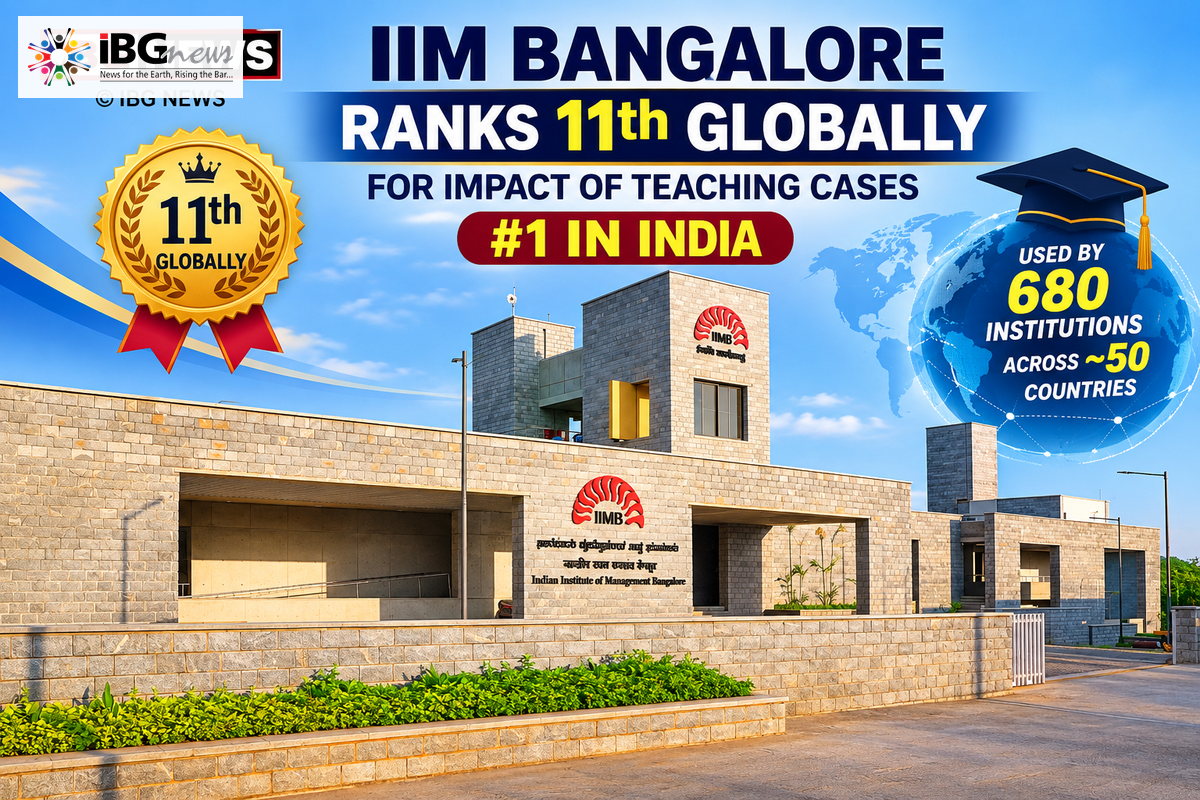

IIM Bangalore Ranks 11th Globally for Impact of Business School Teaching Cases
Institute Secures No. 1 Position in India as Its Case Studies Reach 680 Higher-Education Institutions Across Nearly 50 Countries
Bengaluru, October 9, 2026: The Indian Institute of Management Bangalore (IIMB) has secured the 11th position globally among the top 50 business schools and ranked first in India for the impact of its teaching cases, according to the Financial Times’ 2026 assessment of academic influence on business and public policy.
The recognition highlights the Institute’s growing international reach in management education and the widespread adoption of its case-based teaching materials by academic institutions, faculty members, students and industry professionals.
According to IIM Bangalore, approximately 680 higher-education institutions across nearly 50 countries subscribed to and used its teaching cases during 2024 and 2025. These educational resources connect academic research with practical business challenges, helping learners examine managerial decisions through real-world examples.
Financial Times Expands Assessment of Academic Impact
The Financial Times’ 2026 assessment examines how academic work translates into practical outcomes beyond traditional research publications. Its framework evaluates four areas: practitioner publications, policy impact, external grant funding and teaching cases.
Within the teaching cases category, the ranking assesses the creation, distribution and adoption of case studies used in management education. The 2026 methodology combines information from five international case distributors: Case Centre at CEIBS, Harvard Business Impact, IESE Publishing, Ivey Publishing and The Case Centre.
The assessment draws on a common methodology based on The Case Centre’s Impact Index, with indicators covering case production, authorship, organisational adoption, international reach and student usage.
IIMB Leadership Highlights the Value of Applied Research
Prof. U. Dinesh Kumar, Director-in-charge of IIM Bangalore, emphasised the importance of connecting academic research with the challenges faced by businesses.
He noted that teaching cases bring together research findings, managerial experience and practical business problems, enabling students to understand complex decisions in realistic contexts.
According to him, the international adoption of IIMB’s cases demonstrates the demand for management teaching resources that combine academic rigour with contemporary business realities.
Case Sales Record Strong Growth
IIM Bangalore’s teaching cases have recorded substantial demand through Harvard Business Impact. The Institute published 26 cases through the platform in each of 2024 and 2025.
Sales increased from 140,457 in 2024 to 184,879 in 2025, representing growth of approximately 31.6%, or nearly 32%.
The figures indicate growing engagement with IIMB’s case materials and their relevance to management education across multiple markets.
Diverse Case Studies Address Real-World Business Challenges
The Institute’s widely adopted cases examine practical questions spanning product management, marketing, customer analytics, digital transformation, healthcare, human resources and emerging technologies.
Among the prominent titles were:
- ‘redBus: Art and Science of Product Management’ — co-authored by Prof. Shankhadeep Banerjee, Chairperson of the Information Systems area.
- ‘Testing Marketing Hypotheses at WSES’ — authored by Prof. Dinesh Kumar of the Decision Sciences area.
- ‘Customer Analytics at Bigbasket – Product Recommendations’ — co-authored by Prof. Dinesh Kumar.
These cases attracted sustained demand across 2024 and 2025, featuring among the Institute’s leading sellers in both years.
Other successful titles included ‘Apollo Hospitals: The Journey of Digital Transformation’, co-authored by Prof. R. Srinivasan, Chairperson of the Centre for Digital Public Goods, and ‘Shodh – Market Research for Economy Housing (A)’, authored by Prof. Avinash G. Mulky, formerly of the Marketing area.
Additional cases addressed healthcare demand forecasting, employee engagement, human-resource analytics and the application of generative artificial intelligence in business.
Exploring Innovation, Sustainability and Digital Transformation
The Institute’s case portfolio also examines how organisations respond to changing markets, technological disruption and sustainability requirements.
Examples include:
- ‘Business Model Innovation at LOG9’ — co-authored by Prof. Sreelata Jonnalagedda of the Marketing area.
- ‘AuctionBazaar.com: Lubricating the NPA Disposal Process’ — co-authored by Prof. R. Srinivasan.
- ‘FieldAssist: Enabling Sales Performance and Incentive Design for Strategic Alignment of Frontline Salesforce in FMCG’ — authored by Prof. Debolina Dutta, formerly associated with the Organisational Behaviour and Human Resource Management area.
- ‘Ecosystem Development for Digital Public Goods: The Case of Jugalbandi’ — co-authored by Prof. Shankhadeep Banerjee.
Other case studies explore decarbonisation, green steel, employee experience, digital platforms, healthcare and transformations in the semiconductor industry.
Together, these subjects demonstrate the breadth of business and policy questions that can be explored through case-based learning, from operational decision-making to technological innovation and sustainable development.
How the Teaching Case Impact Ranking Works
The Financial Times assessment considers business schools that submitted at least one case for distribution during the preceding two years, alongside cases published over the previous seven years.
The analysis examines a 12-month reporting period running from July 1 to June 30. It considers the number of unique cases and authors, the extent of adoption across organisations, geographical distribution and total student usage.
The indicators are statistically normalised using z-scores and combined to calculate an overall impact score. Each of the five distributors applies the methodology to its own dataset, after which the results are scaled for comparability, weighted according to market share and combined to determine the final institutional ranking.
This approach seeks to assess not merely how many cases a business school produces, but also how widely its teaching materials are used and the extent of their reach across educational and professional settings.
Strengthening India’s Global Presence in Management Education
IIM Bangalore’s position in the 2026 assessment reinforces the international visibility of Indian management education and highlights the contribution of Indian academic institutions to global discussions on business practice.
The Institute’s case studies provide a platform for examining the challenges faced by businesses operating in diverse economic, technological and regulatory environments. Their international adoption also creates opportunities for Indian business experiences and management perspectives to inform classroom discussions worldwide.
The recognition underscores the potential of applied research and case-based learning to connect academic knowledge with decision-making in industry and public policy.
News Desk: Suman Munshi
IBG NEWS

