











Global Regime-Change Operations: The Science of Power, Covert Action and U.S. Intervention from the Second World War to 2026
A chronological geopolitical investigation | Historical research, intelligence methods, military interventions and the struggle for political influence
Introduction: Regime change as an instrument of global power
Regime change is one of the most consequential and controversial instruments of international politics. It refers to an attempt to replace a country’s existing political leadership or governing system with another leadership or political order. The process can range from diplomatic pressure and economic coercion to covert intelligence operations, military intervention, support for opposition movements and the occupation of a country.
Since the Second World War, the United States has played a major role in several documented efforts to remove foreign governments, influence leadership transitions or reshape political systems. Some operations were conducted by the U.S. military; others involved the Central Intelligence Agency (CIA), diplomatic services, economic pressure or partnerships with local political and military actors.
The historical record, however, requires an important distinction: not every revolution, coup, civil war or government collapse involving a country opposed to Washington was orchestrated by the United States. In some cases, documentary evidence establishes direct American involvement. In others, the evidence supports a more limited conclusion, such as political backing, assistance to opposition groups or an unsuccessful attempt to influence events.
A serious investigation must therefore examine not only what happened, but also the methods employed, the strategic objectives, the local actors, the documentary evidence and the consequences.
This article traces the evolution of American regime-change policy from the closing years of the Second World War through 10 October 2026, distinguishing documented operations from disputed allegations and broader geopolitical interpretations.
1. The historical foundation: How the United States institutionalised covert action
1944–1949 | From wartime intelligence to peacetime political intervention
The Second World War transformed the relationship between intelligence, military power and political decision-making. Governments increasingly recognised that military victory could be influenced by intelligence gathering, resistance networks, propaganda, industrial capacity, economic pressure and the political loyalties of populations.
The United States entered this period with the Office of Strategic Services (OSS), which conducted intelligence and clandestine activities during the war. The OSS was dissolved in 1945, and the Central Intelligence Agency was established under the National Security Act of 1947.
A particularly important development came in December 1947, when National Security Council Directive NSC 4-A authorised peacetime covert psychological operations. In June 1948, NSC 10/2 broadened the framework for clandestine operations against hostile states and in support of friendly governments and political groups.
The US State Department’s historical record describes an authorised range of covert activities that included propaganda, economic warfare, sabotage, subversion and assistance to selected resistance movements. These directives established an institutional framework for covert intervention, although they did not mean that every subsequent operation was authorised under identical rules.
Office of the Historian
+1
The emerging framework
The historical pattern can be understood through six broad instruments:
1. Intelligence and political assessment
Identifying political divisions, elite rivalries, military loyalties and the interests of influential domestic groups.
2. Information and propaganda
Shaping perceptions of a government through political messaging, media activity and information campaigns.
3. Political and financial influence
Supporting selected political parties, candidates, opposition networks or allied elites.
4. Economic pressure
Restricting aid, imposing sanctions or limiting access to finance and trade to change a government’s calculations.
5. Security-sector intervention
Building relationships with military officers, intelligence services and armed political organisations.
6. Direct military force
Invasions, targeted strikes, occupations or military operations that remove a government or create conditions for its replacement.
These are analytical categories, not a claim that every operation followed a single blueprint. Their significance lies in how they reveal the relationship between intelligence, diplomacy, financial leverage and military power. Declassified US records show that covert political programmes could combine several instruments while concealing the extent of official American involvement.
Office of the Historian
+1
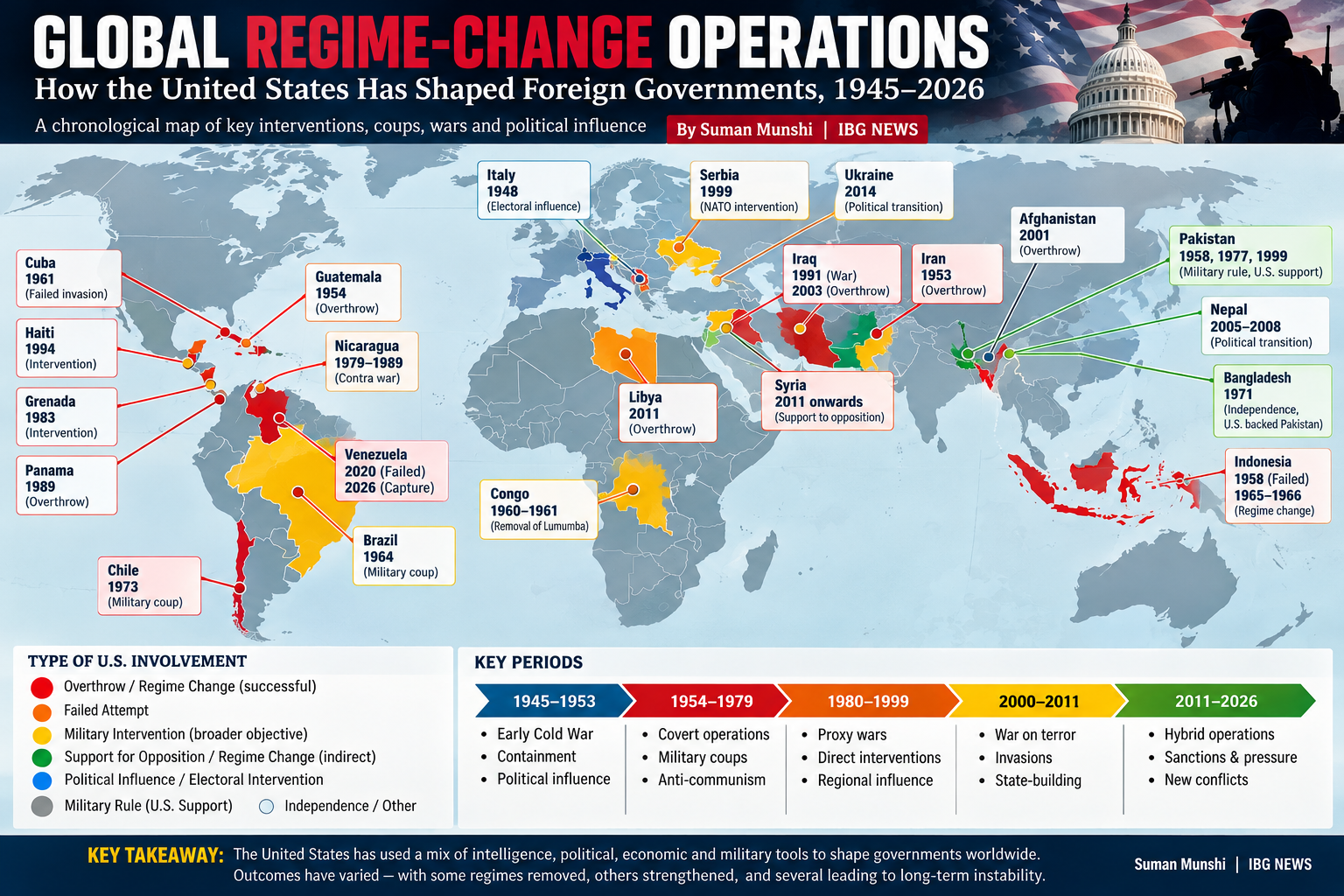
2. Chronological record: Major American regime-change efforts
The following timeline concentrates on prominent cases with substantial documentary or scholarly support. It includes successful overthrows, failed operations, attempts to influence political outcomes and overt military interventions. It is not an exhaustive inventory of every American intelligence operation or every instance of foreign-policy pressure.
1945–1952: Early Cold War political intervention
1945–1949 — Italy and the wider European political struggle
The United States sought to prevent communist parties from gaining power in post-war Europe. In Italy’s 1948 election, American officials used political and economic influence, including support for anti-communist forces. This was intervention in a political contest rather than a coup or an invasion.
Method: Diplomatic pressure, economic leverage and political support.
Assessment: A significant example of US involvement in shaping another country’s political direction, but not a government overthrow.
1947–1949 — Greece
The Truman administration expanded American assistance to the Greek government during the civil war against communist-led insurgents. The policy helped sustain the existing government rather than replace it.
Method: Military and economic assistance to an allied government.
Assessment: A major example of intervention to preserve a political order, not a classic regime-change operation.
These early cases demonstrate an important distinction: American Cold War policy included both efforts to prevent governments from changing and efforts to replace governments considered hostile. Both belong to the broader history of political intervention, but they should not be classified as identical operations.
National Security Archive
+1
1953 — Iran: Operation TPAJAX
6
Target government: Prime Minister Mohammad Mosaddegh Outcome: Government overthrown; the Shah’s position strengthened Evidence assessment: Extensive declassified documentary evidence of US and British involvement.
In 1951, Mosaddegh’s government nationalised the Anglo-Iranian Oil Company, intensifying its conflict with Britain. The dispute over oil, concerns about Iran’s political direction and Cold War fears contributed to the decision by American and British officials to support a covert operation against Mosaddegh.
The CIA’s Operation TPAJAX, conducted with British intelligence cooperation, sought to remove the prime minister and restore the Shah’s political authority. The operation involved political manoeuvring, propaganda, financial support and relationships with influential Iranian actors. The August 1953 crisis culminated in Mosaddegh’s overthrow.
The National Security Archive has published CIA historical accounts and related documents that confirm the depth of American involvement while also showing that Iranian actors played consequential roles in the events.
National Security Archive
+1
Strategic consequences: The Shah consolidated power, but the episode became a lasting source of distrust toward the United States in Iran. The monarchy was overthrown in the 1979 Iranian Revolution, demonstrating that a successful short-term intervention does not guarantee long-term political legitimacy.
Historical significance: Iran became one of the clearest documented examples of a covert operation designed to remove a sitting government without a conventional American invasion.
1954 — Guatemala: Operation PBSUCCESS
10
Target government: President Jacobo Árbenz Outcome: Árbenz resigned; a new political order emerged under military influence Evidence assessment: Extensive declassified CIA records.
Árbenz pursued land reform that threatened the interests of powerful landowners and the US-based United Fruit Company. Washington also viewed Guatemala through the lens of Cold War competition and feared the growth of communist influence.
The CIA’s Operation PBSUCCESS combined political pressure, propaganda, covert support for an armed opposition force and efforts to weaken confidence in the government and military leadership. Árbenz resigned in June 1954, and Colonel Carlos Castillo Armas subsequently took power.
The CIA’s own archival collection includes thousands of documents on the planning, execution and aftermath of the operation.
CIA FOIA (foia.cia.gov)
+1
Strategic consequences: The overthrow helped usher in decades of political repression, deep polarisation and armed conflict. The longer-term consequences were far more complex than the immediate removal of one president.
Historical significance: Guatemala illustrated how psychological operations, political pressure and a relatively limited armed challenge could combine to destabilise a government without a large-scale US invasion.
1958 — Indonesia: A failed covert intervention
During the late 1950s, the United States supported anti-communist forces opposing President Sukarno’s government. In 1958, a CIA-backed rebellion challenged the central government, but the insurgency failed.
The episode is important because it demonstrates the limits of covert intervention: local military capabilities, political loyalties and public legitimacy can determine the outcome regardless of outside support. The operation did not overthrow Sukarno.
National Security Archive
+1
1960–1961 — Congo: The campaign against Patrice Lumumba
Target: Prime Minister Patrice Lumumba Outcome: Lumumba lost power, was transferred into the custody of his enemies and was assassinated by Congolese and Katangan actors in January 1961.
After Congo gained independence in 1960, political turmoil and the secession of Katanga created a major international crisis. US officials feared that Lumumba might turn to the Soviet Union and authorised covert efforts to prevent him from retaining power.
Declassified State Department records document a covert political programme, financial support for Lumumba’s opponents, propaganda activities and high-level consideration of assassination. The documents also record that Congolese rivals and other actors played direct roles in his eventual death. American involvement in the campaign against Lumumba is well documented; the precise allocation of responsibility for every subsequent act must be treated separately.
Office of the Historian
+1
Historical significance: Congo demonstrates how foreign intervention can interact with domestic rivalries, secessionist movements and institutional instability, producing outcomes that extend well beyond the original political objective.
1961 — Cuba: The Bay of Pigs invasion
7
The CIA organised and supported a force of Cuban exiles that invaded Cuba in April 1961. The operation aimed to overthrow Fidel Castro’s government but ended in failure, with invading forces defeated and many captured.
Unlike the covert coups in Iran and Guatemala, the Bay of Pigs became a conspicuous military fiasco. The operation strengthened Castro’s domestic position and reinforced Cuba’s security relationship with the Soviet Union.
Lesson: An external power may underestimate local support for a government, overestimate the willingness of citizens to revolt and discover that a covert operation becomes politically damaging once its sponsorship is exposed. The failed invasion is documented in the National Security Archive’s history of CIA covert operations.
National Security Archive
+1
1964 — Brazil: The overthrow of João Goulart
Target government: President João Goulart Outcome: Military coup; a military-led regime ruled until 1985.
American officials viewed Goulart’s government with growing concern because of its domestic reform programme and its relationship with left-wing political forces. Declassified presidential recordings and other records show that the Kennedy administration considered ways to undermine or replace his government. Under President Lyndon B. Johnson, Washington prepared support for the military uprising that began in March 1964.
Operation Brother Sam involved preparations to provide logistical and military assistance, including fuel and arms, if the coup encountered serious resistance. The Brazilian military took power, and the planned US support was not required on the scale anticipated.
National Security Archive
+1
Historical significance: Brazil is a key example of how advance planning, diplomatic signals and preparations to assist a military faction can influence a crisis even when a foreign power does not itself conduct the coup.
1965 — Dominican Republic: Military intervention and political order
Following the Dominican Republic’s civil conflict, US forces intervened in April 1965. Washington publicly cited the protection and evacuation of American citizens and concerns about the political crisis, while the intervention also shaped the balance of power between rival Dominican factions.
The episode did not follow the same pattern as the CIA’s secret coups in Iran or Guatemala. It was a direct military intervention in a domestic conflict, with significant consequences for the country’s political future. It is included here as a case of overt intervention in a contested political transition rather than a simple covert overthrow.
Every CRS Report
+1
1965–1966 — Indonesia: The destruction of the Indonesian Communist Party
After the events of September 1965, the Indonesian military under General Suharto gained power, and mass killings and imprisonment devastated the Indonesian Communist Party and its suspected supporters. Sukarno’s authority collapsed, and Suharto eventually became president.
The US government supported the Indonesian Army’s anti-communist campaign and provided forms of assistance and political encouragement. Historical scholarship and declassified records document American knowledge of the repression and the role of US officials in supporting the Army. However, claims that the CIA directly organised every element of the 1965 coup or the subsequent killings go beyond what the evidence uniformly establishes.
Assessment: Strong evidence of US support for anti-communist forces and the new political order; claims of direct operational control over the entire episode require more specific proof.
The distinction matters: documented complicity, political support and direct orchestration are different historical findings.
National Security Archive
+1
3. The 1970s: Covert destabilisation, military rule and regional power
1970–1973 — Chile: From political pressure to the Pinochet coup
7
Target government: President Salvador Allende Outcome: Military coup on 11 September 1973; General Augusto Pinochet established an authoritarian dictatorship.
Allende was elected president in 1970, leading a left-wing coalition committed to socialist economic reforms. The Nixon administration opposed his government and authorised covert efforts intended to prevent his accession to power or undermine his administration.
Declassified documents show that American policy included covert political funding, propaganda, support for opponents and economic pressure. Washington also explored ways to encourage a military coup. The historical record clearly establishes substantial US intervention against Allende, although it is important not to equate that involvement with proof that American officials controlled every decision made by Chilean military leaders.
The 1973 coup was executed by Chilean armed forces. Allende died during the assault on the presidential palace, and Pinochet’s government subsequently imposed extensive repression, including political imprisonment, torture, killings and disappearances.
National Security Archive
+1
Why this case matters: Chile illustrates how foreign pressure can operate over several years through political, economic and covert channels before a domestic military institution takes decisive action.
1970s — British Guiana, Bolivia and other Cold War theatres
American covert activity during this period was not limited to governments that were eventually overthrown.
Declassified records describe covert political operations in British Guiana, assistance to anti-communist political forces in Bolivia and other countries, and continuing intelligence activity across Africa, Asia and Latin America. The historical evidence varies by case: some operations involved direct political funding, while others focused on supporting existing allies or preventing unfavourable electoral outcomes.
The National Security Archive’s compilation of CIA operations during the Kennedy-to-Nixon years documents political action in several countries, including Brazil, Chile, British Guiana, Haiti and the Congo.
National Security Archive
+1
1979–1989 — Nicaragua: The Contra war
After the Sandinista National Liberation Front overthrew the Somoza dictatorship in 1979, the Reagan administration sought to weaken the new Sandinista government. The United States supported Contra insurgents operating against the government, using military assistance, intelligence support and other forms of aid.
The policy became the centre of the Iran-Contra scandal after secret arms transactions and the diversion of proceeds to the Contras were exposed. The affair raised fundamental questions about executive authority, congressional restrictions and the accountability of covert operations.
Unlike the coups in Iran and Guatemala, the Nicaragua campaign did not achieve its initial objective through a direct overthrow by US forces. The Sandinistas lost power in the 1990 election, after years of conflict, economic disruption and international pressure. The extent to which US policy determined the electoral outcome remains a matter of historical interpretation, but American support for the Contra war is well documented.
National Security Archive
+1
4. The 1980s: Direct intervention returns
1983 — Grenada
The United States invaded Grenada following an internal political crisis and the killing of Prime Minister Maurice Bishop. The Reagan administration cited the protection of American citizens and regional security. The intervention removed the revolutionary military leadership and led to a new political order.
Method: Direct military invasion.
Assessment: An overt operation that resulted in the replacement of the governing authorities, although its justification and legality were disputed internationally.
Every CRS Report
+1
1989 — Panama
US forces launched Operation Just Cause against the government of Manuel Noriega. Noriega was captured and taken to the United States, where he faced criminal charges. The intervention led to the consolidation of a new Panamanian government.
Method: Large-scale military intervention, capture of the country’s de facto leader and political transition.
Assessment: A direct regime-removal operation. The stated rationales included protecting US citizens, defending democratic processes and combating drug trafficking, while the intervention also raised major questions about sovereignty and the use of force.
Every CRS Report
+1
These cases marked a transition from the deniable political operations common during the Cold War to more overt uses of American military power. Yet the underlying strategic problem remained the same: removing a leader is not equivalent to establishing a stable political system.
5. The 1990s: From Cold War containment to political transitions
1991 — Iraq: Defeating an army without removing its president
The US-led coalition expelled Iraqi forces from Kuwait during the Gulf War. It did not overthrow Saddam Hussein, who remained in power until 2003.
The distinction is essential. The 1991 war had the immediate objective of reversing Iraq’s occupation of Kuwait, not a completed programme of regime change. Subsequent US policy included sanctions, containment, no-fly zones and pressure on the Iraqi government.
1994–1995 — Haiti: Restoring Jean-Bertrand Aristide
In 1991, Haiti’s elected president, Jean-Bertrand Aristide, was removed by a military coup. In 1994, the United States led an intervention that compelled Haiti’s military leadership to yield power and enabled Aristide’s return to office.
This was an unusual case in which American military power helped reverse a previous overthrow and restore an elected president. The intervention was followed by international involvement in Haiti’s political transition.
Every CRS Report
+1
1999–2000 — Serbia: Military pressure and electoral change
NATO’s 1999 air campaign against the Federal Republic of Yugoslavia was conducted in the context of the Kosovo conflict, not as a conventional invasion to remove Slobodan Milošević. Nevertheless, it altered the regional security environment.
In 2000, Milošević lost a presidential election and was subsequently removed from power following mass protests and a political confrontation over the result. Western governments supported democratic opposition and civil society in Serbia, but the transition also depended on domestic voters, opposition organisations and the choices of Serbian institutions.
Assessment: This is best understood as a combination of military pressure in the preceding year and a domestically driven electoral transition supported by foreign actors—not as a coup demonstrably directed in every detail by Washington.
The Serbian case is a useful reminder that foreign support for an opposition movement does not, by itself, establish foreign control of the resulting political change.
Every CRS Report
+1
6. The 2000s: The age of overt regime change
The attacks of 11 September 2001 reshaped American security policy. The George W. Bush administration increasingly linked military intervention to counterterrorism, the removal of hostile governments and the reconstruction of political institutions.
2001 — Afghanistan: Overthrowing the Taliban government
9
Following the September 2001 terrorist attacks, the United States launched Operation Enduring Freedom against al-Qaeda and the Taliban government that had provided it sanctuary. Working with Afghan anti-Taliban forces, US military operations led to the collapse of the Taliban’s government in late 2001.
The intervention initially achieved its immediate military objective of removing the Taliban from national power. It subsequently expanded into a long-running effort to build Afghan security institutions, support a new political order and counter an insurgency.
The Taliban returned to power in August 2021 after the US withdrawal and the collapse of the Afghan government.
Assessment: A clear case of foreign-imposed regime change followed by an unsuccessful long-term effort to sustain the replacement political order. Research comparing Afghanistan with Iraq, Panama, Haiti, Germany and Japan highlights the importance of local political coalitions and the ability to incorporate existing elites into a new governing system.
Oxford Academic
+1
2003 — Iraq: The overthrow of Saddam Hussein
8
The US-led invasion of Iraq in March 2003 removed Saddam Hussein’s government. The Bush administration justified the war primarily through claims about Iraq’s alleged weapons of mass destruction, enforcement of United Nations resolutions and national security. The administration also presented political transformation as an important objective.
The subsequent discovery that the central pre-war claims about existing Iraqi stockpiles of weapons of mass destruction were not substantiated by the post-invasion investigations severely damaged the credibility of the case for war.
The military campaign rapidly defeated the Iraqi government, but the post-war phase proved much harder. The dissolution of key state institutions, the insurgency, sectarian conflict and the expansion of extremist organisations undermined the goal of building a stable successor order.
Assessment: The overthrow succeeded militarily, but the broader political project produced years of conflict and instability. The distinction between battlefield success and sustainable political transformation is central to understanding the Iraq experience.
Oxford Academic
+1
7. The 2010s: Revolutions, airpower and indirect intervention
2011 — Libya: NATO intervention and the fall of Muammar Gaddafi
10
The uprising against Muammar Gaddafi began during the Arab Spring. As the conflict escalated, the United Nations Security Council adopted Resolution 1973, authorising measures to protect civilians, including a no-fly zone.
The United States and NATO partners conducted air operations against Libyan government forces. The intervention helped change the military balance in favour of anti-Gaddafi forces. Gaddafi was captured and killed by Libyan opponents in October 2011.
The stated international mandate centred on civilian protection, rather than an explicit UN authorisation to overthrow the government. However, the practical evolution of the intervention and the assistance provided to forces fighting Gaddafi generated lasting controversy over whether the mission moved beyond its original mandate.
Libya subsequently suffered from institutional fragmentation, armed-group competition and prolonged political instability. A 2026 assessment by MIT’s Security Studies Program notes that the intervention achieved Gaddafi’s removal but left Libya in a deeply fragmented condition years later.
MIT Security Studies Program (SSP)
+1
Historical lesson: Airpower can weaken a government rapidly when combined with capable domestic opponents. It cannot, by itself, build a unified successor state.
2011 onwards — Syria: The failed effort to shape a political transition
The Syrian uprising began in 2011 and developed into a complex civil war involving the Assad government, domestic opposition groups, Kurdish-led forces, extremist organisations and multiple foreign powers.
The Obama administration called for Bashar al-Assad to step aside and supported elements of the Syrian opposition. The CIA also operated a covert programme to support selected anti-government rebels. At the same time, US military operations later concentrated heavily on defeating the Islamic State, while Russia and Iran supported the Assad government.
The US-backed effort to influence Syria’s political future did not initially produce the desired leadership transition. The situation became more complicated as opposition forces fragmented, extremist organisations expanded and outside powers pursued conflicting objectives.
In December 2024, Assad’s government fell after a major offensive by Syrian rebel forces. The fall of the government was driven directly by Syrian armed actors, against a background of years of civil war and foreign intervention.
Assessment: US support for anti-Assad forces is documented, but the Syrian government’s collapse cannot accurately be attributed to a single American operation. Russia, Iran, Turkey, Syrian opposition groups and changing domestic military conditions all mattered. The evidence supports a history of competing interventions rather than a simple, centrally controlled US regime-change campaign.
MIT Security Studies Program (SSP)
+1
2014 — Ukraine: Political upheaval and contested claims of foreign orchestration
Ukraine’s 2013–2014 protests began over the government’s decision to suspend preparations for an association agreement with the European Union. The protests broadened into a national political crisis. President Viktor Yanukovych left Kyiv in February 2014, and Ukraine’s parliament voted to remove him from office and hold an early presidential election.
The United States supported pro-European political forces and Ukrainian civil society. A widely discussed leaked telephone conversation involving senior US diplomat Victoria Nuland also demonstrated that American officials discussed their preferences for the composition of a possible post-crisis Ukrainian government.
These facts are relevant to understanding Washington’s political involvement. They do not, however, establish that the United States created or controlled the entire protest movement or every decision leading to Yanukovych’s departure.
Russia’s annexation of Crimea and the subsequent conflict in eastern Ukraine transformed the crisis into a major international confrontation.
Assessment: The events combined domestic mobilisation, elite defections, institutional decisions and foreign influence. Describing the entire upheaval simply as an American coup overstates what the documentary record establishes.
2014–2019 — Iraq and Syria: Military intervention without a single regime-change objective
The United States and its partners used airpower, special operations, intelligence and local military partnerships to defeat the Islamic State’s territorial organisation in Iraq and Syria.
These operations had substantial consequences for political authority in the two countries. Nevertheless, defeating the Islamic State was not identical to removing the governments of Iraq or Syria. In Syria, the American presence and support for local partners coexisted with the unresolved conflict over Assad’s future.
This distinction is essential when comparing military intervention with regime change: the presence of US troops or the use of American airpower does not automatically establish that overthrowing the national government was the primary objective.
MIT Security Studies Program (SSP)
+1
8. The 2020s: Sanctions, strategic coercion and direct leadership removal
The contemporary period combines several older methods with new technological capabilities. Financial sanctions, restrictions on international banking, cyber operations, intelligence partnerships, precision strikes and information campaigns can all affect a government’s ability to retain power. However, their effects differ substantially, and the success of any particular measure must be established from evidence rather than assumed.
2020 — Venezuela: The unsuccessful effort to remove Nicolás Maduro
The United States intensified sanctions against Venezuela and recognised opposition leader Juan Guaidó as interim president in 2019. In May 2020, an unsuccessful maritime incursion known as Operation Gideon was carried out by Venezuelan dissidents and private contractors, including former US special-operations personnel.
The operation failed to remove Maduro. Although its participants included Americans, the available evidence does not establish that the US government directed the incursion as an official military operation. It must therefore be distinguished from documented CIA coups and overt US invasions.
The broader American campaign against Maduro involved sanctions, diplomatic pressure and support for the opposition, but these measures did not achieve an immediate transfer of power.
The Week US
+1
2022–2025 — Strategic competition and pressure on rival governments
During these years, Washington continued to use sanctions, export controls, diplomatic isolation and military partnerships to constrain governments it regarded as adversarial. Russia’s invasion of Ukraine in 2022, the continuing confrontation with Iran and competition with China reinforced the role of economic and technological power in American foreign policy.
These policies should not all be classified as regime-change operations. Sanctions may aim to deter military action, restrict access to technology, impose costs or compel negotiations without necessarily seeking to replace a government.
The appropriate classification depends on the declared objective, internal policy documents, operational conduct and the political outcome being pursued.
3 January 2026 — Venezuela: Direct capture of President Nicolás Maduro
8
The most consequential recent case in this chronology occurred on 3 January 2026, when US forces conducted a military operation in Venezuela that resulted in the capture of President Nicolás Maduro and his wife, Cilia Flores, and their transfer to the United States for criminal proceedings.
The operation was described by the Trump administration as a law-enforcement action supported by military force. In a January 2026 policy statement, the administration confirmed that American forces had carried out strikes inside Venezuela in connection with the operation. President Donald Trump also stated that the United States would oversee the country until a transition could be arranged.
The American Presidency Project
+1
The operation raised fundamental questions about the use of force, national sovereignty, executive authority and the relationship between criminal prosecution and foreign military intervention. Legal experts cited by FactCheck.org questioned its compatibility with the UN Charter’s restrictions on the use of force and raised concerns about the absence of congressional authorisation.
FactCheck.org
+1
Historical assessment: Unlike covert political funding or sanctions, the removal of a sitting president through direct military action is an overt intervention in the leadership of another sovereign state. It therefore represents a particularly clear example of the use of force to produce a leadership change.
However, capturing a president does not automatically establish that a stable successor government has been created, that the country’s institutions have been reformed or that the population has accepted the resulting political order. Those questions require separate evidence about Venezuela’s subsequent transition.
2026 — Iran: Economic coercion and military confrontation
As of 10 October 2026, US policy toward Iran has combined military confrontation with renewed economic pressure. Recent reporting describes a US-led campaign that includes restrictions on Iranian oil exports, financial sanctions and measures targeting networks accused of helping Iran evade sanctions.
On 1 October 2026, the US Treasury announced action under Operation Economic Outcast against a network it said was involved in sanctions evasion. The announcement described measures targeting financial channels associated with Iran.
GovDelivery
+1
These developments illustrate how economic coercion can be integrated with military pressure. Nevertheless, the existence of sanctions or a military confrontation does not, by itself, prove that a specific government-overthrow plan is being executed. The objectives, official statements and actual operational conduct must be assessed separately.
The Iran case also shows the limits of coercion: economic damage may weaken a government or constrain its choices, but it does not guarantee capitulation, political transition or the emergence of a government acceptable to the outside power.
9. The science of regime change: What the historical record reveals
The cases above suggest that regime change is not a single technique. It is a political process in which external power interacts with domestic legitimacy, elite cohesion, economic conditions, military loyalty and international constraints.
A comparative model of intervention
An analytical framework derived from the historical cases—not a claim that every operation follows the same sequence.
Strategic objective
Containment, leadership change, security or regional influence
Political instruments
Diplomacy, electoral support, public messaging and elite relationships
Coercive instruments
Sanctions, military assistance, covert action and direct force
Domestic political response
Public mobilisation, military decisions, elite defections, resistance or institutional continuity
Possible outcome
Leadership removed, a transition negotiated or a preferred political order established
Possible failure
Resistance, state fragmentation, prolonged conflict or restoration of the previous order
Five findings that emerge from the historical evidence
1. Removing a leader is easier than building a legitimate state.
Iran in 1953, Guatemala in 1954 and Chile in 1973 demonstrate that governments can be removed through a combination of domestic opposition and foreign intervention. Afghanistan and Iraq show why the subsequent task of creating a durable political order is much more difficult.
National Security Archive
+2
2. Domestic actors are indispensable.
Foreign governments can supply resources, political support and military power, but local institutions, armed forces, opposition organisations and citizens determine how those resources translate into political outcomes. The historical record rarely supports a simplistic model in which the United States alone controls every stage of a political crisis.
3. Covert action and overt force have different political costs.
Covert operations are designed to obscure sponsorship, while military invasions openly expose the intervening state to diplomatic, legal and military consequences. Yet secrecy does not eliminate responsibility, and a successful military campaign does not guarantee a successful political transition.
4. Economic pressure is not a reliable substitute for political legitimacy.
Sanctions can reduce government revenue and restrict access to international financial systems. Their effect on leadership survival depends on the government’s capacity to adapt, the availability of alternative trading partners, domestic political conditions and the willingness of outside states to sustain enforcement. The recent Iran experience illustrates why economic pressure should not be treated as proof of impending regime collapse.
The Washington Post
+1
5. The political consequences can last for generations.
A study of superpower interventions during the Cold War found that interventions to support foreign leaders were associated with significant short- and medium-term declines in democracy. Its findings caution against assuming that external intervention necessarily produces democratic improvement.
ScienceDirect
+1
10. The legal and ethical questions
Any comprehensive assessment must distinguish political controversy from legal findings. The legality of a particular intervention depends on the facts, the applicable international law, the existence of a valid legal justification and, where relevant, domestic constitutional requirements.
Article 2(4) of the United Nations Charter generally prohibits the threat or use of force against another state’s territorial integrity or political independence. The Charter also recognises exceptions, including self-defence under Article 51 and the use of force authorised by the Security Council.
Consequently, the legality of an intervention cannot be determined simply by whether the intervening state describes it as humanitarian, anti-terrorist or a law-enforcement operation. The actual conduct, legal basis and circumstances matter.
The historical cases raise several recurring ethical questions:
- Can an outside power legitimately determine another country’s political leadership?
- Does support for an opposition movement become unlawful intervention when it involves coercion or the use of force?
- What responsibilities does an intervening state have for civilian casualties, institutional collapse and the aftermath of a conflict?
- Can a government claim to promote democracy while supporting authoritarian allies elsewhere?
- How should accountability operate when covert activities are disclosed only decades later?
These questions remain central to the international debate over sovereignty, democracy and the limits of national power.
11. Final assessment: From the Cold War to 2026
The history of American regime-change efforts since the Second World War reveals a broad evolution in the instruments of power.
| Period | Dominant pattern | Representative cases |
|---|---|---|
| 1945–1952 | Political influence and Cold War containment | Italy, Greece |
| 1953–1961 | Covert political action and sponsored opposition | Iran, Guatemala, Indonesia, Congo, Cuba |
| 1962–1979 | Political destabilisation and military alignments | Brazil, Chile, Nicaragua |
| 1980–1999 | Insurgency support and direct military interventions | Nicaragua, Grenada, Panama, Haiti |
| 2001–2010 | Invasion, leadership removal and state reconstruction | Afghanistan, Iraq |
| 2011–2019 | Airpower, opposition support and fragmented conflicts | Libya, Syria |
| 2020–2026 | Sanctions, strategic coercion and direct leadership removal | Venezuela, Iran |
The categories in this table are broad historical summaries rather than mutually exclusive classifications. The cases differ considerably in their objectives, legal circumstances, level of US involvement and outcomes.
The central conclusion is that American power has been used both to overthrow governments and to preserve or influence political orders, but the results have varied dramatically. Some interventions removed their immediate targets; others failed, generated prolonged conflict or undermined the legitimacy of the political order they sought to establish.
The most important lesson is not that every international crisis is the product of a hidden American plan. It is that a rigorous understanding of regime change requires documentary evidence, careful distinctions between direct and indirect involvement, attention to domestic political agency and an honest assessment of long-term consequences.
From the CIA’s early covert-action framework in 1947–1948 to the military and economic pressure campaigns of 2026, the instruments have evolved. The underlying challenge has remained remarkably consistent: external power can influence who governs a country, but it cannot reliably guarantee the legitimacy, stability or durability of the government that follows.
Selected research sources
The following sources provide a starting point for deeper documentary research. Priority has been given to declassified government records, established archival research and scholarly analysis.
1. US Department of State — Foreign Relations of the United States (FRUS)
Official historical documents covering covert action, intelligence policy and US foreign relations.
Explore the FRUS historical document series
2. National Security Archive — Iran, Guatemala, Chile and Brazil
Declassified records and expert historical analysis on major covert interventions.
National Security Archive
+3
Browse the National Security Archive
3. CIA Freedom of Information Act Reading Room
Declassified intelligence records, including the Guatemala collection and historical accounts of covert action.
4. Oxford University Press — Foreign-imposed regime change
Scholarly analysis comparing the post-war experiences of Afghanistan, Iraq, Panama, Haiti, Germany and Japan.
Oxford Academic
5. Academic research — Regime change and democracy
Quantitative research on the short- and medium-term democratic consequences of superpower interventions.
ScienceDirect
6. MIT Security Studies Program — Airpower and regime change
Analysis of the limits of airpower, including Iraq in 2003 and Libya in 2011.
MIT Security Studies Program (SSP)
7. UK House of Commons Library — Venezuela, January 2026
A parliamentary research briefing on Maduro’s capture, international reactions and questions of international law.
House of Commons Library
Read the parliamentary briefing
Editorial note: This article is a chronological synthesis of selected major cases, not a verified census of every US regime-change attempt. Allegations of direct control, disputed operations and events with incomplete documentation should be evaluated individually against primary records.
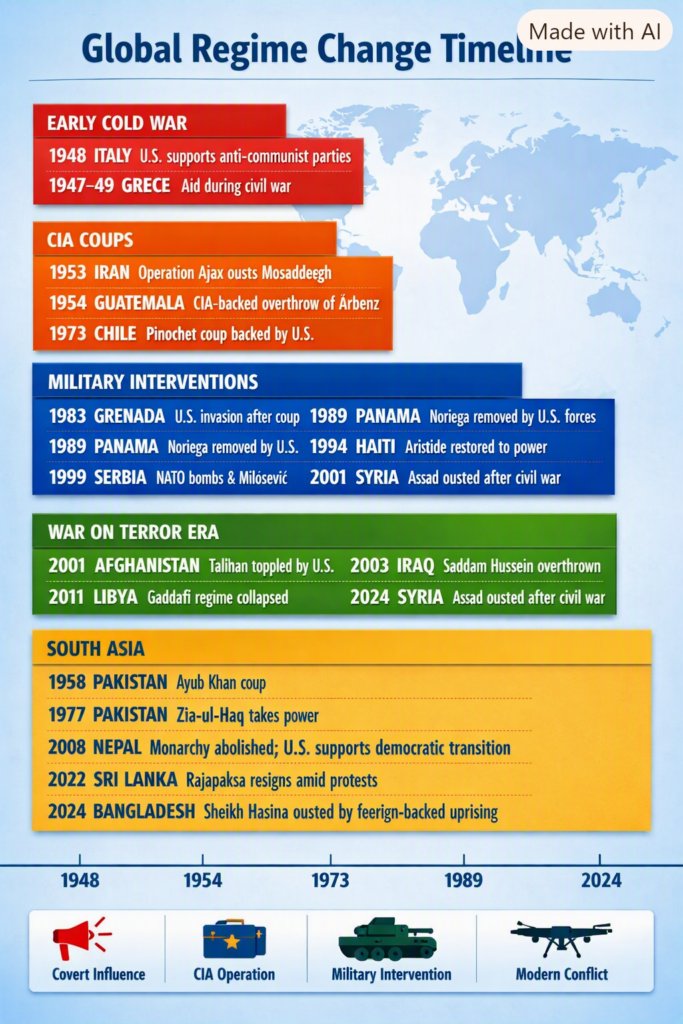
🌍 Global Regime‑Change Operations: From World War II to South Asia in 2026
For more than eight decades, the United States has used regime‑change strategies—covert CIA missions, economic pressure, and direct military invasions—to reshape political landscapes worldwide. While Latin America, the Middle East, and Africa provide the most documented cases, South Asia has also experienced U.S. influence, often through subtler channels.
📖 Introduction
Regime change refers to efforts to replace a country’s leadership or governing system. These operations range from propaganda and financial manipulation to coups and invasions. Since 1945, Washington has repeatedly intervened abroad, sometimes achieving short‑term success but often leaving behind instability and mistrust.
🕰️ Cold War Foundations (1945–1960s)
- Italy, 1948: U.S. covert funding and propaganda blocked communist electoral gains.
- Greece, 1947–49: Military and economic aid sustained the government during civil war.
- Iran, 1953 (Operation Ajax): CIA and MI6 removed Prime Minister Mosaddegh after oil nationalization.
- Guatemala, 1954 (Operation PBSUCCESS): President Árbenz resigned under CIA‑backed pressure.
- Congo, 1960–61: U.S. covert support undermined Patrice Lumumba, who was later assassinated by rivals.
- Cuba, 1961 (Bay of Pigs): CIA‑trained exiles failed to topple Fidel Castro.
🌍 Expanding the Playbook (1960s–1970s)
- Brazil, 1964: U.S. prepared to back a military coup against President Goulart.
- Dominican Republic, 1965: Direct U.S. military intervention shaped political order.
- Indonesia, 1965–66: U.S. supported the army’s anti‑communist campaign as Sukarno fell and Suharto rose.
- Chile, 1970–73: U.S. covert funding and economic pressure destabilized Salvador Allende, paving the way for Pinochet’s coup.
⚔️ Direct Military Interventions (1980s–1990s)
- Grenada, 1983: U.S. invasion removed revolutionary leadership.
- Panama, 1989 (Operation Just Cause): Manuel Noriega captured and flown to the U.S.
- Haiti, 1994: U.S. forces restored elected President Aristide.
- Serbia, 1999–2000: NATO airstrikes weakened Milošević; his removal followed elections and protests.
🏛️ The “War on Terror” Era (2001–2011)
- Afghanistan, 2001: Taliban regime collapsed under U.S. invasion, but long‑term stability failed.
- Iraq, 2003: Saddam Hussein overthrown; absence of WMDs undermined U.S. credibility.
- Libya, 2011: NATO airpower helped topple Muammar Gaddafi, leaving Libya fragmented.
- Syria, 2011 onwards: U.S. support for rebels failed to remove Assad; his eventual fall in 2024 was driven by domestic forces amid foreign interventions.
🌏 South Asia: Influence and Intervention
🇵🇰 Pakistan
- 1958 Coup (Ayub Khan): U.S. recognized and supported the military regime.
- 1977 Coup (Zia‑ul‑Haq): Bhutto ousted; Washington aligned with Zia during the Soviet‑Afghan war.
- Post‑9/11: Pakistan became a major non‑NATO ally, receiving billions in aid while balancing U.S. demands and domestic politics.
🇱🇰 Sri Lanka
- Civil War (1983–2009): U.S. emphasized human rights and reconciliation but did not engineer regime change.
- 2022 Economic Crisis: Mass protests forced President Gotabaya Rajapaksa to resign; U.S. influence was diplomatic, not covert.
🇳🇵 Nepal
- 1996–2006 Maoist Insurgency: U.S. supported monarchy and later democratic institutions.
- 2008 Abolition of Monarchy: Transition to republic was domestically driven, with U.S. aid supporting governance reforms.
- 2025 Youth Protests: Interim government formed; U.S. policy emphasized democracy, but no coup evidence exists.
🇧🇩 Bangladesh
- 2024 Ouster of Sheikh Hasina: Student‑led protests forced her resignation; Nobel laureate Muhammad Yunus led an interim government.
- Foreign Influence: Reports cite U.S. grants, USAID programs, and NED activities shaping the transition. Aid peaked at $572 million in 2024, coinciding with Hasina’s removal. Analysts argue Washington sought a Bay of Bengal foothold to counter China’s Belt and Road Initiative.
📌 Lessons Across Regions
- Regime removal ≠ stability: Afghanistan, Iraq, and Libya show that military success rarely guarantees legitimacy.
- Domestic actors matter: Even with foreign backing, local elites and institutions determine outcomes.
- South Asia’s distinction: U.S. influence was more indirect—via aid, diplomacy, and military ties—except in Bangladesh, where 2024 stands out as a clear case of foreign‑engineered transition.
📰 Conclusion
From Iran in 1953 to Bangladesh in 2024, U.S. regime‑change operations reveal a consistent pattern: short‑term objectives achieved through covert or overt means, followed by long‑term instability. While Latin America and the Middle East provide the most documented coups, South Asia demonstrates how influence can be subtler—shaping political outcomes without always leaving behind declassified evidence of direct orchestration.
Would you like me to turn this into a visual timeline chart (with dates, countries, methods, and outcomes) so you can quickly compare global and South Asian cases side by side?

