














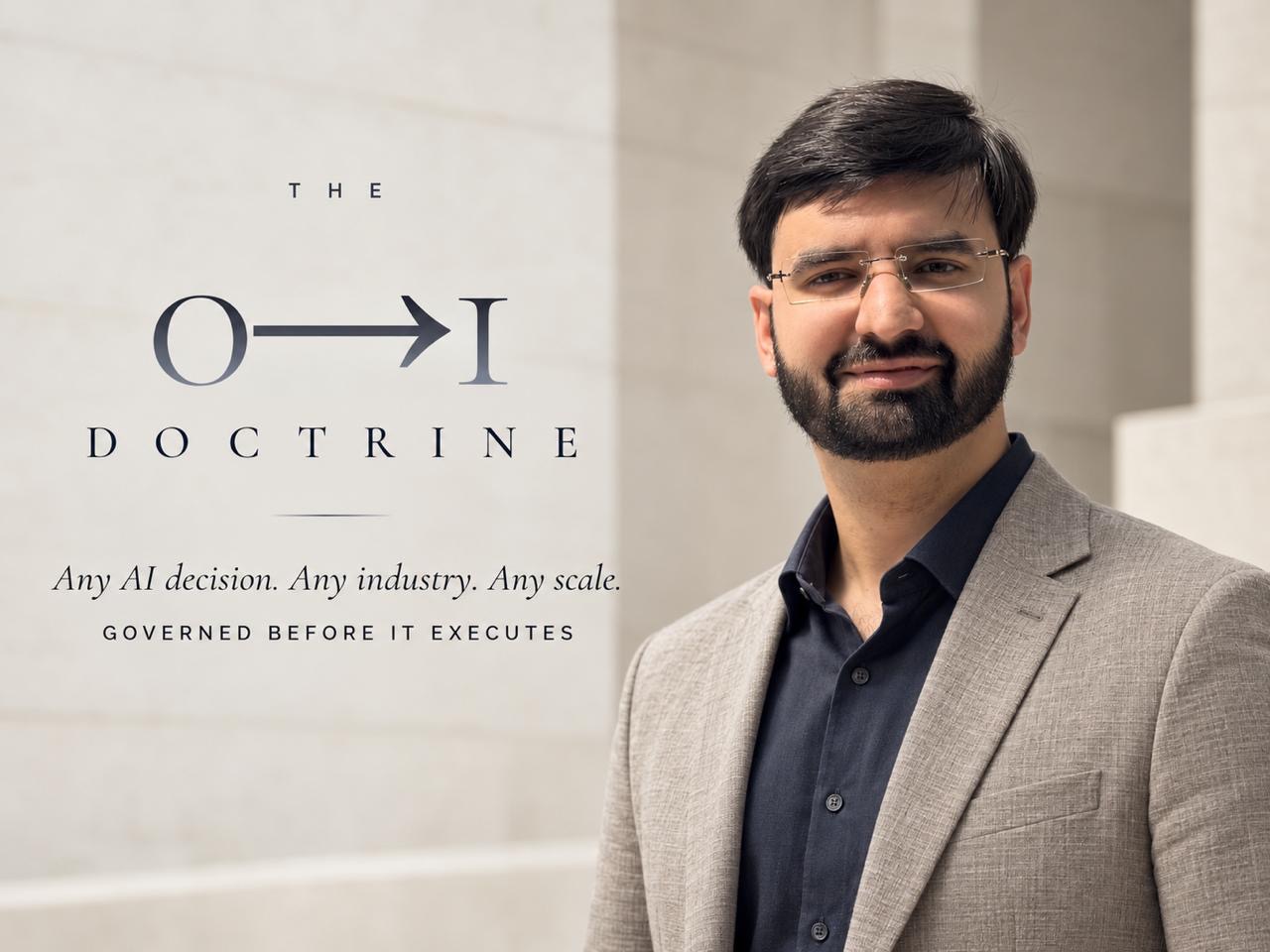

New Theorems for AI, AGI, Superintelligence: 0→1 Doctrine Inventor Vatsal Soin Files Dark Data Patents
Probability tells an AI how worried to be; a theorem shows what must follow once the rules are set.
Vatsal Soin’s foundational 0→1 Doctrine and the BBAT filings of September 23 and October 1, 2026 share one idea: actions are scored between 0 and 1 and tested before they run. The Doctrine governs how AI decides and acts; BBAT governs stored data. Bayesian methods could still advise beside them, as early-warning signals ahead of the check.
LIVE www.0to1doctrine.com
THE TWO INVENTIONS, SIMPLY
The 0→1 Doctrine writes a need and a limit as ranges on one scale from 0 to 1, and compares them before an AI system acts. Band-Based Archive Triage, or BBAT, filed later, applies the same scale to dark data: stored records nobody uses. Each can work alone. Together they cover what AI does and what it learns from.
ODDS VERSUS A LINE
A Bayesian method reports how likely trouble is, and updates as evidence arrives. That suits early warning well.
A decision, though, must end as go, stop or ask a person. The authorised rules set that line; a theorem shows what follows from them. The filings leave room for such methods as advisers beside the gate.
WHY THEOREMS
A rule says what should happen. A theorem shows what must follow once the starting rules, the axioms, are set, and a reviewer can check the reasoning. These are the inventor’s proposals, set out for independent review. Some cover only the designs as filed, and none replaces testing. Mathematics gives reviewers a common language.
A SMOKE DETECTOR AND A FIRE DOOR
A Bayesian layer works like a smoke detector: it senses drift and rising risk early, and advises. The gate works like a fire door: it checks each proposed action against fixed limits, the same way every time. Neither replaces the other. Together they could cover both the warning and the decision.
THREE LAYERS, ONE ORDER
Think of three layers. At the base sit the axioms, the starting rules. Above them sit the theorems, what must follow from those rules. At the top sit the actions and records, each ending in go, stop, ask a person or a defined state, with a sealed receipt. Change an axiom and every theorem above it must be rechecked. That is how reviewers could trace any outcome down to a rule, and any rule up to an outcome.
THE SHARED SCALE
Band Intersection says need and limit are compared as ranges, so go, stop or ask follows plainly. Scale Invariance says the logic stays the same for one user or many. Deterministic Closure says every case within its domain ends in one defined outcome. Doubt, such as a gap or an unclear fit, goes to a person.
PRIVACY AND PROOF
Privacy Preservation holds that, by design, only a band leaves its source, not the raw data. Receipt Integrity holds that each decision leaves a sealed record of what was decided, when and under which limits. Together they could let a reviewer check a decision without seeing the data behind it, though resistance to reconstruction needs independent testing. A receipt shows a rule was applied; it does not show the rule was right.
THE HUMAN LINE
The axiom Human Oversight Mandate keeps judgement calls with people. Computability Limit marks what mathematics can settle and what it cannot. Agentic Threshold says autonomy opens only once a system is assessed as capable and authorised; otherwise the gate stays shut. People place that line, and could keep it. Doubt always has somewhere to go.
BBAT ADDS ITS OWN
The axiom Metadata-Only Triage sorts records by metadata, never content, into keep, purge or promote. The In-Vault Derivation Axiom sets conditions, such as a minimum group size and band width, before a band may leave the protected vault. Others cover one-way derivation and proof the source is gone. Fail one, and the design sends nothing.
ORDER MATTERS
The axiom Delete-Before-Share requires the source copy to be destroyed, within its declared scope, before anything is released. Its theorem, Deletion and Egress Ordering, says the release gate cannot open until deletion evidence, hardware proof and a receipt are in place. Receipt-Gated Transition adds that a receipt-bound step stays disabled without a valid one. The order is fixed in design, not left to habit.
WATCHING THE WATCHERS
Receipt-Only Collective Input says a cross-agent monitor can work from sealed receipts alone, without opening archives. A single-agent check reads one agent’s receipts in order, to spot small steps creeping toward a boundary. The axiom Human Escalation sends a breach to a person, not to an automatic fix.
ONE CLOSED SYSTEM
Typed Lifecycle Closure says every BBAT record, within its declared domain, ends in a defined state: kept, purged, promoted, held for a person or verified. The axiom Decision Closure does the same for actions. Both rest on sealed receipts, so doubt can be traced rather than argued. Closure matters because an undecided case is where harm hides.
WHAT DARK DATA GAINS
Dark data costs money to store and is often locked away. Under these theorems a record could be sorted, derived and released as a band, with a receipt, while its source is destroyed first, within its declared scope. Whether that earns money is for pilots to show. The mathematics sets limits; markets set prices.
CHECK IT YOURSELF
A proof only holds inside its assumptions, so test those. Independent mathematicians, auditors and engineers can check the reasoning, and pilots can try the designs. If a theorem fails, the design says so. The aim is claims others can check, not claims taken on trust.
QUICK ANSWERS
Do Bayesian methods stay? They can stay as early-warning advisers beside the gate.
Are the theorems proven? The inventor sets out proofs, and independent review is the natural next step.
Which invention holds which? The Doctrine covers actions; BBAT covers stored records. Each works alone.
Does this cover every risk? It covers defined decisions and records. Wider safety also needs people, law and testing.
Who could check the logic? Regulators, auditors, boards and engineers, without needing access to the data.
Where could a pilot start? One archive or one workflow, with an outside reviewer checking receipts.
CLOSING NOTE
Odds can warn us. A line that holds could protect us. In an age of superintelligence and quantum machines, mathematics could help people keep the last word.
LIVE www.0to1doctrine.com
This can be tested, live, via API, governed against ungoverned, side by side.
THE INVENTOR
Systems theorist, inventor and entrepreneur Vatsal Soin holds granted patents in the US, Japan, India and more; filings span six continents. His August 2026 grant covers AI footwear with Sharable Size Card (SSC). His inventions span AI apparel with Global Biometric Size Card (GBSC), digital twins, robotics, global data, quantum resilience and governance. SIM–RMIT and NTU alumnus. Every invention was a step; 0→1 is the destination.
SELECTED REFERENCES
Granted: US Patent 12,446,652 B2 · Japan Patent 7560909 · India Patents 454081 and 599317. Filed: PCT/IN2025/051943 · US 19/489,595 · India 202511115781 · Australia AU2022450649 · India 202611113867 (23 September 2026) · PCT/IN2026/052042 (1 October 2026).
DISCLAIMER
Informational only. Not certified. No endorsement implied. Not investment advice. Examples are illustrative, not field results. Vatsal Soin · © 2026 All Rights Reserved.

