








Bengal-Born Physicist Ashoke Sen Wins Prestigious Oskar Klein Medal, Becomes First Indian Recipient
From Kolkata’s classrooms to the frontiers of modern physics, Ashoke Sen’s remarkable journey highlights India’s contribution to understanding the universe.
By Suman Munshi | IBG NEWS
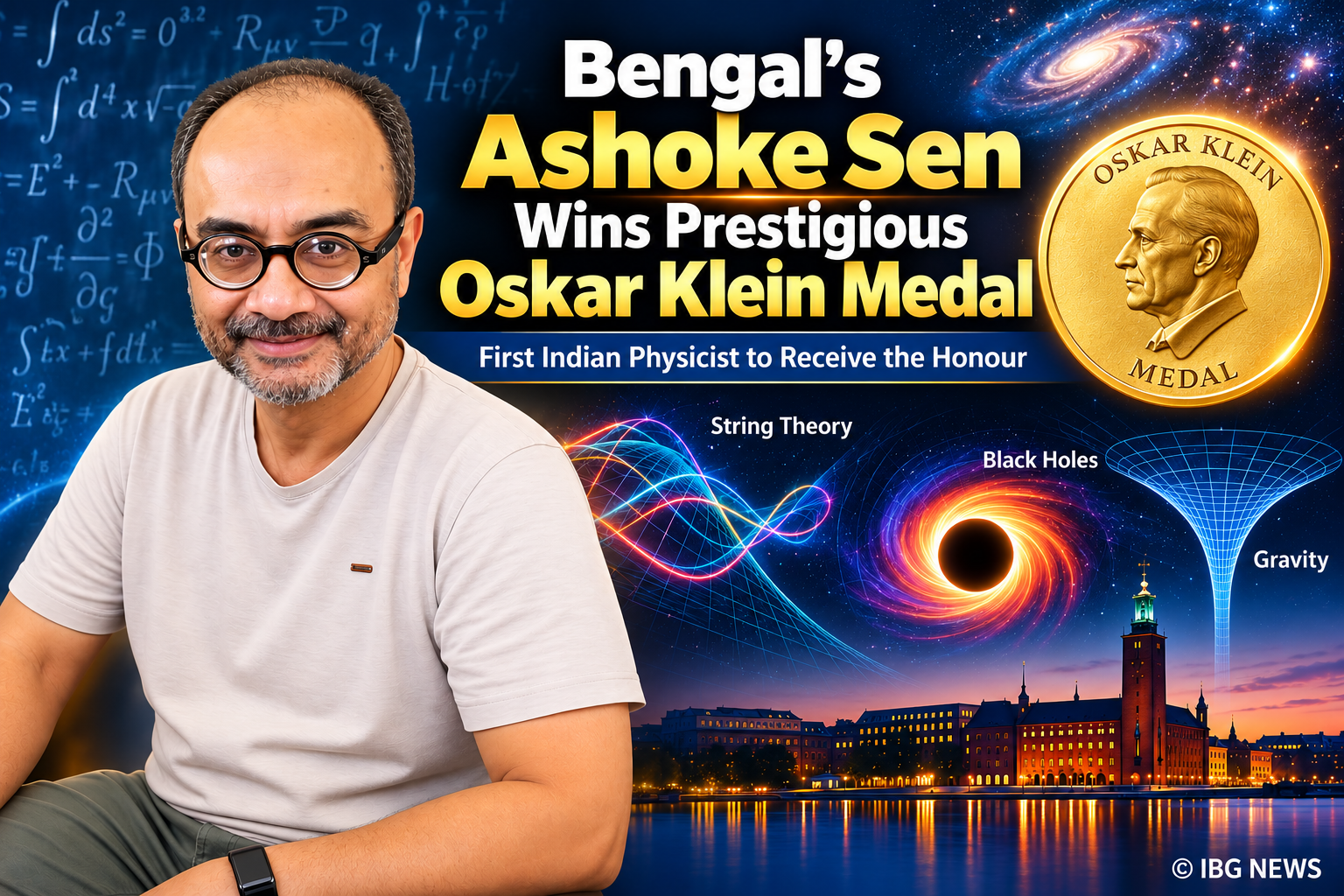
KOLKATA, October 29, 2026: Eminent Indian theoretical physicist Professor Ashoke Sen has achieved a historic milestone by receiving the prestigious 2026 Oskar Klein Medal, becoming the first Indian physicist to receive the international honour.
ICTS itself specifically highlights: “Previous recipients have included leading physicists such as Stephen Hawking, Peter Higgs, Steven Weinberg and Hans Bethe.”
The award recognises his pioneering contributions to string theory, quantum gravity, black-hole physics and the mathematical frameworks scientists use to investigate the fundamental laws of nature.
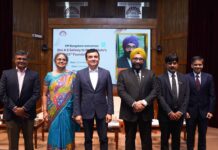
The Bengaluru-based International Centre for Theoretical Sciences (ICTS), where Sen holds the ICTS-Infosys Madhava Chair Professorship, announced the achievement on October 22, 2026. On the same day, Sen delivered the 2026 Oskar Klein Memorial Lecture, titled “Gravity from Strings and Strings from Gravity,” at Stockholm University’s AlbaNova Centre in Sweden.
Established in 1988, the Oskar Klein Medal honours outstanding contributions to physics. It is awarded annually by Stockholm University and the Nobel Committee for Physics of the Royal Swedish Academy of Sciences.
From Kolkata to International Scientific Recognition
Born in Kolkata on July 15, 1956, Ashoke Sen developed an interest in physics and mathematics that eventually led him towards some of the most challenging questions in modern science.
He graduated from Presidency College, Kolkata, in 1975 and completed his master’s degree in physics at IIT Kanpur before pursuing doctoral studies at Stony Brook University.. He subsequently moved to the United States for doctoral studies and earned his PhD from the State University of New York at Stony Brook in 1982.
Sen began his professional research career in the United States before returning to India. In 1988, he joined the Tata Institute of Fundamental Research in Mumbai. He later continued his research at the Harish-Chandra Research Institute in Prayagraj and became associated with ICTS-TIFR in Bengaluru.
Throughout his career, Sen has investigated the mathematical foundations of string theory and the relationship between gravity and quantum physics. His research has helped establish connections between theories that were once considered separate, opening new possibilities for understanding the universe.
What Is His Research About? An Explanation for Everyone
Although Professor Sen’s research involves highly advanced mathematics, its central questions are remarkably simple to express: What is everything made of? How does gravity work at the smallest scales? And what can black holes teach us about the universe?
1. String Theory: The Universe’s Fundamental Building Blocks
Most people learn that matter consists of atoms, which contain smaller particles. String theory explores a deeper possibility: the fundamental constituents of nature might behave like extraordinarily tiny vibrating strings rather than point-like particles.
Imagine a guitar string producing different musical notes as it vibrates in different ways. In a similar analogy, different vibration patterns in string theory correspond to different fundamental particles.
Sen has made important contributions to understanding the mathematical relationships among different versions of string theory.
Why is this important? Scientists are searching for a consistent framework that brings gravity into harmony with quantum physics, which governs the microscopic world. String theory is one approach to this challenge, although it has not yet been experimentally established as the correct description of nature.
2. S-Duality: Discovering Connections Between Different Theories
One of Sen’s most influential contributions concerns a concept called S-duality.
In simple terms, imagine that two mathematical descriptions of nature look very different but ultimately represent the same underlying physics. One description may be difficult to calculate when interactions are strong, while another may offer a simpler way to understand the same situation.
Sen helped demonstrate important connections of this kind within string theory.
These findings allowed physicists to study complicated problems through alternative mathematical descriptions and strengthened the idea that apparently different theories might be parts of a larger, unified framework.
3. Black Holes: Investigating Their Hidden Complexity
A black hole is a region of space where gravity is so strong that nothing can escape from within its event horizon, not even light.
Scientists have long sought to understand black holes using both gravity and quantum physics. One major puzzle involves black-hole entropy, a quantity related to the number of microscopic states associated with a black hole.
Sen’s research helped physicists calculate the microscopic states of certain black holes within string theory.
Put simply, his work helps scientists investigate how a black hole’s observable properties can emerge from an underlying microscopic description.
This research is significant because it provides clues about the relationship between gravity, quantum mechanics and the fundamental structure of space and time.
4. String Field Theory: Making String Interactions Easier to Study
Sen has also made important contributions to string field theory, a mathematical framework for describing strings and their interactions.
Just as conventional field theories help physicists describe interacting particles, string field theory provides tools for studying interacting strings.
His work has helped researchers formulate and investigate difficult questions involving the behaviour of strings and the structure of modern theoretical physics.
Together, these contributions have made Sen one of the influential figures in the development of contemporary string theory.
Ashoke Sen’s Major Awards and Honours: A Chronological Timeline
The following table presents selected major awards and professional recognitions received by Professor Ashoke Sen, arranged from the earliest to the most recent year.
| Year | Award or Recognition | Significance |
|---|---|---|
| 1989 | ICTP Prize | Recognised his contributions to theoretical physics. |
| 1994 | Shanti Swarup Bhatnagar Prize | Honoured his outstanding scientific research. |
| 1998 | Fellow of the Royal Society | Recognised his distinguished contributions to science. |
| 2001 | Padma Shri | One of India’s prestigious civilian honours. |
| 2009 | Infosys Prize in Mathematical Sciences | Recognised his contributions to mathematical sciences. |
| 2012 | Breakthrough Prize in Fundamental Physics | Honoured his contributions to establishing the unifying structure of string theory. |
| 2013 | Padma Bhushan | Recognised his distinguished contributions to science and engineering. |
| 2014 | Dirac Medal | Honoured his major contributions to theoretical physics. |
| 2026 | Oskar Klein Medal | Recognised his pioneering contributions to modern theoretical physics; Sen became the first Indian physicist to receive the medal. |
Source: International Centre for Theoretical Sciences (ICTS). The table lists selected major honours, not every distinction in Sen’s career.
A Milestone for Indian Science
Professor Sen’s latest achievement places an Indian scientist among the distinguished recipients of one of the major international honours in theoretical physics. Previous recipients of the Oskar Klein Medal include leading physicists such as Stephen Hawking, Peter Higgs and Steven Weinberg.
His work demonstrates how theoretical research, often conducted through mathematical calculations rather than laboratory experiments, can transform scientific understanding and provide new ways to investigate fundamental questions.
For Bengal, his journey from Kolkata to international scientific recognition is a source of pride. For young students, it is a reminder that curiosity, rigorous study and persistent questioning can lead to meaningful contributions to global knowledge.
Conclusion: Understanding the Universe, One Question at a Time
Ashoke Sen’s research does not claim to have solved every mystery of the universe. Instead, it has provided important mathematical insights into some of physics’ most difficult problems, particularly the relationship between gravity, quantum theory and black holes.
His achievement is a reminder that science advances not only through visible inventions but also through patient efforts to understand the laws governing reality.
The 2026 Oskar Klein Medal recognises this enduring contribution and highlights the important role Indian scientists continue to play in the international pursuit of knowledge.
IBG NEWS congratulates Professor Ashoke Sen on this remarkable achievement.
By Suman Munshi | IBG NEWS

