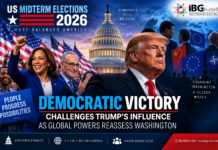















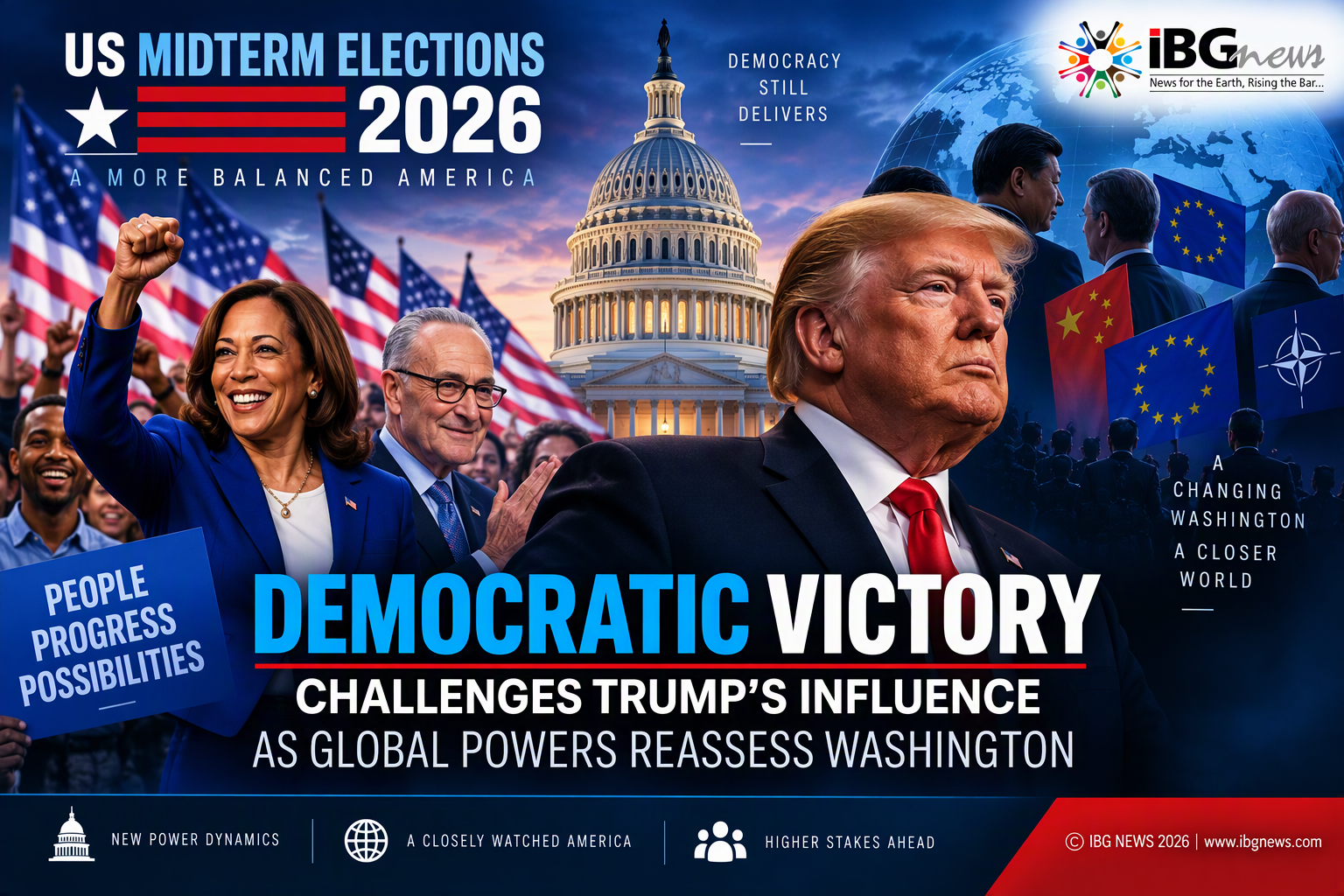

US Midterm Elections 2026: Democratic Victory Challenges Trump’s Authority as Global Powers Reassess Washington
By Suman Munshi | IBG NEWS
4 November 2026
A political setback with consequences beyond America
The 2026 United States midterm elections have delivered a major political setback to President Donald Trump, with the Democratic Party winning control of both the House of Representatives and the Senate, according to results reported on 4 November. The outcome is set to transform the political environment in Washington during the final two years of Trump’s current presidential term.
The elections were widely viewed as a referendum on the administration’s domestic and foreign policies, including the economy, inflation, tariffs, immigration and the United States’ international engagements. The Democratic victory now places both chambers of Congress under opposition control, creating a new phase of divided government.
The result does not remove Trump from office or automatically terminate his executive powers. However, it significantly changes the legislative and political environment in which he will govern—and its consequences could extend well beyond American borders.
What the election means for Trump’s authority
The most immediate consequence is the loss of Republican control over Congress. Democrats will now have greater influence over legislative priorities, congressional committees, government oversight and the approval process for key appointments.
A Democratic-controlled House can initiate investigations, issue subpoenas, conduct public hearings and scrutinise the administration’s decisions. This could bring increased congressional attention to executive actions, government expenditure, trade policy, foreign relations and potential conflicts of interest.
Control of the Senate is equally consequential. The chamber has a constitutional role in confirming senior executive and judicial appointments, including federal judges, ambassadors and cabinet-level officials. Democratic leadership can therefore influence the pace and prospects of future nominations.
Nevertheless, the American constitutional system does not give Congress unlimited control over the President. Trump retains executive authority, the power to veto legislation and considerable influence over foreign policy, national security and federal administration. Overriding a presidential veto requires a two-thirds majority in both chambers—a threshold Democrats do not automatically possess.
The Senate filibuster also remains a significant obstacle to passing many major bills, as most ordinary legislation generally requires 60 votes to overcome it.
Consequently, the election is more accurately understood as a substantial institutional check on Trump’s administration rather than an immediate transfer of presidential authority.
Foreign policy: Greater scrutiny, but not an automatic reversal
One of the most important international consequences may emerge in American foreign policy.
Trump’s approach to Russia, Ukraine, Iran, China and the wider West Asian region has attracted considerable international attention. A Democratic-controlled Congress could increase scrutiny of military engagements, diplomatic negotiations, sanctions, security assistance and the legal basis for the use of American military force.
Russia and Ukraine
Washington’s position on the Russia-Ukraine conflict will remain a major concern for European governments. Congressional Democrats may demand greater transparency over negotiations, security commitments and the administration’s approach to Moscow and Kyiv.
However, Congress cannot independently dictate every diplomatic decision. The President retains significant authority in conducting foreign relations, although legislation, funding and congressional oversight can influence the administration’s options.
The election could therefore make American policy more politically contested without necessarily producing an immediate change in its direction.
Iran and West Asia
The conflict involving Iran and the wider West Asian security environment may become another important area of congressional debate. Democratic lawmakers could seek greater oversight of military operations, authorisations for the use of force, civilian consequences and the financial costs of prolonged engagement.
This could affect the political space available to the administration for future military decisions. It may also influence how regional governments assess the reliability and continuity of American security commitments.
China and the Indo-Pacific
Relations with China are likely to remain strategically important regardless of which party controls Congress. Trade restrictions, semiconductor technology, artificial intelligence, maritime security and Taiwan will continue to shape the relationship.
Democratic lawmakers may challenge particular elements of the administration’s trade and diplomatic approach, but broad strategic competition with Beijing is likely to remain a central feature of US policy.
For Asian economies, including India, the crucial question will be whether Washington maintains predictable engagement across trade, technology, defence and regional security.
What does the outcome mean for Europe and America’s allies?
European governments and NATO partners will closely examine the political consequences of the election.
The Democratic victory may provide greater congressional space for discussions about transatlantic relations, security assistance and the future of European defence cooperation. At the same time, it does not guarantee a fundamental change in Trump’s approach to NATO or America’s expectations of European allies.
For governments that have been adapting to uncertainty in US policy, the central issue will be institutional continuity. Congressional opposition may constrain some presidential initiatives, but foreign governments must still deal with the sitting President and his administration.
The outcome could also encourage America’s allies to place greater emphasis on independent defence capabilities, diversified economic relationships and long-term diplomatic planning.
Global trade, tariffs and financial markets
The election may have important consequences for international trade.
Trump’s tariff policies have been a major source of uncertainty for trading partners and multinational businesses. A Democratic Congress could intensify political and legislative scrutiny of tariff decisions, particularly where they affect consumers, manufacturers, supply chains and American businesses.
However, the President retains significant statutory and executive tools to impose trade restrictions. Congressional opposition does not automatically cancel existing tariffs or prevent further executive action.
For global markets, the immediate concern will be policy uncertainty. Investors will watch for possible disagreements over government funding, taxation, trade measures and the federal debt ceiling.
The possibility of legislative deadlock could complicate economic decision-making. On the other hand, stronger congressional oversight may be viewed by some investors as an additional institutional constraint on abrupt policy changes.
The eventual market impact will depend less on the election result alone and more on the administration’s response and the ability of both parties to reach agreements on economic priorities.
India: Trade, technology and strategic cooperation in focus
For India, the election presents both opportunities and uncertainties.
India-US relations are built on several areas of cooperation, including defence technology, critical and emerging technologies, semiconductor development, energy, education, space cooperation and Indo-Pacific security.
A Democratic-controlled Congress could bring renewed attention to the institutional dimensions of the bilateral relationship. Congressional committees and lawmakers will remain influential in debates concerning trade, technology restrictions, immigration, human rights and strategic partnerships.
India will also monitor developments in American tariff policy. Changes in the political balance in Washington may create additional opportunities for negotiations, but they do not guarantee tariff relief or a new trade agreement.
The broader strategic relationship is supported by interests that extend across party lines. Nevertheless, businesses and policymakers in both countries will need to prepare for a more complicated American legislative environment.
Did Confrontations with Modi and Netanyahu Cost Trump Political Support? The Global Power Equation
One of the important questions emerging from the 2026 US midterm elections is whether President Donald Trump’s confrontational approach towards international partners—including Indian Prime Minister Narendra Modi and Israeli Prime Minister Benjamin Netanyahu—contributed to the erosion of his political support at home.
There is no direct electoral evidence establishing that disagreements with Modi or Netanyahu independently caused Republican losses. However, the diplomatic tensions surrounding these relationships formed part of a wider foreign-policy environment that became increasingly relevant to American voters.
The Modi factor: Strained relations with a strategic partner
Relations between Washington and New Delhi experienced considerable turbulence during Trump’s second presidency. Trade tariffs, pressure over India’s purchases of Russian oil, disagreements over Trump’s claims of mediation in the 2025 India-Pakistan ceasefire and differences over regional security created friction.
India’s objections to American trade measures and New Delhi’s insistence on strategic autonomy became important features of the relationship. A Congressional Research Service review documented the deterioration in bilateral ties during 2025, while also noting the February 2026 framework for an interim trade agreement. <Cite refs={[“turn900396search3″,”turn900396search4”]}/>
The political consequences for Trump were indirect but potentially significant. A foreign policy that creates uncertainty among strategic partners can generate concerns among American businesses, defence interests and sections of the electorate who favour stable international partnerships.
The issue is not simply whether Modi and Trump disagreed. It is whether the disagreements affected perceptions of American leadership, trade opportunities and the credibility of Washington’s international commitments.
The Netanyahu factor: The cost of an increasingly complicated Middle East policy
Trump’s relationship with Israeli Prime Minister Benjamin Netanyahu also experienced visible strains. Differences over the Iran conflict, Gaza ceasefire arrangements and regional security priorities exposed competing political and diplomatic objectives.
Reporting by The Washington Post in August 2026 described growing tension between the two leaders, particularly over the implementation of Trump’s Gaza peace proposal. Axios also reported disagreements within the Trump administration over Netanyahu’s approach to Gaza, Syria and Lebanon. <Cite refs={[“turn900396search1″,”turn900396search2″,”turn900396search5”]}/>
For American voters, the broader issue was the cost and consequences of overseas military involvement. The 2026 midterm election coverage identified dissatisfaction with the Iran war, alongside the cost of living and concerns about government conduct, as important factors in the Republican setback. <Cite refs={[“turn900396news48″,”turn900396news49”]}/>
This does not establish that support for Israel or disagreements with Netanyahu determined the election. Rather, it suggests that the administration’s Middle East policy became part of a larger domestic debate about military commitments, national priorities and the economic consequences of international conflict.
Did the so-called ‘Deep State’ turn against Trump?
The phrase ‘Deep State’ has become a recurring feature of American political debate. It is generally used by political figures and commentators to describe alleged entrenched networks within government, intelligence agencies, security institutions and the permanent bureaucracy that are believed to resist elected leadership.
However, the term should not be treated as proof of a coordinated organisation or a secret campaign against a President. There is no publicly established evidence demonstrating that a unified ‘Deep State’ engineered the 2026 midterm results or organised a political operation to remove Trump from power.
There are, nevertheless, genuine institutional tensions in Washington. Intelligence agencies, federal departments, courts, congressional committees, military institutions and independent regulatory bodies operate under different constitutional and statutory responsibilities. Their disagreements with presidential decisions can produce political confrontation, investigations and legal challenges.
Democratic control of Congress will now provide stronger institutional mechanisms for scrutinising the administration. This is a consequence of the electoral outcome and the constitutional structure of the United States—not evidence of a secret political conspiracy.
The larger lesson: International leadership has domestic consequences
The experiences involving Modi and Netanyahu highlight a wider challenge for the American presidency. A President’s foreign-policy decisions can influence relationships with allies, international business confidence, defence cooperation, energy markets and domestic political opinion.
The 2026 election results point to voter dissatisfaction with several aspects of Trump’s leadership, particularly economic pressures and the Iran conflict. It would therefore be misleading to attribute the Republican losses to two diplomatic relationships alone.
The more important question is whether Trump’s approach to international partnerships and military engagements has created additional political and economic costs that his administration must now address under stronger congressional scrutiny.
The 2028 presidential election begins to enter the political calculation
The midterm result also changes the political atmosphere ahead of the 2028 presidential election.
Democrats will seek to use their congressional majority to demonstrate an alternative governing approach, while Republicans will face pressure to defend their record and respond to opposition investigations.
Trump, meanwhile, will continue to exercise presidential authority, but his legislative priorities may encounter greater resistance. The administration could increasingly rely on executive actions, regulatory decisions and negotiations with individual lawmakers.
This may create a cycle of political confrontation, particularly over government spending, immigration, healthcare, trade and foreign policy.
The effectiveness of the Democratic majority will ultimately depend on its ability to maintain internal unity and translate electoral gains into legislative outcomes.
A new phase in American power politics
The 2026 midterm elections demonstrate how domestic electoral outcomes can influence the international environment. The United States remains a central actor in global security, trade, finance, technology and diplomacy. Changes in the balance of power within Washington therefore carry consequences for governments and markets worldwide.
Yet the election should not be interpreted as an automatic reversal of American foreign policy or the end of Trump’s presidential authority. The constitutional distribution of power, executive discretion, congressional oversight and political negotiations will continue to shape the next two years.
For global partners, the central challenge will be understanding how much of the administration’s agenda can survive stronger congressional opposition.
The defining question after the 2026 midterms is no longer simply whether Donald Trump controls the White House. It is how effectively he can exercise presidential power when both chambers of Congress are controlled by the opposition—and how that new political reality will influence America’s role in an increasingly uncertain world.
IBG NEWS Analysis | International Affairs

