









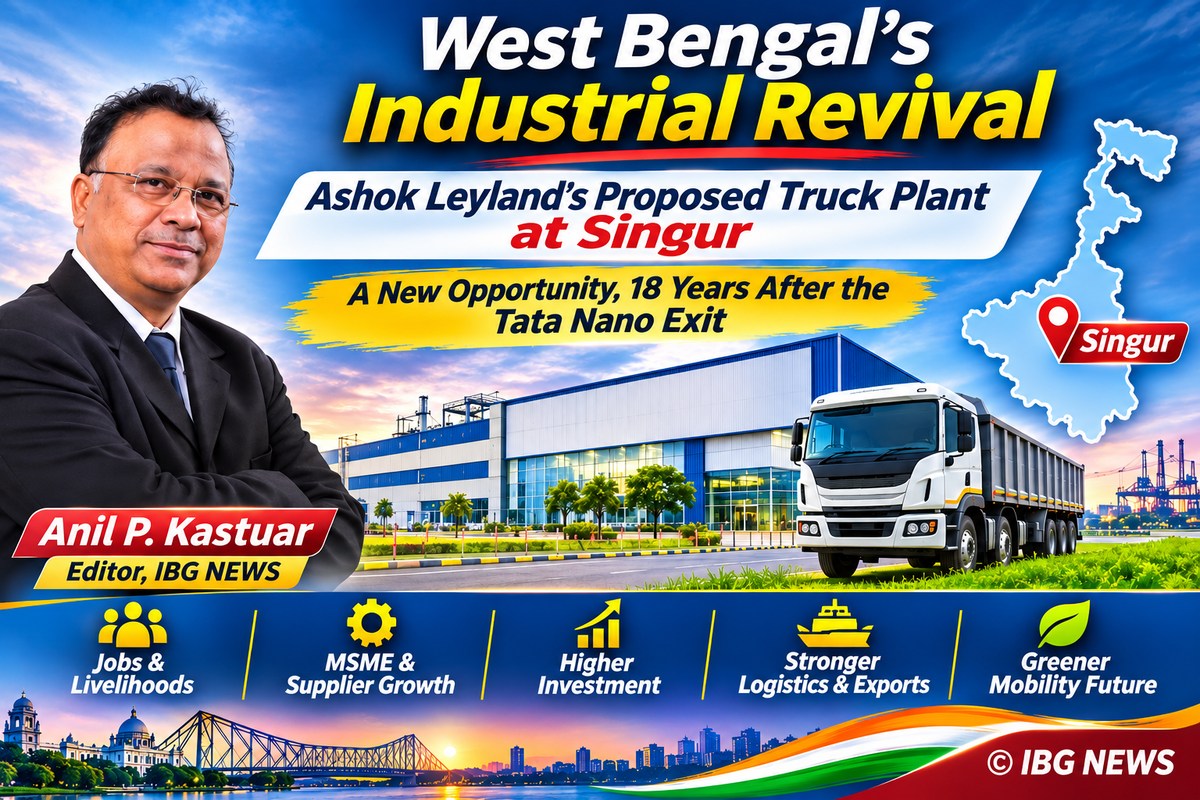

Singur’s Second Chance? Can the Proposed Ashok Leyland Plant Help Revive West Bengal’s Industrial Growth
By Anil P. Kustuar | Editor, IBG NEWS
A New Industrial Opportunity for Bengal
Nearly two decades after the Tata Nano project left Singur amid controversy and uncertainty, the Hooghly district may once again find itself at the centre of West Bengal’s industrial ambitions.
Recent statements by public officials indicate that commercial vehicle manufacturer Ashok Leyland is considering a truck manufacturing facility in Singur. Although key details, including the investment size, production capacity, employment projections and project timeline, have not yet been formally confirmed, the proposal has already reignited discussions about industrial development in the state.
The question is no longer whether Singur can attract industrial attention. The bigger question is whether this proposed project can become a genuine catalyst for economic transformation in West Bengal.
Why Singur Matters Beyond One Factory
The significance of the proposed Ashok Leyland project goes far beyond the construction of a manufacturing unit.
Singur remains one of India’s most recognisable examples of how land acquisition disputes can reshape industrial policy, investor sentiment and regional development. The withdrawal of the Tata Nano project in 2008 became a defining moment in Bengal’s industrial history.
Today, any new industrial proposal at Singur carries symbolic and economic importance.
If implemented successfully with transparency, community engagement and proper land arrangements, the project could help rebuild investor confidence while creating a model for future industrial investments in the state.
However, it is important to remain realistic.
At present, the project should be viewed as a proposed investment opportunity, not a confirmed manufacturing facility. Public reports available so far have not disclosed the final investment amount, employment commitments, production plans or implementation schedule.
For investors, workers and local communities alike, execution will matter far more than announcements.
Why Ashok Leyland Could Be a Game-Changer
Ashok Leyland is among India’s leading commercial vehicle manufacturers, producing everything from light commercial vehicles to heavy-duty trucks and buses.
Unlike many manufacturing sectors, commercial vehicle production creates demand across a vast supplier network. A truck plant requires components and services ranging from steel fabrication and precision engineering to electrical systems, tyres, logistics and industrial maintenance.
A successful manufacturing ecosystem could benefit:
- Engineering and fabrication units
- Metalworking and foundry clusters
- Automotive component suppliers
- Logistics and warehousing operators
- Technical training institutes
- Service and maintenance companies
This multiplier effect is one reason why major automobile investments often become catalysts for regional industrial development.
Bengal Already Has the Industrial Foundations
Contrary to the perception that West Bengal must rebuild industry from scratch, the state already possesses substantial industrial capabilities.
Its strengths include:
Engineering and Manufacturing
Industrial centres such as Howrah, Durgapur, Asansol and Hooghly continue to host engineering, fabrication, foundry and steel-related industries.
Petrochemicals
The Haldia industrial region provides a strong petrochemical and chemical manufacturing base with significant downstream opportunities.
MSME Ecosystem
West Bengal has one of India’s largest MSME networks, creating opportunities for supplier development and local manufacturing integration.
Ports and Connectivity
Kolkata and Haldia ports provide direct access to domestic and international markets, while road, rail and inland waterways strengthen regional connectivity.
Skilled Workforce
The state possesses a large pool of engineers, technicians, IT professionals and vocationally trained workers capable of supporting advanced manufacturing.
The challenge is not the absence of industrial capability. The challenge is connecting these strengths into a modern manufacturing ecosystem capable of attracting sustained private investment.
The Employment Potential
While no official employment estimates have been released, large automotive manufacturing projects typically generate economic activity across multiple levels.
Direct Jobs
Production workers, engineers, technicians, supervisors, quality-control specialists and plant administrators would be required once operations begin.
Indirect Jobs
Employment opportunities often emerge throughout supply chains including:
- Component manufacturing
- Transportation
- Packaging
- Warehousing
- Maintenance services
- Industrial support functions
Local Business Growth
An expanding industrial workforce typically stimulates demand for housing, healthcare, education, retail services and local transportation.
The ultimate impact, however, will depend on the final scale of the project and the extent to which local suppliers participate in the production ecosystem.
Why MSMEs Could Be the Real Winners
One of the most important aspects of the proposal may not be the factory itself but the opportunities it creates for Bengal’s small and medium enterprises.
A major manufacturer often creates demand for hundreds of suppliers.
If local businesses can meet quality, pricing and delivery standards, they could secure long-term roles in automotive supply chains.
To maximise these opportunities, policymakers may need to focus on:
- Supplier development programmes
- Technical certification support
- Access to finance
- Modern manufacturing technologies
- Industry-linked skill training
- Quality and environmental compliance systems
A successful industrial revival requires more than attracting large corporations. It requires ensuring that local businesses grow alongside them.
New Policy Push Could Support Investment
The proposal comes amid a broader push to attract investment under the West Bengal Investment Promotion Policy, 2026.
The policy aims to support manufacturing and services through:
- Investment-linked incentives
- Employment-based support
- Infrastructure assistance
- Research and development encouragement
- Technology upgradation measures
- Single-window clearance mechanisms
Such initiatives are designed to improve the ease of doing business and strengthen investor confidence.
Yet policy announcements alone are not enough.
Long-term investment decisions depend on stable implementation, efficient approvals, reliable infrastructure and predictable regulation.
For investors, credibility is built through execution rather than policy documents.
Logistics Could Be Bengal’s Biggest Advantage
West Bengal occupies a strategically important position in eastern India.
The state serves as a gateway connecting:
- Eastern India
- Northeastern states
- Bangladesh
- Southeast Asian trade corridors
With Kolkata and Haldia ports, major freight corridors, railway networks and expanding logistics infrastructure, Bengal is well placed to support large manufacturing operations.
For a commercial vehicle manufacturer, efficient movement of components and finished vehicles can significantly influence costs and competitiveness.
This makes logistics one of Bengal’s strongest long-term advantages.
Looking Beyond Trucks: The Future Mobility Opportunity
The automotive industry is undergoing rapid transformation worldwide.
Electric vehicles, battery technologies, connected mobility systems, advanced electronics and alternative fuels are increasingly shaping future investment strategies.
Although no such commitments have been announced for the proposed Singur facility, policymakers have an opportunity to attract future-oriented manufacturing alongside conventional vehicle production.
Potential areas for future growth include:
- Electric commercial vehicles
- Battery systems
- EV charging technologies
- Automotive electronics
- Connected vehicle software
- Fleet management technologies
Building capabilities in these sectors could strengthen Bengal’s long-term competitiveness in the evolving mobility economy.
What Could Still Go Wrong?
Despite the opportunities, several challenges remain.
Land and Public Trust
The legacy of the original Singur dispute means that transparency and stakeholder engagement will be essential.
Infrastructure Reliability
Manufacturing depends upon dependable power, water, roads, freight connectivity and industrial services.
Policy Consistency
Investors generally make decisions based on long-term stability rather than short-term incentives.
Skilled Workforce Availability
Training systems must align with industry requirements to provide a steady pipeline of skilled workers.
Project Execution
Perhaps most importantly, announcements must eventually translate into investment, construction and commercial operations.
Without implementation, even the most ambitious proposals remain only proposals.
The Road Ahead
The proposed Ashok Leyland project represents an opportunity rather than a guarantee.
For Singur, it offers a chance to redefine its industrial identity after nearly two decades of political and economic debate.
For West Bengal, it represents the possibility of combining manufacturing, logistics, MSME development, infrastructure and skilled employment into a broader growth strategy.
A single factory will not transform the state’s economy.
But a successful project can send an important signal to investors, encourage supplier development, strengthen industrial confidence and demonstrate that Bengal is ready to compete for large-scale manufacturing investments once again.
The ultimate measure of success will not be the number of announcements made. It will be the number of factories that become operational, the quality of jobs created, the growth of local enterprises and the value generated within the state.
If implemented transparently and effectively, the proposed Ashok Leyland facility could become more than another industrial project. It could mark the beginning of a new chapter in West Bengal’s industrial story.
Editorial Note
As of 22 November 2026, the proposed Ashok Leyland facility at Singur remains under discussion based on statements made by public officials. The company has not publicly released comprehensive details regarding investment value, production capacity, employment estimates, land arrangements or project timelines. Economic impacts discussed in this article should therefore be understood as potential outcomes rather than confirmed project commitments.
Sources: PTI, The Economic Times, The Indian Express, Ashok Leyland, NITI Aayog, West Bengal Budget 2026-27, DPIIT, Ministry of Ports, Shipping and Waterways, PIB India.