











“Haveli Sangeet is the Mother of Our Musical Tradition” – Acharya Shri Ranchhodlalji Goswami
IGNCA Commences Its 38th Foundation Day Celebrations with a Symposium on Haveli Sangeet
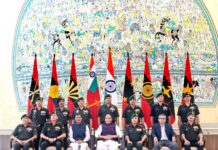
17th March, New Delhi: The 38th Foundation Day celebrations of the Indira Gandhi National Centre for the Arts (IGNCA) commenced with a Symposium on Haveli Sangeet, marking the beginning of a three-day celebration from 17th to 19th March that will showcase the richness of Indian art, culture, music, and dance. The inaugural session was graced by Dr. Sachchidanand Joshi, Member Secretary, IGNCA, as the Chief Guest. Organised in collaboration with the Centre for Cultural Studies & Development (CCSD), the symposium was conducted by Acharya Shri Ranchhodlalji Goswami, a distinguished musicologist and expert in Haveli Sangeet. Also present were Paulomi Guha, Founder Member Secretary, CCSD; G.N. Balaji, Project Advisor, CCSD; and Prof. Richa Kamboj, Head of Kaladarsana, IGNCA, along with other department heads, scholars, and artists.
Speaking as the Chief Guest, Dr. Sachchidanand Joshi highlighted IGNCA’s continued commitment to the preservation and promotion of India’s artistic and cultural heritage. He noted that in India, music transcends entertainment, serving as a spiritual connection with the divine. He emphasised that Haveli Sangeet, the Pushtimargiya Kirtan tradition, holds immense significance in Indian classical music.
Acharya Shri Ranchhodlalji Goswami traced the origins of Haveli Sangeet to nearly 500 years ago, when Vallabhacharya introduced the tradition of devotional singing in service of Shri Nathji. He explained that Indian temples played a crucial role in preserving music through a structured tradition of singing ragas and taals for divine service, aligned with seasonal and time cycles. He further mentioned that great scholars such as Narada Rishi, Bharata Muni, and Bilvamangala have been foundational to this tradition, which remains intact to this day. Several compositions from Haveli Sangeet have influenced the classical forms of Dhrupad, Dhamar, and Khayal.
During his presentation, Acharya Shri Goswami demonstrated various aspects of Haveli Sangeet, beginning with Prabandh, followed by Dhrupad and Dhamar, and concluding with an Ashray Pada. He distinguished between two styles of Holi compositions- Kachchi Holi, a semi-classical and folk form, and Pakki Holi, performed in Dhamar style. Reaffirming its significance, he described Haveli Sangeet as the mother of India’s musical tradition, preserving some of the oldest and rarest forms of kirtan music.

Speaking about the objective of the symposium on Haveli Sangeet, Ms. Paulomi Guha emphasised the importance of preserving traditions in their original form. She stated that efforts must be made to safeguard artistic heritage authentically, and this symposium was a step in that direction. She further noted that Haveli Sangeet is not merely a musical tradition but a way of life, with Dhrupad and Dhamar as its fundamental components. Earlier, Prof. Richa Kamboj delivered the welcome address and introduced the esteemed guests. Mr. G.N. Balaji then provided the audience with an overview of the concept and vision behind the symposium.
The Foundation Day celebrations will continue over the next two days, featuring performances by renowned artists, reflecting the diverse artistic heritage of India. The celebrations will feature diverse performances, beginning on 18 March at 6:00 PM with the Anveshan Group’s contemporary Indian dance presentation under the programme ‘Aadi Anant’, showcasing Kalaripayattu and Chhau, choreographed by Sangeeta Sharma. This will be followed by a Hindustani classical recital by Ronkini Gupta at 7:00 PM. On 19 March at 6:00 PM, Padma Shri Begum Batool will present folk music, followed by Subhash Devradi and his group’s performance of Veer Nitya and other folk dances of Uttarakhand at 7:00 PM.