







Ayodhya Parv is an Opportune Moment for Self-Understanding – Shri Arjun Munda
In Ram Rajya, the king exists to serve, not to be served – Manoj Shrivastava
Ram Rajya also requires Bharat and Hanuman – Didi Maa Mandakini
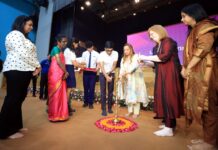
4th April, New Delhi: On the second day of the eighth Ayodhya Parv, organised at the Indira Gandhi National Centre for the Arts (IGNCA) in collaboration with Ayodhya Nyas, the IGNCA premises continued to resonate with the living presence of Lord Rama’s consciousness. The day commenced with a session on the theme ‘Shabari Ke Ram’. The discussion reflected upon that people’s hero form of Lord Rama who is revered even by those standing at the margins of society. Through the episode of Shabari, the speakers brought forth dimensions of devotion, surrender, patience, and pure love, while emphasising the message of social harmony and spiritual equality. On this occasion, the keynote speaker, former Chief Minister of Jharkhand, Shri Arjun Munda, remarked that there is no absence of emotional depth in the character of Shabari. He noted that India is both Aryavarta and Jambudvipa, and that this is a moment for self-understanding. He further observed that, unfortunately, in the post-Independence period, our cultural inheritance became entangled in politics; yet it holds a deep spiritual strength that is now beginning to manifest again. The session was also addressed by BJP spokesperson Dr. Guru Prakash Paswan, Dr. Vinod Tiwari, Dr. Kaushal Panwar, Dr. Rajesh Paswan, and Dr. Rajeev Kumar Verma.
This was followed by a session titled ‘The Idea of Ram Rajya in the Vision of Pt. Ramkinkar Upadhyay’, which reflected on the profound conception of Ram Rajya articulated by the noted exponent of the Lord Rama narrative, Pt. Ramkinkar Upadhyay. His vision was presented not merely as a system of governance, but as a transformation of human consciousness. Speakers in this session included Didi Maa Mandakini, regarded as his spiritual successor; Acharya Krishnakant; former Chief Secretary of Madhya Pradesh, Shri Manoj Shrivastava; former IAS officer Shri Rajeev Gupta; and Rama Katha Vachak Shri Devendra Rawat.
Didi Maa Mandakini observed that when the capital of Lord Rama and the capital of the nation converge, it signifies an auspicious moment of the highest order. Reflecting on the life and works of Pt. Ramkinkar Upadhyay, she stated that the realisation of Ram Rajya requires not only Rama, but also Bharat, Hanuman, and Lakshman. In her view, Rama and Bharat are not merely individuals, but represent two distinct streams of thought.
Manoj Srivastava noted that Pt. Ramkinkar Upadhyay regarded Shabari among the first two citizens of Ram Rajya, the other being Kevat. In this vision, the sole basis of citizenship was devotion. According to him, Ram Rajya is not a mere imagination, but a historical reality. It cannot be brought about through engineering or five-year plans; it emerges through inner disposition. He emphasised that in Ram Rajya, the king exists to serve, not to be served—leadership, in Rama’s model, is grounded in service rather than power.
Acharya Krishnakant elaborated on two forms of consecration: one where the deity is established within the sanctum and devotees come for darshan (reverential viewing), and another where the divine reaches out to devotees. He suggested that Ayodhya Parv, as held in Delhi, represents this latter form. Shri Devendra Rawat remarked that both faith and devotion must reside within the heart. At the conclusion of the session, the convenor of Ayodhya Parv and former Member of Parliament from Faizabad, Shri Lallu Singh, expressed gratitude to the speakers, guests, and attendees.
In the evening, cultural presentations suffused the atmosphere with devotion and aesthetic richness. The first performance featured Ms. Madhavi Madhukar Jha, whose rendering of Sanskrit hymns captivated the audience. This was followed by the theatrical production ‘Shabari ke Ram’, written by Prerna Agarwal and directed by Naveen Agarwal, which deeply engaged the viewers. The play explored lesser-known dimensions of the narrative of Shabari and Lord Rama, bringing forth her devotion and prolonged waiting across lifetimes. It portrayed, with emotional depth, Rama’s exile, the abduction of Sita, and his eventual journey to Shabari.
The second day of Ayodhya Parv thus witnessed an evocative confluence of intellectual deliberation and cultural expression, enriching the audience spiritually, culturally, and intellectually.