











Democracy or Political Theatre?
A Critical Examination of Ethics, Corruption, Accountability and the Crisis of Public Trust in India and the World
By Suman Munshi | Chief Editor, IBG NEWS
“The strength of a democracy is not measured by the number of elections it conducts, but by the degree to which power remains accountable to the people.”
Introduction: The World’s Most Celebrated Yet Most Challenged System
Democracy has long been regarded as humanity’s most progressive form of governance. It promises liberty, equality, justice, accountability, and participation. From the United States to India, from France to Japan, democratic governments derive their legitimacy from the consent of the governed rather than hereditary rule or military authority.
Yet, despite these ideals, public trust in democratic institutions has been steadily declining across many countries. Citizens increasingly question whether elections alone are sufficient to guarantee good governance. While democratic constitutions promise equality before law, transparency, and accountability, the practical experience of many voters is often different. Corruption allegations, political defections, ideological inconsistency, money power, media manipulation, and prolonged legal battles have created a perception that democratic politics frequently serves political survival more than public service.
India, the world’s largest democracy, exemplifies both the extraordinary achievements and the profound contradictions of democratic governance. Since Independence in 1947, India has conducted regular elections, ensured peaceful transfers of power, strengthened constitutional institutions, and expanded political participation to over a billion citizens. Simultaneously, it has witnessed recurring corruption controversies, criminalization of politics, growing election expenditure, judicial delays, and ethical inconsistencies that have repeatedly tested public confidence.
The central question is therefore not whether democracy is inherently flawed. Rather, it is whether democratic institutions are capable of holding political power accountable regardless of ideology, party, or individual.
Democracy Beyond Elections
True democracy extends far beyond the act of voting.
A healthy democracy requires:
- Equality before law
- Independent judiciary
- Autonomous election management
- Professional investigative agencies
- Transparent political funding
- Responsible media
- Protection of dissent
- Efficient public administration
- Equal justice irrespective of political influence
If elections continue while these institutions weaken, democracy risks becoming procedural rather than substantive. Governments may change, yet governance may not improve.
Political Ethics: Principles or Convenience?
One of the greatest criticisms of contemporary politics is ethical inconsistency.
Political leaders across democracies frequently condemn practices when undertaken by opponents but defend similar actions when politically advantageous. Electoral alliances shift, ideological adversaries become governing partners, defectors are criticized one day and welcomed the next, and campaign promises are often revised after elections.
This phenomenon is not confined to one country or one political ideology. It is visible in mature and emerging democracies alike.
When ethics become flexible and accountability selective, citizens begin to lose confidence not merely in governments but in democracy itself.
Corruption Since 1947: A Recurring Challenge
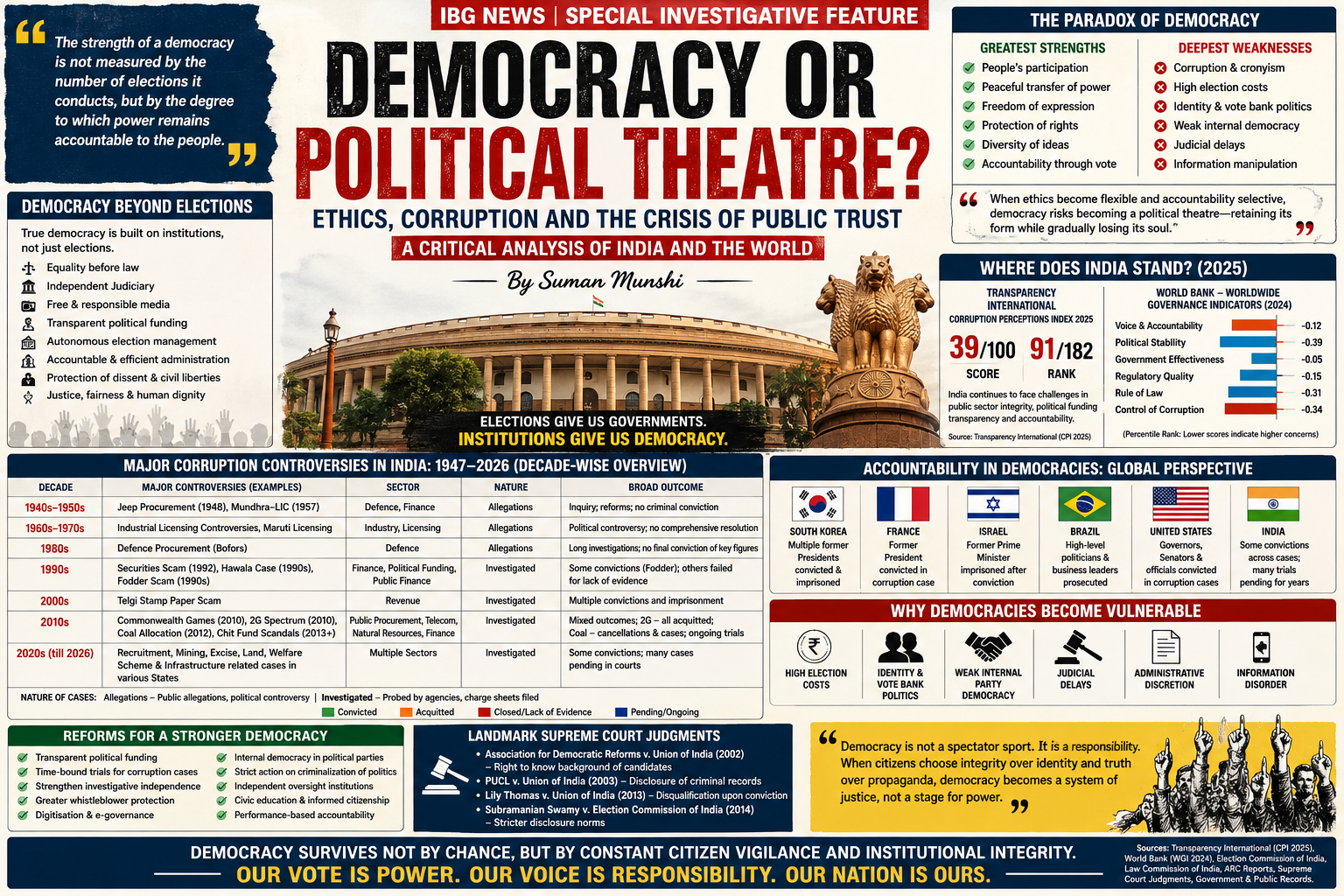
Independent India has experienced major corruption controversies in nearly every decade since Independence. These have involved different governments, different political parties, different economic sectors, and different levels of administration.
The persistence of corruption allegations across successive governments suggests that the problem is institutional rather than partisan.
Major publicly documented controversies include:
| Period | Major Public Controversy | Sector | Broad Outcome |
|---|---|---|---|
| 1948 | Jeep Procurement | Defence | Inquiry; no criminal conviction |
| 1957 | Mundhra–LIC Investment | Banking & Finance | Judicial inquiry; ministerial resignation; reforms |
| 1970s | Industrial Licensing Controversies | Industry | Political controversy; no comprehensive criminal resolution |
| 1980s | Defence Procurement (Bofors) | Defence | Long investigations; no final conviction of key political figures |
| Early 1990s | Securities Scam | Financial Markets | Regulatory reforms; convictions of several market participants |
| Mid-1990s | Hawala Case | Political Funding | Cases largely failed due to insufficient admissible evidence |
| 1990s onward | Fodder Scam | Public Finance | Convictions in several proceedings involving public officials |
| Early 2000s | Telgi Stamp Paper Scam | Revenue | Multiple convictions |
| 2010 | Commonwealth Games | Public Procurement | Investigations; mixed judicial outcomes |
| 2010 | 2G Spectrum Allocation | Telecommunications | All accused acquitted by trial court after lengthy proceedings |
| 2012 | Coal Allocation (Coalgate) | Natural Resources | Supreme Court cancelled numerous allocations; prosecutions in specific matters |
| 2013 onward | Chit Fund Scandals | Financial Sector | Arrests, investigations and continuing proceedings |
| 2020s | Recruitment, Excise, Mining, Land and Welfare-related Cases in Various States | Multiple Sectors | Investigations, convictions in some matters, and ongoing proceedings in others |
The significance of this timeline lies not merely in the scandals themselves but in their recurrence across decades. Every generation of Indians has witnessed public debate over corruption in one form or another.
Some allegations resulted in convictions. Others ended in acquittals. Many remained unresolved for years. This uneven pattern has contributed to widespread public perception that accountability is inconsistent and justice often delayed.
Why Do High-Profile Cases Last So Long?
Financial crime investigations involving public officials are inherently complex. They frequently require examination of thousands of documents, financial records, procurement files, expert opinions, digital evidence, international transactions, and testimony from numerous witnesses.
Appeals through multiple judicial levels are a fundamental safeguard of due process. However, prolonged proceedings may diminish public confidence, regardless of the eventual verdict.
Justice delayed—whether ending in conviction or acquittal—can leave citizens questioning whether institutions are capable of delivering timely accountability.
Corruption Is Not an Indian Phenomenon
No democracy has eliminated corruption.
South Korea has prosecuted and imprisoned former presidents after judicial proceedings. France has convicted a former president in corruption-related proceedings. Israel imprisoned a former prime minister following conviction. Brazil’s anti-corruption investigations implicated political leaders, business executives, and public officials across party lines. Italy’s “Clean Hands” investigations transformed its political landscape. Peru has prosecuted multiple former presidents. In the United States, governors, legislators, judges, and senior public officials have faced criminal convictions over corruption and abuse of office.
These examples demonstrate that corruption is not unique to any one nation. What distinguishes democracies is the strength, independence, speed, and credibility of the institutions responsible for investigating and adjudicating such cases.
Why Democracies Become Vulnerable
Democracies possess inherent strengths but also structural vulnerabilities.
High Election Costs
Modern election campaigns require substantial financial resources, creating incentives for opaque funding and influence.
Identity Politics
Campaigns based on religion, caste, ethnicity, language, or regional identity can overshadow governance debates.
Weak Internal Party Democracy
Candidate selection often remains centralized, limiting grassroots participation.
Administrative Discretion
Where decision-making lacks transparency, opportunities for corruption increase.
Judicial Delays
Lengthy legal proceedings reduce deterrence and weaken public trust.
Information Disorder
Digital platforms have accelerated the spread of misinformation, selective narratives, and emotionally charged political messaging.
Democracy’s Greatest Contradiction
Ironically, democracy’s greatest strength may also be its greatest weakness.
Its openness protects freedom of expression, political competition, and judicial safeguards. These same protections, however, can also slow investigations, complicate prosecutions, and permit prolonged political controversies.
Authoritarian systems may appear more decisive, but they often suppress dissent and independent oversight. Democracies are slower because they attempt to balance accountability with individual rights.
The challenge is ensuring that constitutional safeguards do not become a shield for impunity.
Restoring Public Trust
Democratic renewal requires institutional reform rather than dependence on individual personalities.
Priority areas include:
- Transparent political funding and disclosure.
- Time-bound adjudication of corruption cases.
- Greater protection for whistleblowers.
- Digitised procurement and public services to reduce discretionary decision-making.
- Strong parliamentary oversight.
- Independent anti-corruption institutions.
- Enhanced asset disclosure and conflict-of-interest regulations.
- Greater internal democracy within political parties.
- Civic education emphasizing constitutional values and informed citizenship.
The Role of Citizens
Ultimately, democracy reflects the collective choices of its citizens.
If voters consistently reward transparency, competence, and ethical governance, political incentives gradually change. If emotional appeals, identity politics, or short-term populism dominate electoral choices, institutional quality may suffer.
Citizens therefore remain democracy’s first and last line of accountability.
Conclusion: Democracy must earn public trust every day; it is not just an election-time activity
“Every nation gets the government it deserves.”— Joseph de Maistre
India’s democratic journey since 1947 has been extraordinary in scale and endurance. Few nations have sustained universal adult franchise, peaceful transfers of power, judicial review, and constitutional governance across such immense diversity.
Yet democratic success cannot be measured solely by the conduct of elections. It must also be judged by the integrity of institutions, the speed of justice, the transparency of governance, and the confidence citizens place in the rule of law.
The recurring corruption controversies of the past eight decades—spanning different governments, sectors, and political parties—illustrate that no ideology possesses a monopoly on virtue or vice. Corruption is fundamentally an institutional challenge, and combating it requires stronger systems rather than stronger personalities.
The future of democracy will depend not on louder political rhetoric but on quieter institutional integrity. Elections choose governments; institutions protect democracies. When institutions remain independent, accountable, and trusted, democracy thrives. When they weaken, democracy risks becoming political theatre—retaining its form while gradually losing its soul.