















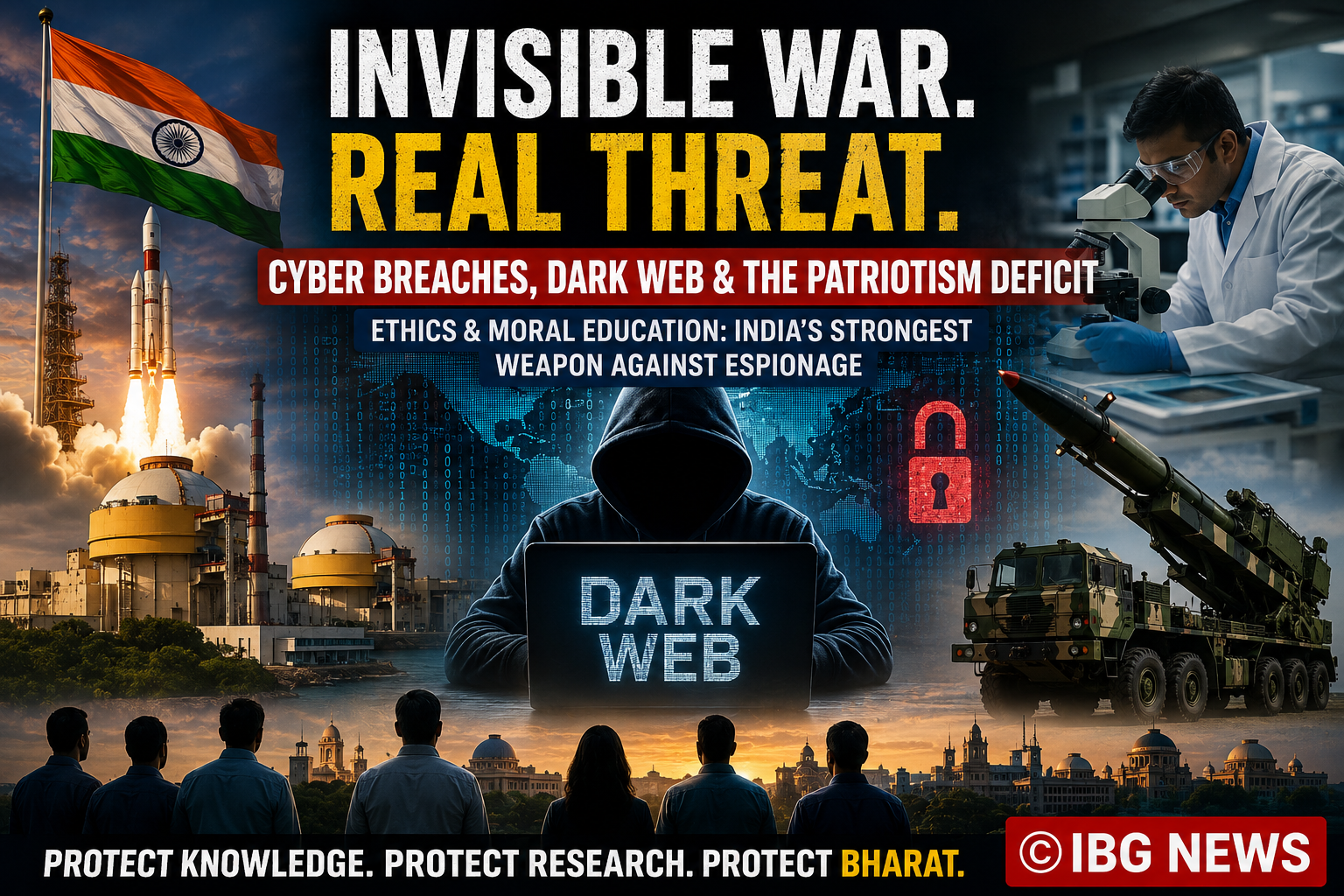
The Invisible Frontline: The Kudankulam Data Breach, Dark Web Threats and Why Ethical Education Is India’s Strongest National Security Shield
How Cybersecurity, Patriotism and Scientific Integrity Must Work Together to Protect India’s Strategic Future
By Suman Munshi | IBG NEWS (Strategic Affairs & National Security Analysis)
A Wake-Up Call for India’s Strategic Establishment
India today stands among the world’s leading scientific and technological powers. Its achievements in space exploration, nuclear energy, missile technology, artificial intelligence, semiconductor research, quantum computing and defence innovation have placed the country at the centre of global strategic competition.
However, in the digital age, wars are increasingly being fought without firing a single bullet. The battlefield has shifted from borders to laboratories, research centres, data servers, cloud infrastructure and even the minds of scientists and engineers.
Recent reports concerning the alleged exposure of documents related to the Kudankulam Nuclear Power Plant (KKNP) have once again highlighted the growing importance of cybersecurity and insider resilience. According to Reuters, the ransomware group World Leaks claimed to possess nearly 858,000 files allegedly stolen from Reliance Infrastructure, including approximately 19,000 files reportedly linked to the Kudankulam project.
The reported documents allegedly include engineering drawings, supplier information, inspection records, insurance papers, equipment reviews and project documentation. Reuters reviewed some of the files but stated that it could not independently verify their authenticity.
Importantly, there is no official confirmation that classified reactor designs, nuclear weapon information or nuclear safety systems were compromised.
The Nuclear Power Corporation of India Ltd. (NPCIL) has categorically stated that the reactor’s safety and security systems remain uncompromised, clarifying that the allegedly exposed information pertains only to the Balance of Plant (BoP) and associated infrastructure rather than the nuclear reactor itself.
Similarly, Union Minister Dr. Jitendra Singh has publicly clarified that no reactor data was leaked, assuring citizens that India’s nuclear infrastructure remains secure.
Nevertheless, security experts agree that even infrastructure-level documentation can possess significant intelligence value for hostile actors if misused.
The Dark Web: Today’s Marketplace for Stolen Intelligence
The Dark Web has evolved into an underground marketplace where ransomware groups and cybercriminals often advertise or attempt to monetize stolen corporate and government information.
Not every claim made by such groups is genuine. Some datasets may be exaggerated, fabricated, duplicated or only partially authentic. Therefore, every alleged breach requires rigorous forensic verification by competent authorities.
Yet, the broader strategic lesson remains clear.
Modern espionage increasingly revolves around:
- Scientific research
- Defence technology
- Artificial Intelligence
- Semiconductor designs
- Aerospace engineering
- Nuclear infrastructure
- Quantum computing
- Cybersecurity tools
- Supply-chain intelligence
The most valuable national asset is no longer merely land or minerals.
It is knowledge.
Why Scientists Are the New Strategic Soldiers
Today’s strategic competition is driven by innovation.
The world’s leading intelligence agencies actively seek insights into:
- missile guidance systems,
- AI algorithms,
- satellite technologies,
- semiconductor processes,
- cryptographic systems,
- advanced materials,
- biotechnology,
- quantum research.
Unlike conventional weapons, scientific knowledge cannot simply be rebuilt once compromised.
A stolen missile may be replaced.
A stolen design can never become secret again.
India’s Scientific Institutions: National Assets Beyond Price
India has invested enormous national resources in creating institutions that represent decades of scientific excellence:
- ISRO
- DRDO
- BARC
- NPCIL
- IITs
- IISc
- IISERs
- Indian Statistical Institute (ISI)
- CSIR laboratories
- Semiconductor Mission
- National AI Mission
- Defence Public Sector Undertakings
These institutions are not merely educational centres.
They represent India’s future strategic capability.
History Reminds Us That Espionage Is Real
India has experienced several espionage investigations over the decades, demonstrating that national security threats can emerge in many forms.
Among the better-known cases are:
- The controversial Samba Spy Case during the 1970s.
- The Larkins espionage case involving retired military officers.
- The Naval War Room Leak (2005) involving unauthorized dissemination of sensitive procurement information.
- Various investigations concerning alleged honey-trap attempts targeting defence personnel.
- Repeated cyber campaigns reportedly directed at government departments, defence organisations, power infrastructure and research institutions.
Each incident illustrates a common lesson:
The greatest vulnerability is often not technology—but people.
Cybersecurity Cannot Solve Human Weakness
India has significantly strengthened cyber defences through investments in:
- Artificial Intelligence
- Zero Trust Architecture
- Security Operations Centres
- Endpoint Detection & Response
- Threat Intelligence Platforms
- Encryption
- National CERT mechanisms
These technologies are indispensable.
However, no firewall can prevent:
- an authorised insider intentionally copying confidential data,
- a researcher deceived by sophisticated social engineering,
- or an employee manipulated through financial inducement or coercion.
Human integrity remains a critical layer of defence.
The Four Gateways to Espionage
Counter-intelligence professionals often describe recurring motivations behind insider compromises through the acronym MICE:
- Money
- Ideology
- Compromise (or Coercion)
- Ego
Recruitment attempts may also exploit:
- personal financial distress,
- online relationships,
- career dissatisfaction,
- emotional vulnerabilities,
- social engineering,
- or blackmail.
Patriotism Is More Than Emotion
Patriotism is often reduced to slogans or ceremonial displays.
Yet genuine patriotism is reflected in everyday decisions:
- refusing to disclose confidential information,
- protecting national intellectual property,
- reporting suspicious approaches,
- placing national interest above personal gain.
The strongest patriot is often the scientist working quietly in a laboratory, protecting research that may one day safeguard the nation.
India’s Missing Security Investment: Ethical Education
Technical education teaches:
How to build rockets.
Ethical education teaches:
Why they must never be sold.
Technical education teaches encryption.
Ethics teaches responsibility.
Artificial Intelligence teaches computation.
Integrity teaches restraint.
A nation producing world-class scientists without equally cultivating ethical responsibility risks creating vulnerabilities that technology alone cannot eliminate.
Scientific Integrity Must Become National Policy
Institutions handling strategic research should continue strengthening programmes that reinforce:
- research ethics,
- cybersecurity awareness,
- insider-threat recognition,
- responsible handling of classified information,
- conflict-of-interest disclosure,
- professional accountability.
Such programmes should complement—not replace—technical security measures.
Building a National Security Culture
A comprehensive framework could include:
1. Mandatory National Security Orientation
Every scientist joining strategic institutions should receive structured education on security responsibilities.
2. Ethics in Engineering and Science
Professional ethics should become a core component of higher technical education.
3. Continuous Cyber Awareness
Training should regularly address phishing, ransomware, social engineering and supply-chain risks.
4. Insider Risk Management
Sensitive roles should be supported by appropriate access controls, monitoring and reporting mechanisms consistent with legal safeguards.
5. Strong Research Data Governance
Access to confidential information should follow the principle of least privilege.
6. Leadership by Example
Institutional leaders should reinforce cultures of integrity, transparency and accountability.
7. Public Recognition
Scientists who demonstrate exceptional ethical leadership should receive recognition alongside those achieving technical excellence.
National Security Begins in the Classroom
India rightly invests billions in:
- missiles,
- satellites,
- supercomputers,
- quantum technologies,
- semiconductor fabrication,
- artificial intelligence.
But perhaps the most important investment is one that cannot be measured in gigabytes or megawatts:
Character.
Every child entering a classroom today could become tomorrow’s scientist, engineer, intelligence officer or defence technologist.
If ethical responsibility is cultivated from an early age, the nation gains a security advantage that no adversary can easily replicate.
Conclusion: The Strongest Firewall Is Human Conscience
The reported Kudankulam-related data breach serves as an important reminder that cybersecurity is not solely a technological challenge—it is also a human one. While official statements indicate that reactor systems and classified nuclear data were not compromised, the incident underscores the need for constant vigilance across the entire ecosystem supporting strategic infrastructure.
India’s scientific rise will inevitably attract espionage attempts from cybercriminals, hostile intelligence services and other malicious actors.
Protecting the nation’s future therefore requires more than advanced software and secure networks.
It demands scientists of integrity, engineers guided by ethics, institutions committed to accountability, and citizens who understand that safeguarding knowledge is itself an act of patriotism.
In the twenty-first century, the ultimate weapon against espionage is not merely stronger encryption or more powerful artificial intelligence.
It is a society where technical excellence is inseparable from ethical responsibility, national commitment and professional integrity. Such a culture may well prove to be India’s most enduring strategic advantage.