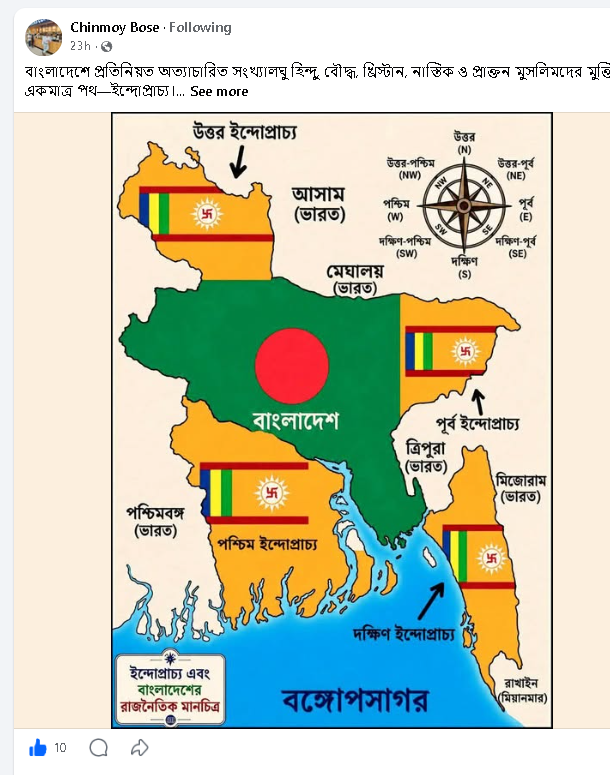












Indoprachya: A New Proposal for Minority Security or Another Geopolitical Debate in South Asia?
Analysis | By Suman Munshi | IBG NEWS
Kolkata,20 July 2026:
Some Social media posts are so engaging and thought-provoking that we can not keep quiet on the topic. This “Indoprachya” came to our notice in a Facebook post that appeared in many groups and as induvidual forward message. Let’s analyse the same from a third-party view.
Questions surrounding the security, religious freedom, and human rights of minority communities in Bangladesh have been debated for decades at both national and international levels. In recent years, a new geopolitical concept known as “Indoprachya” has gained attention on social media and among sections of the Bangladeshi diaspora and advocacy groups.
Supporters of the proposal argue that a separate administrative or political entity could provide greater protection, cultural preservation, and political representation for Bangladesh’s religious minorities, including Hindus, Buddhists, Christians, atheists, and former Muslims.
However, it is important to note that Indoprachya is not a recognized country, nor is it an officially proposed administrative plan of the Government of Bangladesh. It has not received recognition from the United Nations or the international community. At present, it remains a political and conceptual proposal that has generated both support and criticism.
What is the Proposed Indoprachya?
According to information circulating among its proponents, the proposed entity would have:
- Proposed Capital: Chattogram (Chittagong)
- Proposed Area: Approximately 92,022 square kilometres
- Proposed Districts: 38
Proposed Administrative Regions
North Indoprachya (8 Districts)
- Rangpur
- Gaibandha
- Kurigram
- Lalmonirhat
- Nilphamari
- Dinajpur
- Thakurgaon
- Panchagarh
South Indoprachya (5 Districts)
- Chattogram
- Cox’s Bazar
- Rangamati
- Khagrachari
- Bandarban
East Indoprachya (4 Districts)
- Sylhet
- Moulvibazar
- Habiganj
- Sunamganj
West Indoprachya (21 Districts)
- Shariatpur
- Madaripur
- Faridpur
- Gopalganj
- Rajbari
- Bhola
- Patuakhali
- Barishal
- Barguna
- Pirojpur
- Jhalokathi
- Khulna
- Bagerhat
- Satkhira
- Jashore
- Jhenaidah
- Kushtia
- Chuadanga
- Magura
- Narail
- Meherpur
Why Has This Proposal Emerged?
Advocates of Indoprachya argue that repeated incidents of attacks on minority communities, vandalism of religious sites, alleged land seizures, forced displacement, and discrimination have highlighted the need for a long-term political and administrative solution to ensure minority rights and security.
Critics, however, contend that proposals involving changes to the territorial boundaries of a sovereign state are highly sensitive and raise significant legal, political, and diplomatic concerns. They argue that protecting minority rights should be pursued through constitutional safeguards, the rule of law, independent judicial processes, democratic participation, and stronger human rights protections rather than territorial reorganization.
International Law and the Debate
International law recognizes both the right to self-determination and the principle of territorial integrity of sovereign states. In practice, the creation of a new state or alteration of internationally recognized borders generally requires a complex combination of political negotiations, legal processes, and international recognition.
Consequently, any proposal such as Indoprachya would face significant legal and diplomatic challenges before it could move beyond the level of political advocacy.
Possible Implications for India
Should such a proposal ever gain international attention, it could have implications for India’s eastern and northeastern regions in areas such as border security, migration, trade, maritime connectivity, and regional diplomacy.
At present, however, these remain theoretical considerations, as no formal process regarding the proposal exists.
Unanswered Questions
The discussion surrounding Indoprachya raises several important questions:
- How can the security of minority communities in Bangladesh be strengthened?
- What institutional reforms are needed to ensure equal rights and justice?
- Can long-term solutions be achieved within Bangladesh’s existing constitutional framework?
- How can regional stability be preserved while addressing legitimate human rights concerns?
Origin of the Term “Indoprachya”
The concept of “Indoprachya” appears to have emerged in online advocacy circles during 2025–2026, particularly in discussions concerning the protection and rights of religious minorities in Bangladesh.
As of now, no publicly verifiable source conclusively identifies the individual or organization that first coined the term. While the concept has gained visibility on social media and among certain advocacy groups, there is currently no documented academic publication, official manifesto, or government record establishing its origin or authorship.
Conclusion
Whether Indoprachya remains an online political concept or evolves into a broader policy discussion, its emergence reflects ongoing concerns about minority rights, religious freedom, and governance in Bangladesh.
At the same time, the proposal underscores the complexity of balancing human rights with the principles of sovereignty and territorial integrity under international law.
Any lasting solution to the concerns raised in this debate would ultimately depend on constitutional protections, democratic institutions, respect for human rights, constructive dialogue, and peaceful political processes.
A peaceful world without hate is most important for any civilized society; hate is not always the suitable solution for any conflict.
Editor’s Note: This article is an analytical report examining a publicly discussed geopolitical concept. IBG NEWS neither endorses nor opposes the proposal. The purpose of this report is to present the available information, legal context, and differing perspectives in a balanced and objective manner. Published as part of freedom of expression to share the issues raised in social media for analysis not to promote any debated ideology.