
















Atmanirbhar Bharat: India’s Defence Transformation from Import Dependence to Indigenous Strength
By Anil P. Kastuar, Editor, IBG NEWS
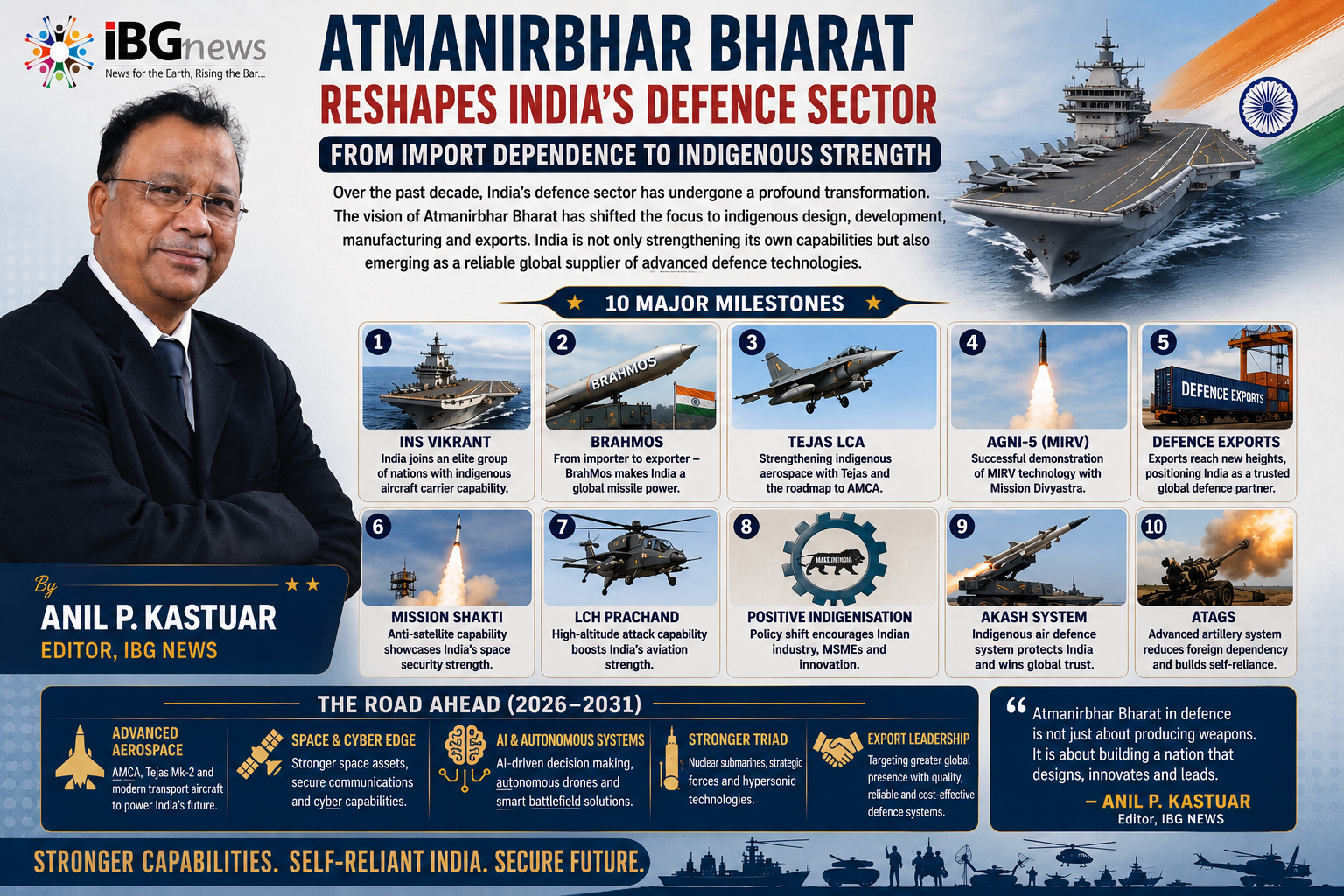
Over the past decade, India’s defence sector has undergone a profound transformation. The vision of Atmanirbhar Bharat has increasingly shifted the focus from dependence on imported military equipment towards indigenous design, development, manufacturing and technological innovation.
This transformation is visible across almost every major segment of national defence—from aircraft carriers and fighter aircraft to missiles, artillery, air-defence systems, helicopters, drones, electronic warfare, cyber capabilities and space technologies.
More importantly, India is gradually emerging not only as a nation capable of meeting a greater share of its own defence requirements, but also as an increasingly significant exporter of military equipment and technologies.
INS Vikrant: A Landmark in Indigenous Shipbuilding
The commissioning of INS Vikrant, India’s first indigenous aircraft carrier, represents one of the most significant milestones in the country’s naval-industrial journey.
The achievement demonstrated India’s ability to undertake the complex design and construction of a large aircraft carrier domestically. It also provided an important boost to India’s warship-design, shipbuilding and engineering ecosystem.
The country’s indigenous naval capability has simultaneously expanded through the construction and induction of advanced destroyers, frigates, submarines, survey vessels, anti-submarine warfare platforms and specialised naval ships.
BrahMos: From Indigenous Development to International Markets
The BrahMos programme has become one of the strongest symbols of India’s growing defence-export capability.
With expanding domestic production and international demand, BrahMos has helped demonstrate that Indian-developed defence systems can move beyond national requirements and enter global markets.
The export agreement with the Philippines marked an especially important moment in India’s evolution from a predominantly defence-importing nation towards an emerging defence exporter.
Tejas and the Rise of Indian Aerospace
The Light Combat Aircraft Tejas programme has played a crucial role in strengthening India’s indigenous aerospace ecosystem.
The operationalisation of Tejas and the large-scale procurement of the Tejas Mk-1A have created greater opportunities for domestic aerospace manufacturing, component production, engineering and technological development.
The next stages of India’s fighter-aircraft ambitions include the Tejas Mk-2 and the Advanced Medium Combat Aircraft (AMCA) programme, reflecting the country’s long-term objective of developing increasingly sophisticated combat-aircraft capabilities.
Strategic Missile Capabilities
India’s missile-development programmes have also reached important technological milestones.
The Agni-5 Mission Divyastra demonstration showcased India’s capability in Multiple Independently Targetable Re-entry Vehicle technology. This represents a significant advancement in strategic missile technology.
Alongside the Agni family, India has continued developing and deploying a broad range of missile systems covering air-to-air, surface-to-air, anti-tank, anti-ship, precision-strike and strategic applications.
Defence Exports Enter a New Era
One of the clearest indicators of India’s changing defence landscape is the growth of defence exports.
Indian companies and defence organisations are increasingly supplying products ranging from ammunition and artillery systems to radars, missiles, naval equipment and other military technologies to international customers.
The expansion of exports is strategically important because it can create economies of scale, strengthen domestic manufacturing capabilities, encourage innovation and integrate Indian companies into global defence supply chains.
India’s ambition is increasingly moving towards becoming a reliable long-term supplier of competitive defence products to partner nations.
Mission Shakti and Space Security
India’s defence transformation has also extended beyond conventional military platforms.
Mission Shakti, India’s anti-satellite demonstration, established an important milestone in the country’s space-security capabilities.
The wider defence ecosystem is now increasingly incorporating satellite communications, secure networking, electronic intelligence, artificial intelligence and other space-enabled technologies.
As military operations become increasingly dependent on information and networked systems, the ability to protect and utilise space-based assets is becoming an important element of national security.
LCH Prachand and High-Altitude Capability
The induction of the Light Combat Helicopter Prachand represents another important achievement in indigenous military aviation.
Designed for demanding operational environments, the helicopter strengthens India’s ability to deploy armed aviation assets in high-altitude areas.
The development of Prachand, along with the broader evolution of India’s helicopter programmes, demonstrates the growing maturity of the domestic rotorcraft industry.
Positive Indigenisation: Changing the Procurement Philosophy
A major policy shift has accompanied India’s defence-manufacturing transformation.
The introduction of Positive Indigenisation Lists has encouraged the armed forces to increasingly source designated equipment and components from Indian manufacturers.
This approach has created new opportunities for domestic defence companies, engineering firms, MSMEs and technology start-ups.
The broader reform architecture includes initiatives such as iDEX, ADITI, Defence India Startup Challenges and the SRIJAN portal, designed to encourage innovation, indigenous development and greater participation by emerging technology companies.
Akash and Indigenous Air Defence
The Akash air-defence system has become another prominent example of India’s indigenous defence capability.
The system has been deployed by India’s armed forces and has also entered international markets. Its development demonstrates India’s ability to build complete air-defence solutions domestically and subsequently offer them to friendly countries.
The continued development of systems such as Akash-NG is expected to further expand India’s indigenous air-defence technology base.
ATAGS and Modern Artillery
The Advanced Towed Artillery Gun System (ATAGS) demonstrates India’s growing ability to develop sophisticated artillery platforms through cooperation between defence research institutions and private industry.
India’s artillery ecosystem has also expanded through programmes involving Pinaka rocket systems, self-propelled artillery and other indigenous firepower solutions.
These developments are reducing dependence on foreign sources while strengthening domestic manufacturing and engineering expertise.
Drones, Autonomous Systems and Artificial Intelligence
The battlefield of the future will increasingly depend on unmanned systems, artificial intelligence, autonomous platforms and real-time information.
India has consequently expanded research and development in UAVs, remotely piloted systems, autonomous flight technologies and counter-drone solutions.
Artificial intelligence is also being introduced across multiple defence applications, including surveillance, decision support, predictive analysis, autonomous systems and information processing.
The integration of these technologies could significantly change the way future military operations are planned and conducted.
Cyber and Space: The New Frontiers
Modern defence preparedness extends far beyond conventional weapons.
India has strengthened its institutional capabilities in cybersecurity, space operations, secure communications, electronic intelligence and network-centric warfare.
Indigenous software-defined radios, tactical communication systems, electronic-intelligence platforms, secure networking and emerging quantum-security technologies are becoming increasingly important components of India’s strategic technology architecture.
Private Industry and Start-ups Take Centre Stage
Perhaps one of the most important changes has been the increasing participation of India’s private sector.
Large industrial groups, established engineering companies, MSMEs and technology start-ups are becoming increasingly involved in defence manufacturing and research.
This broader industrial participation can create a more diversified supply chain and provide the armed forces with access to new technologies and innovative solutions.
Start-up programmes and innovation platforms are particularly important because many emerging defence technologies—such as autonomous systems, AI, advanced sensors and space technologies—are evolving rapidly outside traditional defence establishments.
The Road Ahead
The next phase of India’s defence transformation is likely to be defined by advanced aerospace, artificial intelligence, autonomous systems, space technology, hypersonic systems, cyber capabilities and increasingly sophisticated indigenous platforms.
The development of AMCA and Tejas Mk-2, expansion of naval capabilities, advancement of unmanned systems and growth in defence exports could significantly influence India’s position in the global defence ecosystem.
However, genuine self-reliance will require continued investment in research and development, advanced manufacturing, critical components, propulsion technology and specialised materials.
Reducing dependence on imported technologies in strategically important areas will remain a major challenge.
Equally important will be the need to accelerate testing, certification and procurement processes so that successful indigenous technologies can move from laboratories and prototypes to operational deployment more efficiently.
From Self-Reliance to Technological Sovereignty
Atmanirbhar Bharat in defence is ultimately about much more than replacing imported equipment.
It is about creating a complete national ecosystem in which scientists, engineers, armed forces, public-sector organisations, private companies, MSMEs and start-ups collectively build India’s defence capabilities.
The transformation already underway has created a broader industrial foundation spanning naval shipbuilding, aerospace, missiles, artillery, air defence, land systems, electronics, cyber, space and artificial intelligence.
The strategic objective for the coming years should therefore be clear: India must move from self-reliance in selected defence products towards technological sovereignty across critical domains.
If this transition continues with sustained investment, innovation and industry collaboration, India can strengthen not only its own national security but also its position as a capable and responsible contributor to the global defence ecosystem.
— Anil P. Kastuar
Editor, IBG NEWS