














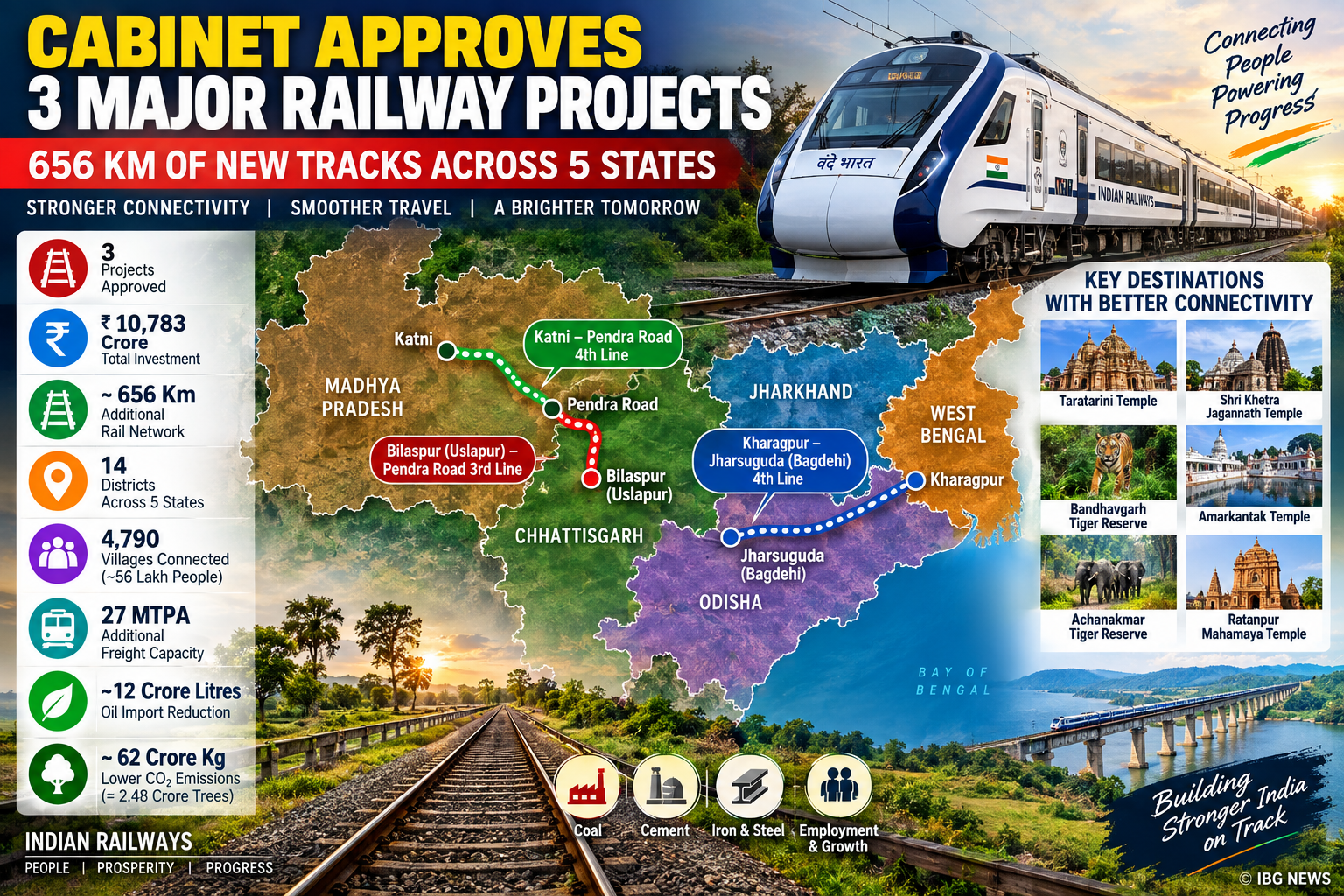

Cabinet Clears ₹10,783-Crore Railway Expansion Plan Across Five States, Adding 656 Km of New Tracks
By Suman Munshi, IBG NEWS
New Delhi, September 9, 2026: The Union Cabinet has approved three major railway multitracking projects involving an estimated investment of ₹10,783 crore, aimed at expanding rail capacity and easing congestion across parts of West Bengal, Jharkhand, Odisha, Madhya Pradesh and Chhattisgarh.
The decision was taken by the Cabinet Committee on Economic Affairs (CCEA), chaired by Prime Minister Narendra Modi, on Wednesday.
The three projects together will add approximately 656 kilometres to the Indian Railways network and are targeted for completion by 2029-30.
Three major railway projects approved
The approved works comprise:
- Kharagpur–Jharsuguda (Bagdehi) 4th Line
- Katni–Pendra Road 4th Line
- Bilaspur (Uslapur)–Pendra Road 3rd Line
The additional tracks are expected to provide greater flexibility for train operations, reduce bottlenecks on busy sections and improve the reliability and efficiency of railway services.
Connectivity to 4,790 villages
According to the government, the projects will pass through 14 districts across the five states and improve railway connectivity for nearly 4,790 villages, collectively serving a population of around 56 lakh people.
The expansion is expected to benefit both passenger and freight movement by creating additional capacity on strategically important railway routes.
The government said the projects are aligned with the PM Gati Shakti National Master Plan, which focuses on coordinated infrastructure planning and improved multimodal connectivity.
The upgraded network is expected to facilitate smoother movement of people, goods and essential services, while supporting logistics efficiency across the connected regions.
Boost to freight movement
The railway corridors covered by the projects are important routes for transporting key industrial commodities, including coal, cement, iron and steel.
Once the additional capacity becomes available, the projects are expected to facilitate approximately 27 million tonnes per annum (MTPA) of additional freight traffic.
Higher rail capacity could also help reduce pressure on road transportation and improve the movement of raw materials and finished goods between industrial and commercial centres.
Tourism destinations to gain improved rail access
The railway expansion is also expected to strengthen connectivity to several important religious, historical and natural tourism destinations.
Among the destinations identified by the government are:
- Taratarini Temple
- Shri Khetra Jagannath Temple
- Bandhavgarh Tiger Reserve
- Virateshwar Temple
- Amarkantak Temple
- Jwaleshwar Dham
- Achanakmar Tiger Reserve
- Khutaghat Dam
- Malhar Archaeological Site
- Ratanpur Mahamaya Temple
Improved railway access to these destinations could support tourism-related economic activity and make travel more convenient for visitors.
Potential employment and regional economic benefits
The Centre said the infrastructure expansion is intended not only to improve transportation but also to contribute to wider economic development in the regions covered by the projects.
Better connectivity can facilitate the movement of goods and workers, support industrial activity and create opportunities for employment and self-employment in areas connected by the upgraded railway network.
The projects are also being positioned within the government’s broader objective of developing infrastructure that can strengthen regional economic activity and contribute to greater self-reliance.
Environmental gains expected from rail expansion
The government has also highlighted the environmental advantages of shifting more freight movement towards railways, which are generally more energy-efficient than road-based transportation.
The additional freight capacity is projected to help reduce the country’s dependence on imported oil by approximately 12 crore litres and lower carbon dioxide emissions by around 62 crore kilograms.
According to the government, the estimated reduction in emissions is comparable to the carbon absorption associated with planting approximately 2.48 crore trees.
Infrastructure push continues
The approval represents another significant step in expanding railway capacity on high-demand routes. By adding additional tracks rather than relying solely on existing infrastructure, the projects are expected to allow passenger and freight services to operate with greater flexibility.
With completion targeted for 2029-30, the three multitracking projects are expected to strengthen the railway network across eastern and central India while supporting industrial logistics, tourism, employment and regional connectivity.
Source: Press Information Bureau (PIB), Government of India, September 9, 2026.

