













EU Moves to Strengthen Online Protection for Children Under New ‘EU KIDS Act’
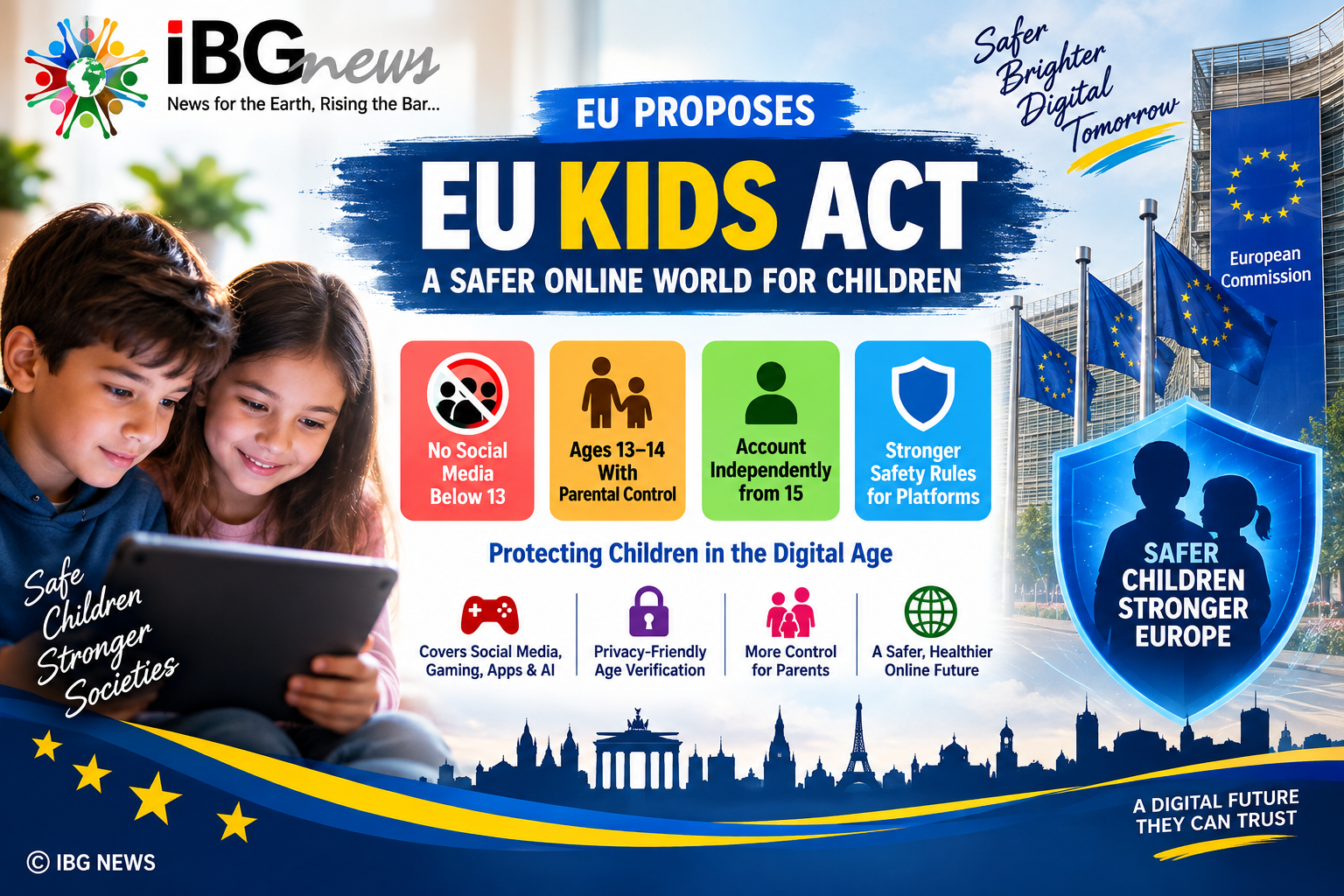
Brussels, September 17, 2026: The European Commission has proposed a new legislative framework aimed at making digital services safer for children and teenagers across the European Union. The proposed EU KIDS Act would introduce common age-related safeguards and require online services to take greater responsibility for protecting younger users.
Under the proposal, children below the age of 13 would not be allowed to access social media platforms, while users aged 15 and above would be able to create social-media accounts independently. For those aged 13 and 14, the framework proposes specially restricted accounts that would operate with parental involvement and additional safeguards.
Stronger Duties for Online Platforms
The proposal places greater emphasis on safety by design, meaning platforms would be expected to consider children’s safety when developing and operating their services.
The Commission also proposes additional obligations for very large online platforms and services. These requirements would cover the introduction of new features and services where there may be implications for children’s safety.
The proposed measures would extend beyond conventional social media. Depending on the type of service, the framework would address online gaming, app stores, operating systems and AI-based services, including AI chatbots and companion services.
Privacy-Conscious Age Verification
Another key element is age assurance. The Commission proposes the use of privacy-preserving age-verification technology rather than relying solely on users entering their own age.
The proposed approach is intended to allow services to establish whether a user meets a particular age threshold without unnecessarily requiring platforms to collect additional personal identification information.
Greater Role for Parents
The EU KIDS Act would also provide parents with stronger tools to manage their children’s digital activities. Proposed measures include controls over screen time, contacts and certain online settings, alongside mechanisms for reporting harmful content.
The European Commission said the initiative is designed to establish a more consistent approach to child protection across the EU while working alongside existing digital legislation.
Legislative Process Still Ahead
The EU KIDS Act is currently a legislative proposal, rather than an immediately applicable EU-wide law. It will have to go through the European Union’s legislative process, during which the final provisions may be debated and amended.
The initiative reflects the Commission’s broader effort to address risks faced by children in an increasingly digital environment while balancing online access, parental responsibility, privacy and the obligations of technology companies.
By Suman Munshi, IBG NEWS