















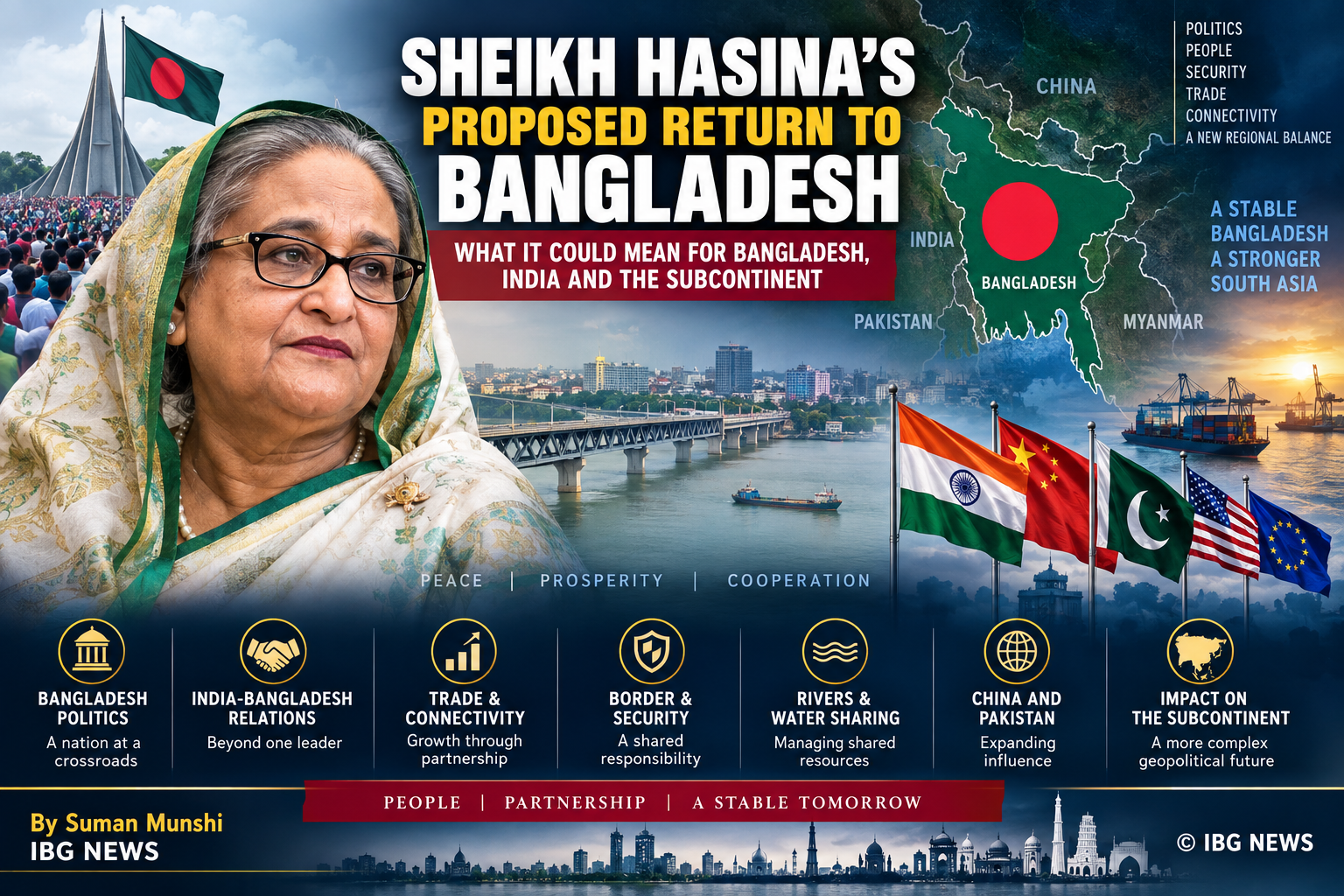
Sheikh Hasina’s Proposed Return to Bangladesh: Possible Implications for Dhaka, Delhi and the Subcontinent
By Suman Munshi, IBG NEWS
Special Geopolitical Analysis | September 21, 2026
Introduction
The prospect of former Bangladesh Prime Minister Sheikh Hasina returning from India to Bangladesh has emerged as one of the most consequential issues in the evolving relationship between Dhaka and New Delhi.
However, it is important to distinguish between a declared intention to return and an actual return. Hasina has said she intends to return to Bangladesh in December 2026 and surrender before the courts, but as of September 21, she remains in India. Bangladesh has separately sought her extradition, while India has said that the request is being examined through established procedures. (Prothomalo)
The issue therefore extends beyond the personal legal circumstances of one former prime minister. It intersects with Bangladesh’s domestic political transition, India-Bangladesh relations, border security, trade and connectivity, China’s growing economic role, Pakistan’s renewed engagement and the wider strategic balance in South Asia.
A Political Landscape Transformed Since 2024
Sheikh Hasina left Bangladesh on 5 August 2024 following the mass uprising that ended her long tenure as prime minister. Since then, Bangladesh has undergone a major political transition.
The Awami League’s political activities were subsequently restricted, and the party did not participate in the February 2026 parliamentary election. The election brought the Bangladesh Nationalist Party (BNP), led by Tarique Rahman, into government.
Hasina’s proposed return therefore would take place in a substantially different political environment from the one she left in 2024.
Her own stated position is that she intends to return voluntarily and face the legal process. At the same time, Bangladeshi authorities have continued to demand her return and have linked the issue to the wider bilateral relationship with India. (Prothomalo)
The Legal Question Is Central
The legal dimension is likely to remain the immediate issue surrounding any potential return.
Bangladesh’s International Crimes Tribunal has convicted Hasina in absentia and imposed a death sentence. Hasina has rejected the proceedings and disputed the allegations against her.
India’s position has been that Bangladesh’s extradition request is being examined according to established procedures. (Indian Express – Bangla)
Consequently, any actual movement of Hasina from India to Bangladesh would involve not only political considerations but also legal and diplomatic processes.
Her proposed voluntary return is therefore different from an extradition carried out by India. The distinction could have significant implications for the diplomatic relationship between the two countries.
India-Bangladesh Relations: The Hasina Factor
For New Delhi, the question is part of a much larger bilateral relationship involving:
- border management;
- counter-terrorism and cross-border security;
- trade;
- transit and connectivity;
- river-water sharing;
- energy cooperation;
- migration and trafficking;
- northeastern India’s access to regional routes;
- ports and maritime connectivity.
Bangladesh has repeatedly raised Hasina’s extradition with India. Recent diplomatic reporting indicates that Dhaka has regarded progress on the issue as an important element in improving bilateral relations. (Indian Express – Bangla)
At the same time, India has continued to signal an interest in a forward-looking relationship with Bangladesh.
This creates a complicated diplomatic equation: Hasina’s legal status is a bilateral issue, but India-Bangladesh relations encompass much broader strategic and economic interests.
Tarique Rahman’s India Engagement
The situation has also affected Bangladesh’s engagement with New Delhi.
Bangladesh Prime Minister Tarique Rahman’s proposed India visit has been discussed repeatedly, but earlier plans did not materialise. Recent reporting indicates that the two countries are now examining dates for a possible bilateral visit in November 2026. The discussions are taking place against continuing differences over Hasina’s status. (The Indian Express)
Reuters previously reported that Dhaka was awaiting India’s response regarding Hasina’s extradition and other fugitives while the two governments discussed Rahman’s prospective visit. (Reuters)
The eventual handling of the issue could therefore influence the diplomatic atmosphere surrounding any future high-level engagement.
Why the Issue Matters to India’s Northeast
Bangladesh occupies a strategically important geographical position for India’s northeastern states.
Its territory provides important routes connecting India’s Northeast with the rest of the country and with the Bay of Bengal.
India and Bangladesh already cooperate through several transport mechanisms, including:
- rail connectivity;
- inland waterways;
- road corridors;
- border trade points;
- access to Bangladeshi ports.
A deterioration in bilateral relations could complicate some of these arrangements, while sustained cooperation could support their expansion.
For India, therefore, Bangladesh is not simply a neighbouring country; it is also an important component of the connectivity architecture linking the Northeast with eastern India and the Bay of Bengal.
China’s Expanding Economic Role
Another dimension is China’s expanding economic engagement with Bangladesh.
Bangladesh has sought investment and infrastructure partnerships with multiple external powers, including China. Recent agreements involving the Mongla Port Economic Zone illustrate the continuing expansion of Chinese economic involvement in Bangladesh.
This does not automatically mean that Bangladesh is choosing one major power against another. Dhaka has traditionally sought room for manoeuvre among competing external partners.
Nevertheless, Bangladesh’s growing engagement with China has strategic relevance for India because of the country’s geographical position along the Bay of Bengal.
Pakistan and the Wider South Asian Equation
Bangladesh’s renewed engagement with Pakistan also deserves attention.
Relations between Dhaka and Islamabad have shown signs of greater diplomatic activity since the political transition in Bangladesh.
For India, developments involving Bangladesh, Pakistan and China cannot be viewed entirely in isolation because they overlap with questions of:
- Bay of Bengal access;
- maritime security;
- regional connectivity;
- defence cooperation;
- trade routes;
- political influence in South Asia.
However, Bangladesh’s foreign policy remains a matter for Dhaka, and increased engagement with one country does not necessarily mean a corresponding strategic alignment against another.
Water Sharing Remains a Long-Term Issue
The India-Bangladesh relationship also includes unresolved water-management questions.
The Ganges water-sharing arrangements, the Teesta issue and management of other transboundary rivers remain important to both countries.
Political changes in Dhaka can alter the atmosphere surrounding negotiations, but these issues are governed by their own technical, environmental and diplomatic considerations.
A change in Bangladesh’s political leadership therefore does not automatically resolve or terminate long-standing water-sharing questions.
Trade and Economic Interdependence
Despite political tensions, the two economies remain interconnected.
Bangladesh is an important trading partner for India, while Indian connectivity provides Bangladeshi businesses access to the wider Indian market and regional transport networks.
The relationship also encompasses:
- electricity and energy;
- pharmaceuticals;
- textiles;
- agricultural products;
- logistics;
- ports;
- tourism;
- medical travel;
- border commerce.
This economic interdependence provides a separate layer to the diplomatic relationship.
Political disagreements may affect business confidence or individual sectors, but the underlying geographic and commercial relationship cannot easily be removed.
Three Possible Political-Legal Pathways
The consequences of Hasina’s proposed return would depend heavily on how the situation develops.
1. Voluntary Return and Legal Proceedings
If Hasina returns voluntarily and appears before Bangladeshi courts, the immediate focus would shift from extradition diplomacy to the judicial process inside Bangladesh.
The response of the Bangladeshi government, courts, political parties and security agencies would become critical.
2. Continued Stay in India
If she remains in India, the extradition question could continue to influence India-Bangladesh diplomacy.
The issue could remain particularly significant in negotiations surrounding high-level political visits and bilateral cooperation.
3. Broader Political Reopening
A third possibility would involve wider changes in Bangladesh’s political environment, including future decisions concerning the participation of Awami League politicians.
Such developments cannot presently be assumed. They would depend on Bangladesh’s constitutional, judicial and political processes.
What It Could Mean for the Subcontinent
The significance of the Hasina issue ultimately goes beyond one individual.
For India, Bangladesh is important because of geography, Northeast connectivity, border security, trade and the Bay of Bengal.
For Bangladesh, relations with India are important because of trade, transit, energy, water resources and geography, while Dhaka also has reasons to maintain relationships with China, the United States, Japan, Pakistan, Türkiye and Gulf countries.
For China, Bangladesh provides an important economic and geographical relationship in the Bay of Bengal region.
For Pakistan, closer relations with Dhaka could represent a significant diplomatic development after decades of complicated bilateral history.
For the United States and other external powers, Bangladesh’s strategic position makes its political stability and foreign-policy orientation relevant to the wider Indo-Pacific environment.
A Relationship Larger Than the Hasina Question
Sheikh Hasina’s future undoubtedly has major consequences for Bangladesh-India relations, but the bilateral relationship cannot be reduced entirely to her status.
Former Indian High Commissioner to Bangladesh Pinak Ranjan Chakravarty, in a recent interview with The Indian Express, discussed Hasina’s importance to India’s security and strategic interests while also arguing that there remains scope for repairing India-Bangladesh relations under the current BNP government. These are his assessments, not an official government position. (The Indian Express)
The larger relationship involves millions of people, extensive trade, a 4,000-km-plus border, shared rivers, interconnected economies and established transport networks.
That structural reality is likely to remain relevant irrespective of individual political changes.
Conclusion
Sheikh Hasina’s proposed return to Bangladesh could become a significant turning point in South Asian diplomacy, but its consequences will depend on how the legal process, Bangladesh’s domestic politics and India-Bangladesh diplomatic engagement evolve.
As of September 21, 2026, the key fact is that Hasina has announced an intention to return in December, but she has not yet returned. India continues to examine Bangladesh’s extradition request, while Dhaka continues to regard her return as an important bilateral issue. (Prothomalo)
The broader geopolitical question is therefore not simply whether Sheikh Hasina returns. It is how Bangladesh balances its domestic political transition with relationships with India, China, Pakistan, the United States and other regional partners, while preserving its economic and strategic interests.
For India, the evolving Bangladesh equation will remain closely connected to the Northeast, the Bay of Bengal, border security, trade, connectivity and water diplomacy. For Bangladesh, managing these relationships simultaneously will be an important feature of its post-2024 foreign-policy environment.
By Suman Munshi
IBG NEWS