









IGNCA Hosts Discussion on the Unresolved Questions of Partition Through Vivek Shukla’s Book
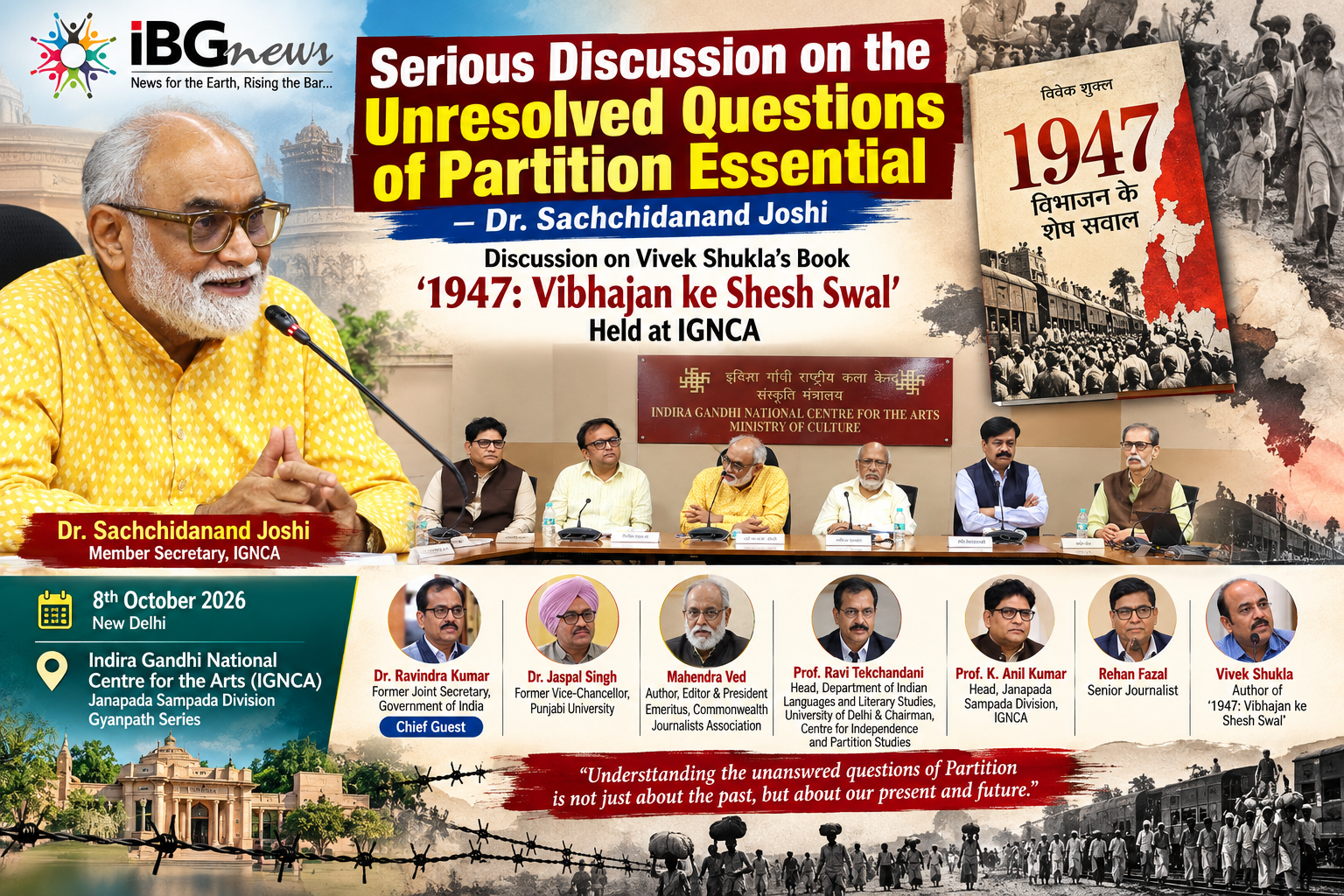
New Delhi, October 8, 2026: The Indira Gandhi National Centre for the Arts (IGNCA) organised a special discussion on senior journalist and author Vivek Shukla’s book 1947: Vibhajan ke Shesh Swal as part of its ‘Gyanpath Series’. The programme explored the historical, social, cultural and human consequences of the Partition of 1947, while also examining questions and experiences that continue to remain relevant nearly eight decades later.
The discussion was organised by IGNCA’s Janapada Sampada Division and was chaired by Dr. Sachchidanand Joshi, Member Secretary, IGNCA. Dr. Ravindra Kumar, former Joint Secretary, Government of India, attended as the Chief Guest. Other distinguished participants included Dr. Jaspal Singh, former Vice-Chancellor of Punjabi University; Mahendra Ved, author, editor and President Emeritus of the Commonwealth Journalists Association; and Prof. Ravi Tekchandani, Head, Department of Indian Languages and Literary Studies, University of Delhi, and Chairman, Centre for Independence and Partition Studies.
Prof. K. Anil Kumar, Head of the Janapada Sampada Division, delivered the welcome address. Senior journalist Rehan Fazal also participated in the discussion and spoke about the relationship between the historical record of Partition, collective memory and contemporary discourse.
Beyond Partition as a Political Event
Introducing his book, Vivek Shukla discussed the circumstances that led to its writing, his research methodology and the questions surrounding Partition that continue to find a place in the collective memory of Indian society.
The discussion emphasised that the Partition of 1947 cannot be understood solely through the political decisions and territorial changes of the period. Its legacy also encompasses displacement, rehabilitation, cultural disruption, family memories, loss of homeland and experiences transmitted across generations.
Shukla highlighted the human and emotional dimensions of Partition and the continuing relevance of memories associated with the upheaval.
‘Unresolved Questions Require Continued Study’
In his presidential address, Dr. Sachchidanand Joshi described Partition as one of the most tragic episodes in Indian history and stressed that its consequences extended well beyond the creation of new political boundaries.
He underlined the importance of sustained dialogue and scholarly engagement with the unresolved issues surrounding Partition, noting that a deeper examination of its social, cultural and human consequences can contribute to a broader understanding of history.
Partition and the Film Industry
Chief Guest Dr. Ravindra Kumar discussed the historical circumstances surrounding Partition and examined some of its impact on the Indian film industry.
He pointed out that a number of artistes moved to Pakistan following Partition. In his discussion, he specifically referred to Noor Jehan and Ishrat, popularly known as Bibbo, among those who subsequently established themselves successfully.
Memories of Displacement and Belonging
Dr. Jaspal Singh, Mahendra Ved and Prof. Ravi Tekchandani also contributed their perspectives on the book and the broader questions raised during the programme.
Prof. Tekchandani appreciated Shukla’s accessible writing style and his sensitive presentation of the human dimension of Partition. He stressed the importance of preserving memories of the period so that future generations can understand the magnitude of the tragedy.
Drawing upon his own family’s experience of displacement from Sindh, he spoke about the enduring emotional connection people maintain with their ancestral homes and sense of belonging. He also called for greater research into the experiences of people who crossed the newly established borders, pointing out that many dimensions of Partition still warrant deeper investigation.
Understanding Partition Through Human Experience
The speakers collectively observed that nearly eight decades after 1947, the memories of Partition continue to influence the social and cultural landscape of the Indian subcontinent.
They emphasised that studying the “remaining questions” of Partition is not simply an exercise in revisiting history. It can also provide valuable insights into contemporary society and the ways in which displacement, memory and identity continue to shape generations.
The programme also included detailed exchanges on the book, historical documents and several questions surrounding Partition that remain subjects of discussion and research.
Gyanpath Series Promotes Serious Dialogue
In his welcome address, Prof. K. Anil Kumar explained the significance of the Gyanpath book-discussion series. He said such programmes create a platform for wider intellectual engagement with important issues concerning society, culture and history through the study of significant books.
The event brought together scholars, writers, journalists, research scholars and cultural enthusiasts, providing an opportunity to examine the Partition of 1947 not merely as a historical event, but as a continuing human experience whose memories remain embedded in the social and cultural consciousness of the subcontinent.
— Suman Munshi
IBG NEWS

