












India’s Tier-2 Metro Revolution: New Rail Networks to Transform Urban Mobility, Industry and Economic Growth
By Suman Munshi | IBG NEWS
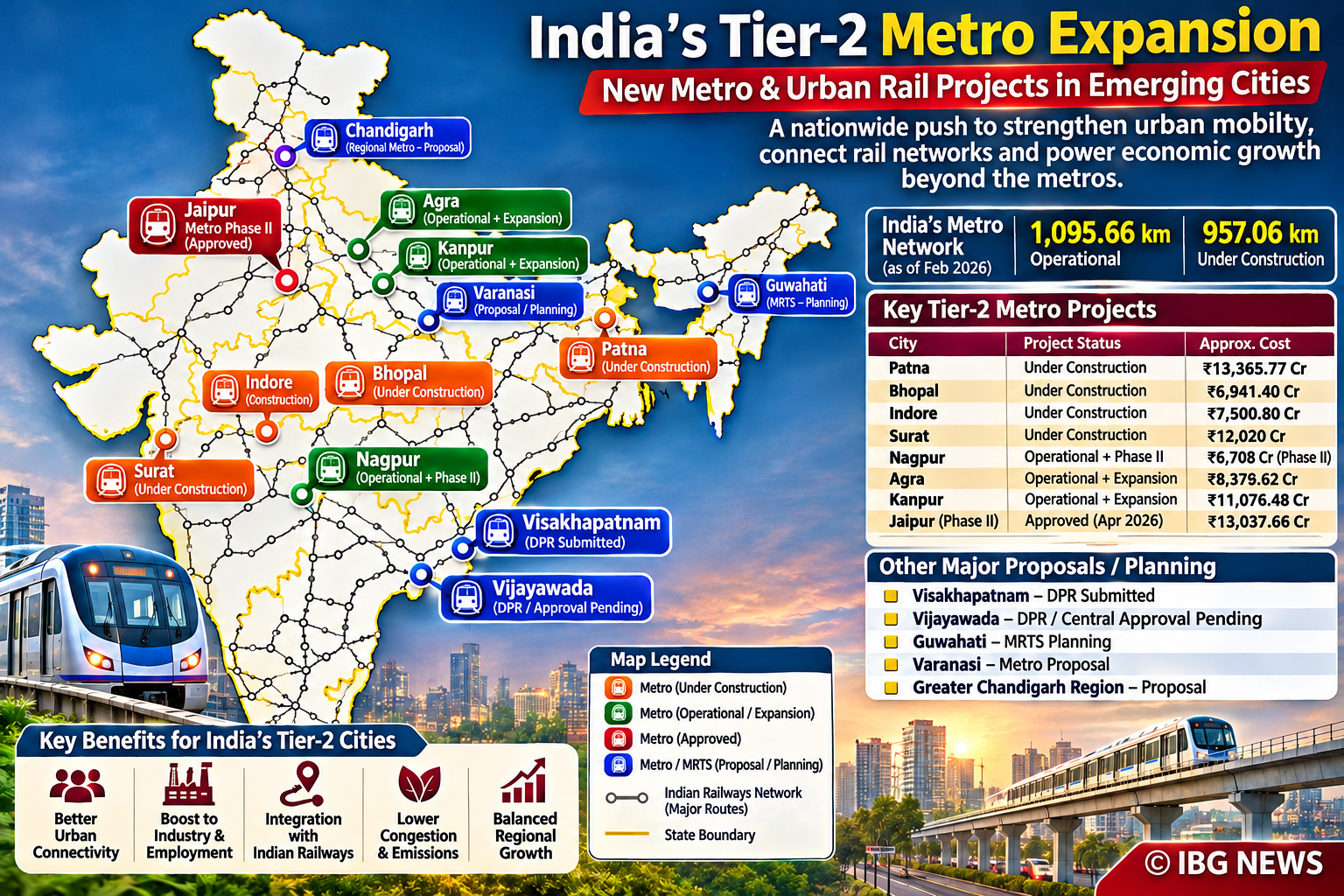
NEW DELHI: India’s urban transportation landscape is entering a significant phase of transformation, with metro rail, regional rapid transit and other mass transportation projects increasingly becoming central to the development strategies of emerging cities. Beyond the established metropolitan centres, cities such as Jaipur, Patna, Indore, Bhopal, Nagpur, Surat, Agra and Kanpur are witnessing major investments in urban rail infrastructure, while several other cities are pursuing new metro proposals and comprehensive mobility plans.
The expansion reflects a broader national ambition to improve urban connectivity, reduce road congestion, strengthen regional economies and create more efficient transportation networks. As India’s Tier-2 cities expand economically and demographically, the demand for reliable public transport is becoming an increasingly important infrastructure priority.
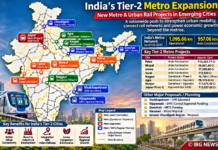
According to information presented by the Ministry of Housing and Urban Affairs in Parliament on 5 February 2026, India’s operational metro network had reached approximately 1,095.66 kilometres, with another 957.06 kilometres under construction. These figures demonstrate the scale of the country’s ongoing urban rail expansion, although the network includes several major metropolitan regions as well as emerging urban centres.
Tier-2 Cities Emerging as the Next Metro Investment Destinations
The development of metro systems in India’s emerging cities represents an important shift in infrastructure planning. Urban rail is no longer being considered exclusively for the country’s largest metropolitan areas. Industrial development, expanding residential settlements, educational institutions, tourism and growing commercial activity are creating new mobility requirements in medium-sized cities.
Among the most significant projects are those in Patna, Bhopal, Indore, Surat and Nagpur.
Patna: Strengthening Bihar’s Urban Connectivity
Patna Metro is one of the most important urban transportation projects in eastern India. With an approved project cost of approximately ₹13,365.77 crore, the network is planned around two principal corridors connecting Danapur, Khemnichak, Patna Railway Station and New ISBT.
The project is expected to improve connectivity between residential neighbourhoods, commercial areas, railway facilities and major transport terminals.
For Bihar’s capital, the metro represents more than a new public transport option. It could become an important component of the city’s long-term economic development by improving access to employment, education, healthcare and intercity transportation.
Integration with Indian Railways and the city’s bus network will be particularly important for maximising passenger convenience.
Bhopal and Indore: Madhya Pradesh’s Urban Rail Transformation
Madhya Pradesh is developing two major metro networks in Bhopal and Indore.
Bhopal Metro, with an approved project cost of approximately ₹6,941.40 crore, is designed around the Orange and Blue Line corridors. The planned network aims to connect important residential, commercial, institutional and healthcare destinations.
Indore Metro, with an approved project cost of approximately ₹7,500.80 crore, is another significant investment. Its proposed network is intended to serve major commercial districts, residential areas, educational centres and important transport connections.
Indore’s position as a major commercial and industrial centre makes efficient urban transportation particularly important. Improved connectivity could support workforce mobility and strengthen access to the city’s expanding economic clusters.
Together, these projects could provide valuable examples of how medium-sized Indian cities can develop modern transportation infrastructure without replicating the scale and complexity of the country’s largest metro systems.
Surat: Metro Connectivity for an Industrial Powerhouse
Surat’s metro project, estimated at approximately ₹12,020 crore in the project-monitoring records cited in 2026, is designed around two principal corridors: Sarthana–Dream City and Bhesan–Saroli.
The project is particularly significant because Surat is one of India’s major centres for textile manufacturing, diamond processing, trade and industrial activity.
Better urban mobility could improve access to employment centres, residential areas and commercial districts while reducing pressure on congested roads.
For a city with extensive manufacturing and migrant-worker populations, the success of the metro will depend on affordable fares, effective feeder transport and convenient connections to major employment locations.
Nagpur: Strengthening Central India’s Transport Hub
Nagpur has emerged as an important example of metro development beyond India’s traditional metropolitan centres.
With its operational Phase I network and approved Phase II expansion, the city is strengthening its position as a major commercial, administrative and logistics centre in central India.
Nagpur’s importance extends beyond passenger mobility. Its railway junction, airport, industrial zones and national highway connections make it a strategic location for integrated transportation planning.
The expansion of the metro network could support better connections between residential areas, commercial centres and important regional transport facilities.
Agra and Kanpur: Expanding Uttar Pradesh’s Urban Rail Network
Agra and Kanpur are also developing significant metro infrastructure.
Agra Metro is designed to connect important parts of the historic city through the Sikandra–Taj East Gate and Agra Cantt–Kalindi Vihar corridors. Its development is particularly relevant to tourism, given the city’s importance as an international heritage destination.
Improved urban connectivity could make travel more convenient for residents and visitors while helping manage road congestion around major tourist attractions.
Kanpur Metro, meanwhile, is intended to connect important educational, industrial, residential and commercial areas through its two principal corridors.
As one of Uttar Pradesh’s major industrial cities, Kanpur requires efficient commuter transportation to support its manufacturing economy and expanding urban population.
Jaipur Metro Phase II: A Major Infrastructure Approval in 2026
One of the significant developments in India’s metro expansion programme came in April 2026, when the Union Cabinet approved Jaipur Metro Phase II.
The project has an estimated cost of ₹13,037.66 crore and covers approximately 41 kilometres with 36 stations.
The proposed North–South corridor will connect Prahladpura and Todi Mod, serving important locations including Sitapura Industrial Area, Jaipur Airport, Tonk Road, SMS Hospital and Stadium, Ambabari and Vidhyadhar Nagar.
The project is planned as a joint initiative of the Union and Rajasthan governments through a 50:50 partnership.
With Jaipur’s growing tourism, manufacturing, commercial and educational sectors, the expansion could play a major role in strengthening the city’s long-term transport infrastructure.
The targeted completion period extends to September 2031, subject to implementation progress.
Visakhapatnam and Vijayawada: Andhra Pradesh’s Metro Ambitions
Andhra Pradesh is also pursuing new urban rail infrastructure for its major cities.
Visakhapatnam has strategic importance as a coastal industrial, port, IT and commercial centre. Its growing residential and industrial areas have increased the importance of long-term urban mobility planning.
A revised metro Detailed Project Report (DPR) was reported to have been submitted for central consideration. However, submission of a DPR should not be interpreted as final central government approval or a construction sanction.
Vijayawada is another important proposed metro destination. Its mobility requirements are closely connected with the city’s railway station, bus terminal, airport, commercial districts and surrounding urban settlements.
The proposed first phase has been discussed around two principal corridors, including the Gannavaram Airport–Pandit Nehru Bus Station and Pandit Nehru Bus Station–Penamaluru alignments.
State-level approval of a DPR and the subsequent central funding and project clearance process are separate stages. The project therefore requires further formal confirmation before being classified as an approved construction programme.
Both cities have the potential to benefit from integrated transport planning that connects urban rail with intercity rail, buses, airports and industrial development.
Guwahati, Varanasi and Chandigarh: Future Urban Rail Opportunities
Several other important cities have appeared in previous metro or mass rapid transit planning exercises.
Guwahati, the principal commercial and administrative centre of Northeast India, has a substantial long-term urban mobility requirement. However, its topography, flood exposure, riverine geography and road infrastructure constraints require careful evaluation before selecting a suitable transport model.
Varanasi faces a different challenge. Its heritage areas, dense settlement patterns, tourism traffic and narrow roads make conventional metro construction particularly complex. A combination of improved electric buses, regional railway connectivity and carefully planned rapid transit could provide a more sustainable approach.
The Greater Chandigarh Region presents another interesting case because transportation planning must cover Chandigarh, Mohali and Panchkula rather than treating each urban centre independently.
A regional transport network could improve commuter movement across administrative boundaries and support more integrated urban development.
These projects should be treated as planning or proposal-stage opportunities unless their current approval and implementation status is formally established.
Why Not Every Tier-2 City Needs a Conventional Metro
Despite the growing interest in metro infrastructure, a conventional metro system may not be the most economical transportation solution for every Indian city.
The Ministry of Housing and Urban Affairs has emphasised the importance of comprehensive mobility planning, passenger demand assessment and economic feasibility before approving urban rail projects.
The cases of Coimbatore and Madurai illustrate this challenge.
In its parliamentary response dated 29 January 2026, the Ministry discussed concerns regarding the proposed Coimbatore metro, including projected ridership, average travel distances, existing road speeds and right-of-way constraints.
For Madurai, the mobility assessment indicated that Bus Rapid Transit System (BRTS) could be more appropriate than a conventional metro based on the demand assessment presented.
These observations highlight an important policy consideration: infrastructure investment should be determined by actual passenger requirements and long-term economic viability rather than by the prestige associated with a metro project.
Depending on the city, Light Rail Transit (LRT), electric buses, BRTS, suburban railway services or Regional Rapid Transit Systems may offer more affordable and practical solutions.
Indian Railways and Metro Networks: The Importance of Integration
The development of urban metro networks is not exclusively an Indian Railways programme. Most metro systems operate through specialised metro corporations, state governments and central-state partnerships under the broader urban transport framework.
Nevertheless, Indian Railways has a crucial role in creating a connected national transportation ecosystem.
Railway stations can become major multimodal interchange centres where intercity trains, suburban services, metro systems, buses and other passenger transport facilities operate together.
Better integration could reduce transfer difficulties for passengers travelling between cities and their final urban destinations.
Railway land utilisation, station redevelopment, suburban services, regional passenger rail and coordinated transport planning can further strengthen the effectiveness of metro investments.
The experience of the Delhi–Meerut Regional Rapid Transit System also demonstrates the importance of transport networks that connect major cities with satellite towns and emerging economic centres.
For cities such as Patna, Nagpur, Indore, Surat and Jaipur, the long-term value of metro development will depend significantly on how effectively these networks connect with conventional railway infrastructure and regional transport services.
Economic Opportunities Beyond Metro Construction
The expansion of urban rail infrastructure creates opportunities across several industries.
Civil engineering, steel, cement, electrical equipment, rolling stock, signalling, telecommunications, automation, security systems and digital infrastructure are all important components of metro development.
The growing importance of intelligent transportation systems also creates opportunities for Indian technology companies.
Artificial intelligence-based predictive maintenance, automated passenger information systems, digital ticketing, intelligent crowd management, energy optimisation and infrastructure monitoring could improve the efficiency of future metro networks.
Digital twins, real-time operational analytics and integrated mobility platforms may also become important tools for managing increasingly complex transport systems.
Station-area commercial development and transit-oriented development could create additional economic activity through retail, office space, housing and passenger services.
For Indian manufacturers and technology companies, the expansion of Tier-2 urban rail networks could therefore generate business opportunities well beyond the conventional construction sector.
Financial Sustainability Will Determine the Success of Future Metro Projects
The Union Budget 2026–27 allocated approximately ₹30,996 crore towards MRTS and metro projects, according to the budget analysis by PRS Legislative Research.
This allocation reflects the continuing importance of mass rapid transit in India’s infrastructure development strategy. However, it is not exclusively earmarked for new Tier-2 city projects.
The major challenge for future projects will be balancing construction costs, public funding, operating expenditure, maintenance requirements and passenger revenue.
Metro infrastructure requires substantial initial investment. In many cities, fare collections alone may not be sufficient to cover the complete cost of operations and long-term infrastructure maintenance.
Consequently, effective feeder transport, station-area commercial development, transit-oriented development and efficient operational planning will be essential for improving financial sustainability.
Governments must also ensure that projects are implemented in phases according to actual passenger demand rather than constructing oversized networks that may remain underutilised.
India’s Next Urban Transport Revolution Must Be Economically Sustainable
India’s Tier-2 cities are becoming increasingly important contributors to national economic growth. Their development requires modern infrastructure capable of supporting industrial expansion, employment generation, tourism, education and improved living standards.
Metro rail can become an important part of this transformation, but it cannot function in isolation.
The next generation of successful urban transport systems will require coordinated investment in metro rail, conventional railway connectivity, regional rapid transit, electric buses, pedestrian infrastructure and digital mobility platforms.
Cities such as Jaipur, Patna, Indore, Bhopal, Nagpur and Surat demonstrate the growing importance of urban rail investment beyond the traditional metropolitan centres. Meanwhile, Visakhapatnam, Vijayawada and Guwahati represent potential future opportunities that require careful project appraisal and formal approval.
India’s challenge is no longer simply to build more kilometres of metro lines. It is to develop transportation systems that are affordable, accessible, financially sustainable and closely connected with the economic geography of each city.
The real measure of India’s Tier-2 Metro Revolution will not be the number of kilometres of railway constructed, but how effectively these networks improve the daily lives of citizens, strengthen regional industries and accelerate sustainable urban development.
About the Author: Suman Munshi is the Chief Editor of IBG NEWS and writes on infrastructure, technology, public policy, economic development and international affairs.
Editorial Note: Project costs, approvals and implementation figures in this report are based on government and parliamentary information available in the cited 2026 research material. Proposed projects and approved projects have been distinguished wherever possible. Project status and completion schedules may change through subsequent government decisions.
Sources and Official References
- Ministry of Housing and Urban Affairs, Lok Sabha Unstarred Question No. 1054, 5 February 2026 – Status of Metro Rail Projects.
- Ministry of Housing and Urban Affairs, Lok Sabha Unstarred Question No. 130, 29 January 2026 – Metro proposals and urban mobility assessment.
- Press Information Bureau, April 2026 – Union Cabinet approval of Jaipur Metro Phase II.
- Ministry of Housing and Urban Affairs – Metro Rail Policy, 2017.
- PRS Legislative Research – Union Budget 2026–27 analysis of the Ministry of Housing and Urban Affairs.
- Ministry of Statistics and Programme Implementation – Project Monitoring Information System.
Copyright © IBG NEWS. All rights reserved.

